

Sol Rashidi: AI Risk is Dependency, Not Just Job Displacement

Sol Rashidi warns businesses that the biggest AI risk isn't job displacement, but fostering dependency and eroding critical thinking skills.

4 min read
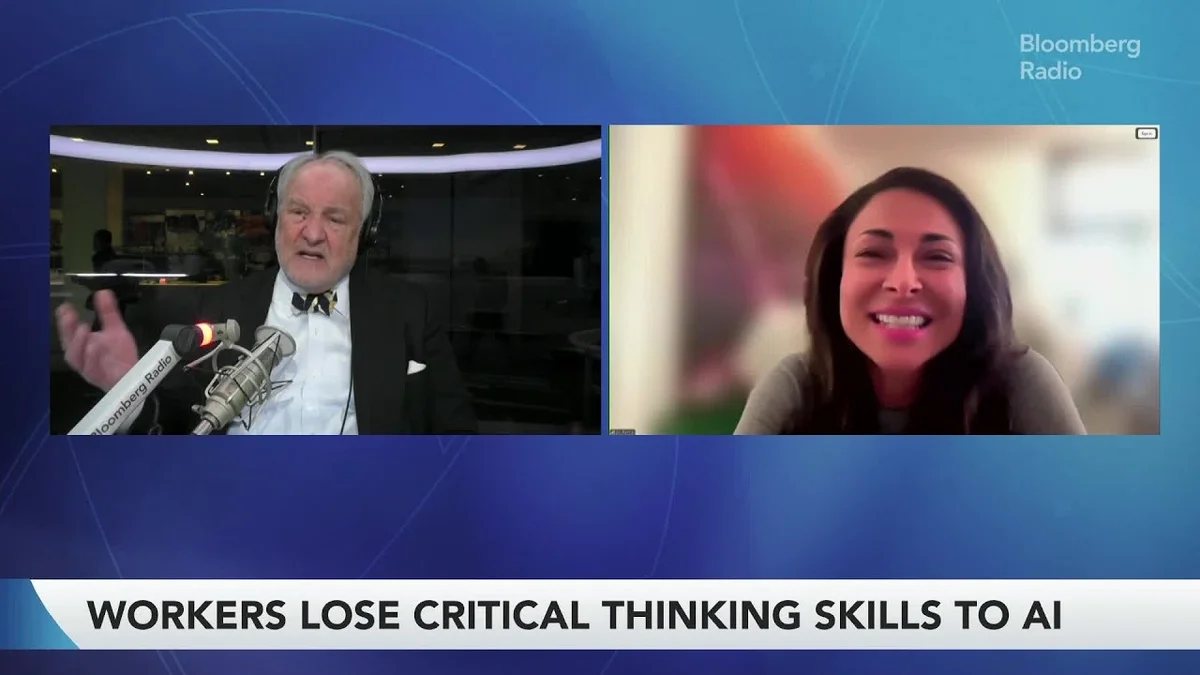
Sol Rashidi speaking on a video call, with Bloomberg Radio branding.
Image credit: Bloomberg Radio· Bloomberg Podcast

Sol Rashidi, a Senior Fellow at Harvard Kennedy School and Chief Strategy Officer at Cyera, shared a critical perspective on the current AI adoption trend. Speaking on Bloomberg Radio, she highlighted that the primary concern for businesses integrating AI should not be job displacement, but rather the potential for fostering dependency and eroding critical thinking skills within their workforce.

Rashidi, who has been involved in the AI space since 2011, including her work on IBM's Watson, emphasized her experience in deploying AI capabilities at scale. She noted that while many companies are focused on the immediate gains in efficiency and productivity that AI offers, they often overlook the subtle but significant impact on their employees' cognitive abilities.

The Real Risk: Dependency Over Displacement

Rashidi drew a parallel to how social media and scrolling have impacted attention spans, suggesting a similar cognitive atrophy could occur with over-reliance on AI. "You break a muscle, you put it in a cast, and you don't use it, what happens? The muscle atrophies," she explained. "The brain is nothing but a big, magnificent muscle. And if it's not used, it atrophies."

The full discussion can be found on Bloomberg Podcast's YouTube channel.
Related startups

AI Dependency Leading to 'Intellectual Atrophy' Among Workforce, Says Sol Rashidi - Bloomberg Podcast
AI Dependency Leading to 'Intellectual Atrophy' Among Workforce, Says Sol Rashidi — from Bloomberg Podcast

She elaborated that the ease with which AI tools like ChatGPT can provide answers can lead to a reduction in the need for deep thinking, critical analysis, and problem-solving skills among users. This dependency, she warned, can be detrimental in the long run, especially for younger generations entering the workforce.

Rashidi stated, "Folks are starting to erode their ability think critically, think deeply, discern and judge, because it's so easy to copy and paste the answers." She believes that the language in which AI communicates can be so sophisticated that it masks the underlying lack of independent thought. Her work involves educating boards and executives about these risks.

Measuring What Matters: Beyond Efficiency Metrics

The core of Rashidi's argument centers on a shift in how companies should measure the success of AI adoption. Instead of solely focusing on traditional metrics like efficiency, productivity, and cost reduction, she advocates for evaluating the impact on human capabilities.

"We are chasing efficiency and productivity," Rashidi observed. "We are retraining enterprises, and enterprises will go down the path of doing the wrong things. You're technically productive, but what we should be doing is measuring other metrics and KPIs that matter."

She emphasized the need to measure how AI impacts an organization's ability to innovate, adapt, and maintain its own intellectual capital. "Are we more effective in consumer acquisition? Are we more effective in building that trust? Are we more effective in conversion?" she questioned. "Or are we simply increasing our leverage of AI capabilities, making our processes more efficient, but potentially making our people less capable?"

A Call for Proactive Governance and Skill Development

Rashidi stressed that understanding and mitigating the risk of cognitive dependency requires a proactive approach to AI governance. She believes that companies need to implement strategies that ensure their workforce remains engaged in critical thinking processes, rather than passively relying on AI outputs.

"The name of the game is, are we as an organization, are we as a society, are we as individuals, going to use these amazing capabilities to amplify human beings, or are we going to use them to augment them?" she posed. "And I would argue for amplifying."

Her advice to businesses is to look beyond the immediate financial benefits and consider the long-term implications for their human capital. She urged them to ask critical questions about how AI is being used, how it affects decision-making, and how it impacts the development of essential skills.

"You have no choice but to be technically proficient, and you have no choice but to understand how your data is being used in all corners," Rashidi stated. "You can't catch up and cut off access to AI, but you have to know how it's being used."

Ultimately, Rashidi's message is a call to action for a more balanced and thoughtful approach to AI integration, one that prioritizes the development and preservation of human cognitive skills alongside technological advancement.

© 2026 StartupHub.ai. All rights reserved. Do not enter, scrape, copy, reproduce, or republish this article in whole or in part. Use as input to AI training, fine-tuning, retrieval-augmented generation, or any machine-learning system is prohibited without written license. Substantially-similar derivative works will be pursued to the fullest extent of applicable copyright, database, and computer-misuse laws. See our terms.