

Snowflake's Adaptive Compute

Snowflake's new Adaptive Compute technology dynamically scales resources for data workloads, promising higher performance and reduced operational complexity.

Diagram illustrating Snowflake's compute options including Adaptive, Gen2, Interactive, and Snowpark-Optimized Warehouses.
Snowflake offers various compute options tailored to different workload needs.· Snowflake
Visual TL;DR
Evolving Data LandscapeDriver
rapidly changing data and AI needs require new compute strategies
From the articleThe data and AI landscape is evolving rapidly, forcing organizations to rethink their compute strategies.
Snowflake Adaptive ComputeCore
new technology dynamically scales resources for diverse data workloads
From the article 9+ mentionsSnowflake is stepping in with Adaptive Compute, a new offering designed to handle diverse and unpredictable workloads without the manual overhead.
Workload-Aware ScalingContext
automatically adjusts to changing demand without manual intervention
From the article 3 mentionsUnlike static compute options, Adaptive Compute is workload-aware.
Use CasesContext
applicable to various data analytics and AI scenarios
From the article 2 mentionsSnowflake also offers Gen2 Warehouses for steady-state analytics, Interactive Warehouses for real-time use cases, and Snowpark-Optimized Warehouses for memory-intensive ML and data science tasks.
Adaptive WarehousesEffect
From the article 9+ mentionsWarehouses built on this technology, dubbed Adaptive Warehouses, promise to eliminate the complex configuration, tuning, and management of compute resources at scale.
Unlocking Performance GainsEffect
delivers high performance for data analytics and engineering tasks
Simplified ManagementOutcome
reduces operational complexity for data teams
From the article 2 mentionsAdaptive Compute represents the next generation of compute for Snowflake, promising dynamic adaptation to workloads and simplified management for faster innovation and improved efficiency.
Contents(5)

The data and AI landscape is evolving rapidly, forcing organizations to rethink their compute strategies. Snowflake is stepping in with Adaptive Compute, a new offering designed to handle diverse and unpredictable workloads without the manual overhead.

StartupHub data

Companies working on this

Profiles of the companies named in this story, with funding and a one-liner from our database.

Snowflake
$12.4B
A cloud-based data platform enabling data warehousing, data lakes, data engineering, and data sharing.

Generally available soon, Adaptive Compute aims to deliver high performance for data analytics and engineering tasks. Warehouses built on this technology, dubbed Adaptive Warehouses, promise to eliminate the complex configuration, tuning, and management of compute resources at scale.

Workload-Aware Scaling

Unlike static compute options, Adaptive Compute is workload-aware. It dynamically adjusts to changing demand without requiring users to manually size resources, manage clusters, or plan capacity. This makes it Snowflake's leading edge for performance and hardware innovation within its compute portfolio.

Snowflake also offers Gen2 Warehouses for steady-state analytics, Interactive Warehouses for real-time use cases, and Snowpark-Optimized Warehouses for memory-intensive ML and data science tasks.

Migrating to an Adaptive Warehouse is a zero-downtime process. Users can expect a familiar experience with fewer configuration parameters, relying on system defaults for a smoother transition.

Unlocking Performance Gains

The core promise of Adaptive Compute is high performance without the guesswork. Users simply create an Adaptive Warehouse and direct their workloads to it. Snowflake handles resource allocation, scaling, and query routing against a shared pool of compute.

It continuously assesses performance, allocating the precise compute and software resources each query needs in real-time. This unified, fully managed experience minimizes operational overhead compared to hyperscaler-native solutions or custom lakehouse stacks.

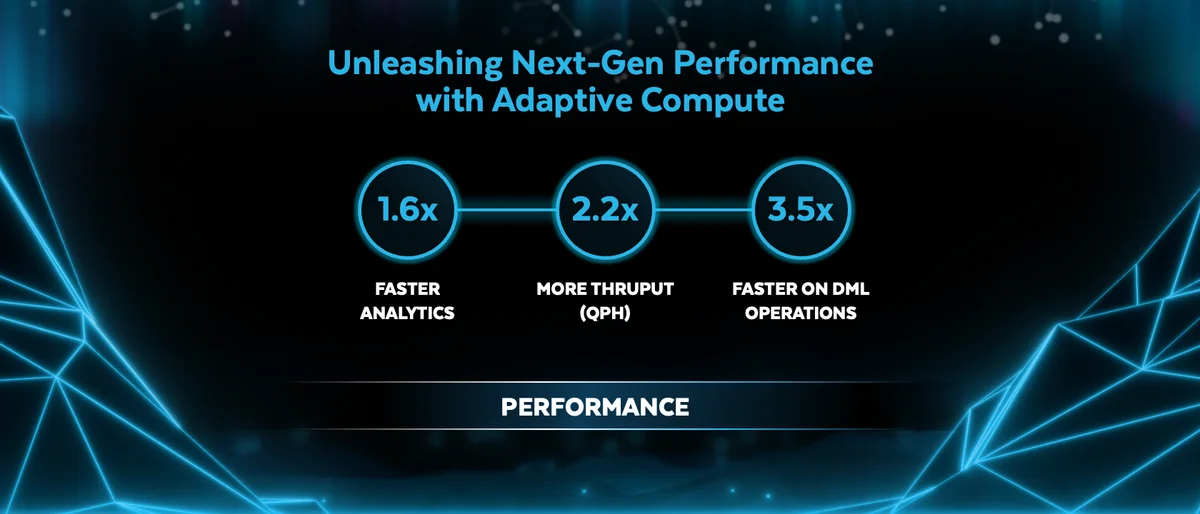
Snowflake claims meaningful performance improvements based on TPC-DS and internal benchmarks:

  • Up to 1.6x faster for analytical workloads.
  • Up to 2.2x higher throughput for concurrent operational analytics.
  • Up to 3.5x faster execution for DML-heavy workloads like data transformations.

Adaptive Compute replaces fixed compute engines with dynamic ones that match required performance levels. Users can still set guardrails through parameters like Maximum Query Performance Level and Query Throughput Multiplier.

This intelligent scaling is crucial for mixed environments with variable workloads, accelerating time to insight and supporting innovation. Coupled with a query-based billing model, Adaptive Warehouses can run more queries at a comparable cost to Gen2.

Simplified Management

Manual compute configuration decisions are fraught with risk. Adaptive Compute removes these burdens from engineering teams.

Users set just two parameters, and Snowflake manages the optimal compute configuration for each query. Cost governance remains familiar, using existing budgets and resource monitors.

Gabriel Tavridis, Head of Product, Observability at Snowflake, noted that their team achieved up to a 30% reduction in query latency with a handful of Adaptive Warehouses compared to managing a thousand traditional warehouses, at a comparable cost.

Use Cases and Getting Started

Adaptive Compute addresses several key use cases:

  • Mixed analytics workloads: Supports fluctuating BI dashboards and ad hoc queries.
  • Data loading pipelines: Ensures consistent ingestion speeds.
  • AI experimentation: Scales dynamically for intensive training cycles.
  • Mixed BI + ETL workloads: Handles diverse, unpredictable tasks.
  • Streaming analytics: Processes real-time event spikes.

Creating an Adaptive Warehouse is straightforward via the Snowsight interface, SQL, or Cortex Code. Users select 'Adaptive' from the warehouse type dropdown and can optionally configure advanced settings.

Adaptive Compute represents the next generation of compute for Snowflake, promising dynamic adaptation to workloads and simplified management for faster innovation and improved efficiency.

© 2026 StartupHub.ai. All rights reserved. You may not republish this article in full without a license. Search engines and AI research tools may crawl and summarize for reference. Bulk reproduction or model training requires a license. See our terms.
Daniel Singer

Written by

Daniel Singer

Editor, StartupHub.ai

Daniel Singer is the editor of StartupHub.ai, a technology expert and thought leader on AI and its applications across sectors, from fintech and healthcare to developer tooling and consumer software. He writes and tests the tools covered here thoroughly and regularly, and built StartupHub.ai to give founders, operators and buyers a clearer read on what they are actually being sold.

More from Daniel Singer