

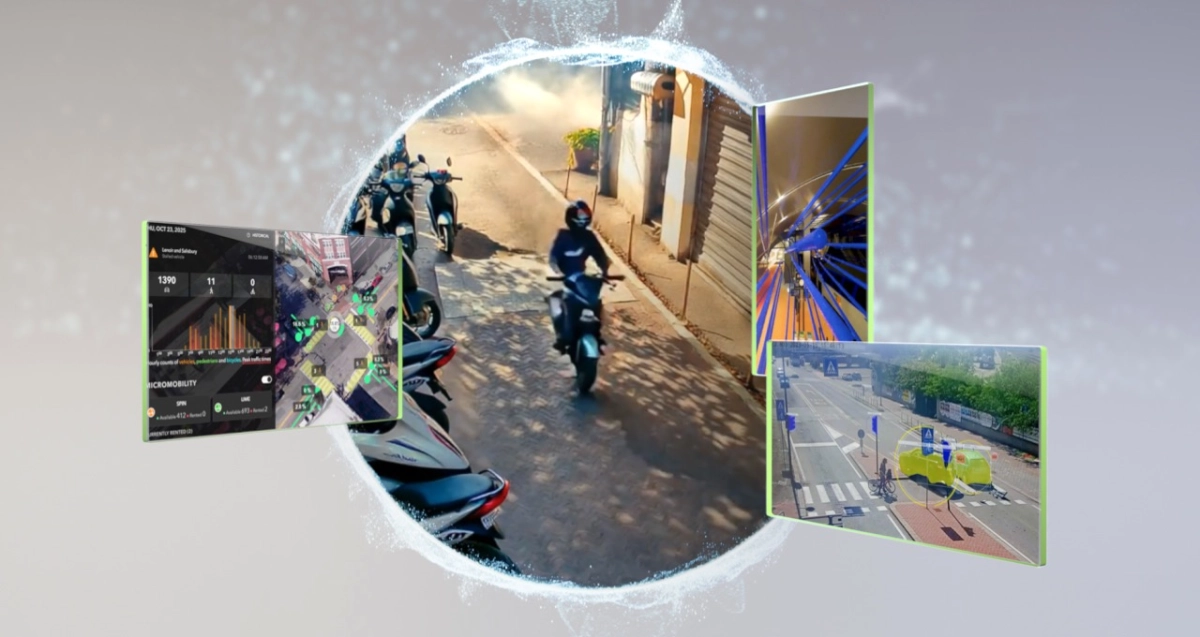
Cities globally grapple with escalating urban populations and strained infrastructure, leading to persistent operational challenges like traffic congestion and fragmented emergency responses. Addressing these issues, NVIDIA has introduced its Blueprint for smart city AI, a reference application designed to build, test, and operate AI agents within simulation-ready digital twins. This comprehensive software stack, leveraging OpenUSD, provides cities with the real-time insights necessary for effective decision-making and proactive urban management, marking a significant shift in how cities approach their complex operational landscapes. According to the announcement
The NVIDIA Blueprint outlines a robust three-stage workflow, beginning with simulation on the NVIDIA Cosmos platform and Omniverse libraries to generate synthetic, physically accurate sensor data. This crucial step allows cities to simulate "what if" scenarios in OpenUSD-enabled digital twins, refining strategies before real-world deployment. Following simulation, the workflow progresses to training and fine-tuning vision AI models, culminating in the deployment of real-time video analytics AI agents via the NVIDIA Metropolis platform and the Video Search and Summarization (VSS) blueprint. This integrated approach moves cities from reactive problem-solving to predictive, optimized operations.
This shift is already yielding tangible results across diverse urban environments. Kaohsiung City, Taiwan, has slashed incident response times by 80% using street-level AI to detect infrastructure events, eliminating manual inspections. Raleigh, North Carolina, achieved an impressive 95% vehicle detection accuracy, significantly enhancing traffic analysis and infrastructure planning through its Esri-enabled digital twin. Furthermore, French rail networks, in partnership with Akila, have optimized energy consumption by 20% and reduced downtime by 50% through live scenario planning within their digital twins, showcasing the profound impact of Smart City AI Agents on critical services.
Operationalizing Intelligence: The Agent Advantage
The deployment of these Smart City AI Agents signifies a paradigm shift from siloed data to integrated urban intelligence. Operational platforms now converge weather data, traffic sensors, and emergency response systems, providing a unified, real-time picture of city dynamics. This integration supports rapid testing of rare scenarios and continuous optimization of urban systems, driven by platforms like NVIDIA Cosmos Reason for world understanding and the VSS blueprint for deployment. The ability to process billions of events annually, as seen in Palermo, Italy, and automate video review to reduce operator fatigue by up to 30% with Milestone Systems’ Hafnia VLM, underscores the transformative potential of these intelligent agents.
The implications for urban planning and citizen experience are substantial. By leveraging simulation, vision AI, and digital twins, cities can move towards truly adaptive and resilient operations, anticipating issues rather than merely reacting to them. This evolution of physical AI, deeply integrated with OpenUSD, promises not just efficiency gains but a fundamental redefinition of how urban environments are managed, fostering smarter, safer, and more sustainable communities for the future.