

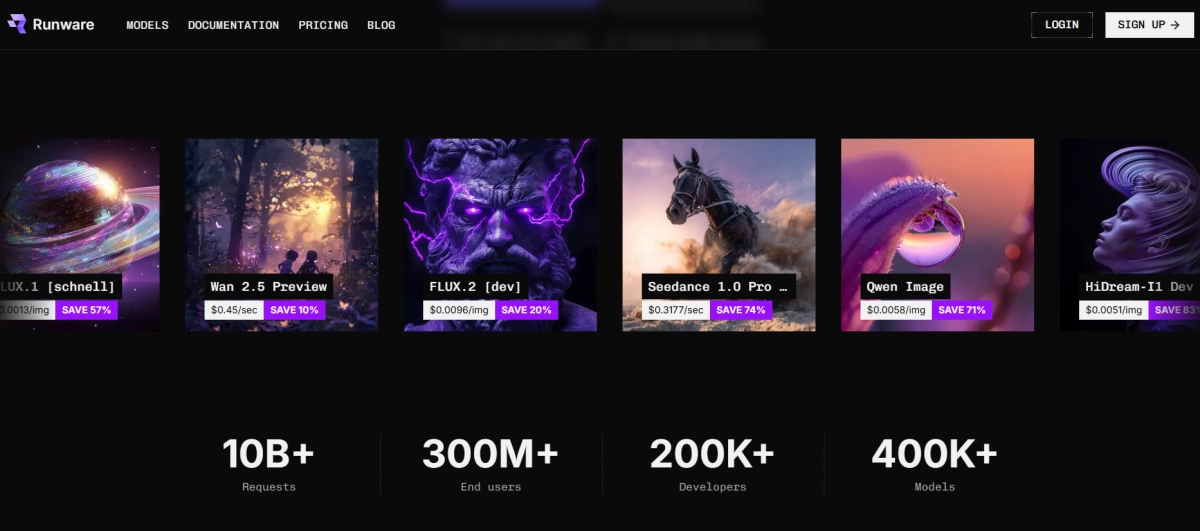
The infrastructure layer beneath the current AI boom is getting expensive and fragmented. Runware, a startup aiming to simplify the entire deployment process, announced a $50 million Series A round today, led by Dawn Capital. Their pitch is simple but ambitious: provide one unified AI API for all models, promising massive performance gains and cost reductions for developers scaling intelligent applications.
Since its founding in 2023, Runware has quickly become a significant backbone, powering over 10 billion generations for hundreds of thousands of developers. The company argues that most teams deploying AI at scale face three major constraints: fragmented model access, slow inference that breaks user experience, and costs that increase faster than adoption.
Runware’s solution combines custom AI inference hardware with its proprietary Sonic Inference Engine, claiming up to a ten times lower pricing structure and faster performance than standard data center setups. This approach has already attracted major customers, including Wix, Quora, and Freepik, who rely on the platform to power image, video, and audio generation for millions of users.
The core of the offering is the unified AI API, which currently aggregates nearly 300 model classes and hundreds of thousands of model variants behind one consistent schema. This abstraction layer allows developers to A/B test, route, or swap models, whether open or closed source, with minimal code changes.
The economic argument is compelling: Runware promises 10x better price and performance for open source models and 10 to 40 percent savings even on closed source foundational models. For open source models specifically, they claim a 30 to 40 percent speed improvement compared with other inference platforms.