


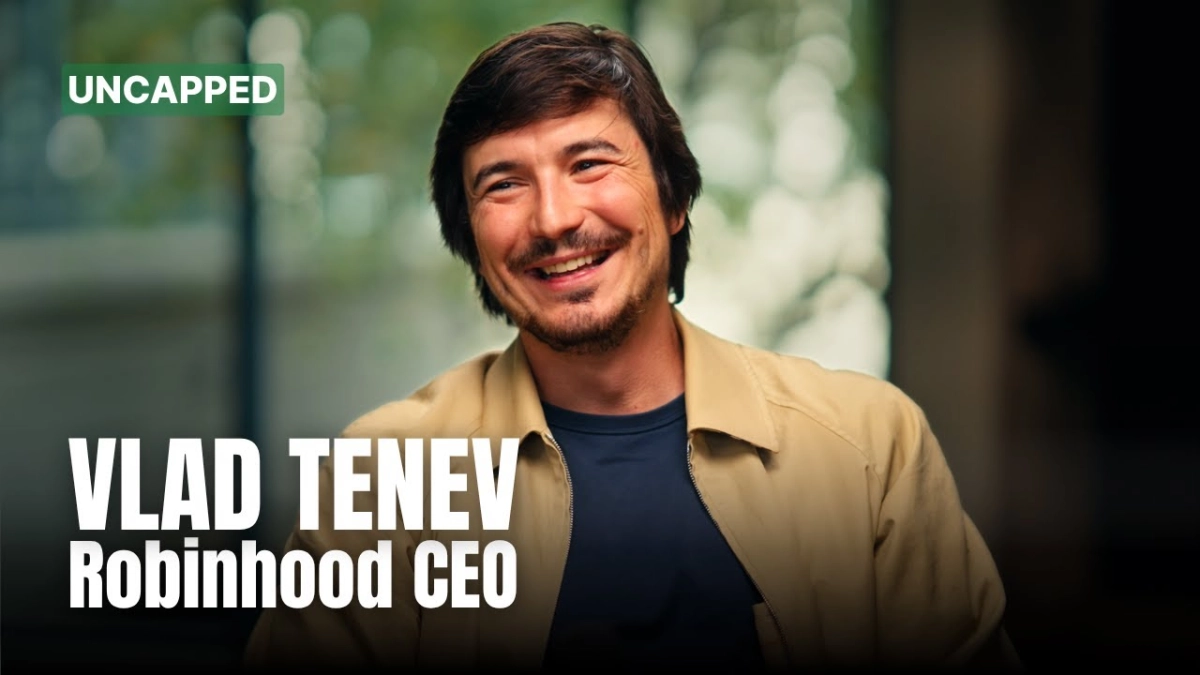
Vlad Tenev, co-founder and CEO of Robinhood, recently sat down with Jack Altman on the Uncapped podcast to discuss the evolution of online brokerage, the genesis of Robinhood, and the company's ambitious future, including the profound impact of AI. The conversation delved into the historical shifts in financial services, highlighting Robinhood's role in democratizing access and its current trajectory toward becoming a comprehensive financial super app.
Tenev framed the history of online brokerage as a continuous wave of democratization driven by lower costs. He drew parallels between Charles Schwab’s disruption of Merrill Lynch in the 1970s—when Schwab eliminated branch offices and reduced trading commissions from hundreds of dollars to around $75 per trade—and Robinhood’s own innovation in offering commission-free trading. This deregulation, known as "Mayday" in 1972, paved the way for Schwab’s phone-based, low-cost model, much like the internet and mobile technology did for E-Trade and later, Robinhood. E-Trade, born from two individuals leveraging an Apple II computer to trade stocks from home, ultimately became one of the first profitable dot-com companies.
Robinhood’s founding in 2012–2013 was predicated on three core innovations. First was the prescient bet on mobile-first design. While competitors dismissed mobile as a "toy" for serious financial transactions, Robinhood built its platform with the smartphone as primary, anticipating its eventual dominance. Second, the company capitalized on the advancements in high-frequency trading (HFT) infrastructure, adapting sophisticated institutional technology for retail users. This allowed Robinhood to drastically lower costs, offering commission-free trading at a time when competitors still charged $7–$10 per trade. "Our big innovation… was that high-frequency trading had completely changed institutional finance on an infrastructure level," Tenev explained. "We took the technology from a sophisticated high-frequency trading firm and that became the backbone for our retail product, which allowed us to lower costs and offer commission-free trading."
The third, and perhaps most resonant, innovation stemmed from the disillusionment following the 2008 Global Financial Crisis and the Occupy Wall Street movement. Tenev, having graduated Stanford in 2008 and witnessed Lehman Brothers' collapse, observed a profound distrust among young people towards traditional financial institutions. Robinhood offered an optimistic counter-narrative, inviting individuals to participate in the system rather than protest it. "It felt like young people in particular were the victims of forces beyond their understanding," Tenev reflected. "We were saying, ‘Why don’t we plug you into the system?’" This ethos resonated deeply with a generation seeking empowerment and access.
A core insight from Tenev is that financial engagement evolves, rather than graduates. He noted a shift among Gen Z and Gen Alpha, who are now opening retirement accounts as young as 19, a stark contrast to millennials who largely deferred such planning. This indicates a growing interest in long-term financial health, alongside a desire for active engagement. For Robinhood, the strategy is not to force users into a single investment style, but to cater to diverse financial behaviors. "As their money grows, they just have more and more buckets," Tenev stated. "They have your retirement, long-term money, which for many people is passively managed, but they always want to have a little bit at least that they’re making decisions on."
This understanding has propelled Robinhood’s transformation into a financial super app, moving beyond a pure trading platform. The company now offers Robinhood Banking, a credit card, and Robinhood Gold for premium features, alongside retirement accounts that manage $25 billion in assets. Tenev envisions Robinhood as the primary and secondary financial account for users, encompassing a wide array of services. The company's growth strategy involves expanding across two "linearly independent vectors": from retail-only to business and institutional clients, and from a US-centric operation to a global presence.
Related Reading
- Banking on AI: Profit Upside vs. Enduring Challenges
- Goldman Sachs: AI’s Transformative Path, Not a Bubble Yet
- AI's Universal Impact: Every Job Transformed
Looking to the future, Tenev expressed excitement about prediction markets and AI. He views prediction markets as "truth machines," providing a reliable source of information by leveraging collective wisdom with real financial stakes. He highlighted their accuracy in forecasting events like the 2016 and 2020 presidential elections, often outperforming traditional news outlets. The recent legalization of federal election prediction markets in the US, following a Supreme Court case, has spurred significant growth, with Robinhood quickly integrating the feature. Tenev sees this as a disruptive force, particularly in sports prediction, as it offers a more granular and transparent alternative to traditional sports betting. He believes that by allowing individuals to express their views through financial contracts, rather than just polls, a more accurate and valuable forecast emerges.
AI, for Tenev, presents a similar opportunity for disruption and empowerment. He envisions "vibe trading," where AI assists users in making informed decisions by sifting through vast amounts of information and offering tailored insights. While acknowledging the potential for AI to automate jobs, he believes human-centric fields like entertainment and sports will remain resilient. Robinhood’s embrace of AI aims to provide advanced tools for both sophisticated traders and those seeking more conservative, long-term investment strategies. The ultimate goal is to democratize access to powerful financial intelligence, ensuring that individuals can navigate complex markets effectively.

