

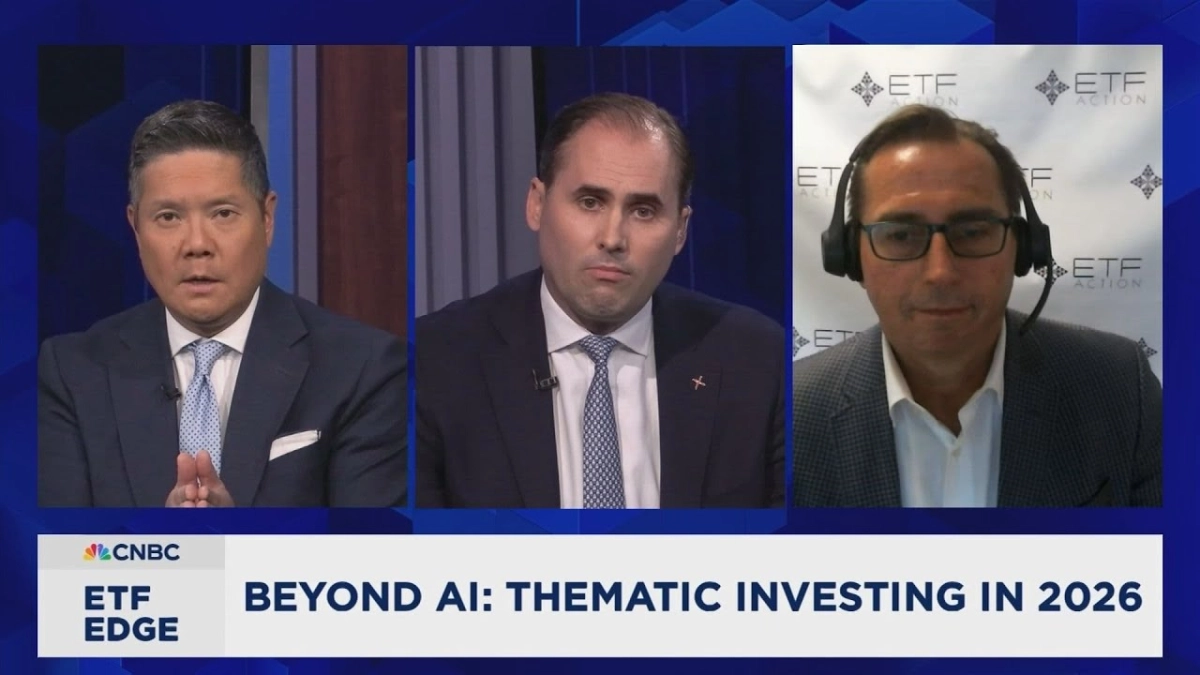
The artificial intelligence boom, while captivating global markets, is merely the overture to a deeper, more profound transformation requiring significant underlying investments. While the spotlight remains firmly on AI’s dazzling capabilities and immediate returns, discerning investors and industry leaders are already charting the next wave of thematic opportunities, recognizing that sustained technological advancement necessitates a robust, localized, and electrified foundation. This forward-looking perspective formed the core of a recent discussion on CNBC’s ETF Edge, where host Dominic Chu engaged with ETF Action founding partner Mike Akins and Global X ETFs CEO Ryan O’Connor about the investment landscapes emerging beyond the current AI-driven fervor, specifically looking towards 2026 and beyond.
Dominic Chu initiated the conversation by acknowledging the market's intense focus on AI, while also questioning the longevity of its current parabolic ascent, referencing recent "corrective action." His central query pushed the experts to identify the "next big frontier" in thematic investing, seeking insights into areas ripe for growth once the immediate AI narrative potentially matures or shifts. The dialogue quickly moved beyond software and algorithms to the tangible, physical infrastructure essential for supporting technological evolution.
Mike Akins of ETF Action highlighted a significant macroeconomic shift, observing that "the pendulum always swings." He pointed to a growing emphasis on "reshoring products," encompassing traditional infrastructure and industrial sectors that have long been overshadowed. This trend, Akins posited, is not arbitrary but driven by compelling factors on both the policy and consumer fronts, signaling a move away from hyper-globalization towards more localized production. He noted the irony in this shift, stating, “some of the names that you wouldn’t think about when you start talking thematics, I think are actually going to start getting a lot of the conversation as we move into the next year and beyond.” This suggests a re-evaluation of mature industries, now imbued with renewed strategic importance.
Ryan O’Connor from Global X ETFs echoed Akins’ sentiment regarding the resurgence of infrastructure, an area Global X has already heavily invested in with products like their PAVE ETF. O’Connor further elaborated on the drivers, suggesting that while tariffs have not yet had a "massive impact on the consumer," any future escalation could accelerate reshoring efforts, making domestic infrastructure plays even more compelling. This indicates a strategic alignment of economic policy with investment opportunities, fostering an environment where localized industrial strength becomes paramount.
The critical insight O’Connor introduced, however, was the burgeoning theme of electrification, articulating its direct and indispensable link to the ongoing AI boom. He explained, "The idea of all of the things that are going to be required for us to continue to support this AI boom, the electrification of the US economy is certainly one of them." This statement underscores a profound interdependence: the insatiable energy demands of AI, from training colossal models to powering vast data centers, cannot be met without a fundamental overhaul and expansion of electrical grids and renewable energy sources. This isn't just about cleaner energy; it's about the sheer volume and reliability of power needed to sustain the next generation of computing.