

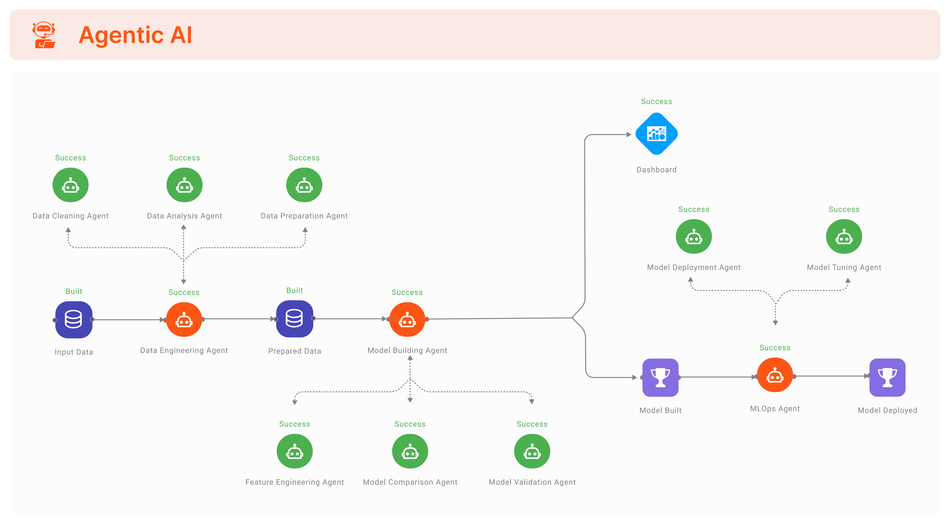
RapidCanvas, a provider of AI-driven business transformation solutions, has announced a $16 million Series A funding round to support the growth of its AI agent platform. The funding will help the company scale its hybrid AI-human solution, which automates up to 75% of tasks traditionally handled by data scientists and engineers, addressing the global shortage of technical talent.
Led by Peak XV with participation from Titanium Ventures, Accel, and Valley Capital Partners, this funding round brings RapidCanvas’s total investment to over $23.5 million since its founding in 2021.
As AI adoption accelerates, the demand for skilled data scientists and engineers is outpacing supply. According to Gartner, more than 80% of enterprises will implement AI-powered processes in the next few years, but 68% of executives report that a lack of technical talent is a significant barrier to progress. High salaries, repetitive coding tasks, and time-consuming data transformation processes are delaying AI implementation, hindering ROI, and stalling business growth.
Unlike traditional software tools that simply help humans work faster, RapidCanvas’s AI agents can process vast amounts of data in seconds, performing complex tasks that would normally take humans days to complete. The platform combines AI automation with human expertise, allowing AI agents to handle routine tasks like data preparation and modeling, while expert engineers focus on tasks that require creativity and deep domain knowledge.
This hybrid approach allows RapidCanvas to achieve superior results with significantly fewer human resources. For example, while traditional firms may require 10 engineers to complete a project, RapidCanvas typically needs only 1 or 2 experts, thanks to the efficiency of AI agents. AI agents can automate up to 70% of coding tasks, making them both faster and more cost-effective than human workers, while human experts handle the remaining tasks that require high-level problem-solving.
RapidCanvas’s "Service-as-Software" model is especially impactful in software development, where it can automate up to 70% of the tasks performed by engineers, freeing them to focus on more strategic work that drives business value. This model has significant implications for the industry, as it enables businesses to unlock AI-driven innovation without requiring a large technical workforce.
With over 30 million software engineers and data scientists worldwide, representing nearly $1 trillion in annual salaries, RapidCanvas estimates that AI agents could perform up to 70% of the tasks currently handled by humans, enabling engineers to focus on high-value activities. This shift could drive significant cost savings and productivity gains across the tech industry.
“RapidCanvas is revolutionizing how businesses solve complex challenges by seamlessly integrating AI automation with human expertise,” said Rahul Pangam, CEO and co-founder of RapidCanvas. “Our AI agents automate key tasks like data preparation, transformation, and modeling, allowing users to create tailored AI solutions using simple natural language prompts. With our expert-in-the-loop approach, we ensure human oversight at crucial decision points, validating outcomes and delivering real-world impact. This enables businesses to achieve results in days or weeks, not months, at a fraction of the cost of traditional methods.”
RapidCanvas’s model represents a significant departure from traditional Software-as-a-Service (SaaS) tools, which primarily focus on increasing employee productivity. In contrast, RapidCanvas directly links software costs to business outcomes, with AI agents autonomously handling complex tasks and reducing the need for technical talent. This shift from efficiency gains to measurable business results marks a fundamental change in how companies use software.
“The gap in data science expertise is a huge challenge for organizations, forcing many to rely on expensive consultants or abandon AI projects altogether,” said Harshjit Sethi, MD at Peak XV Partners. “RapidCanvas’s innovative approach helps organizations fill this gap by combining AI agents with subject matter experts, driving scalable and efficient results.”

