

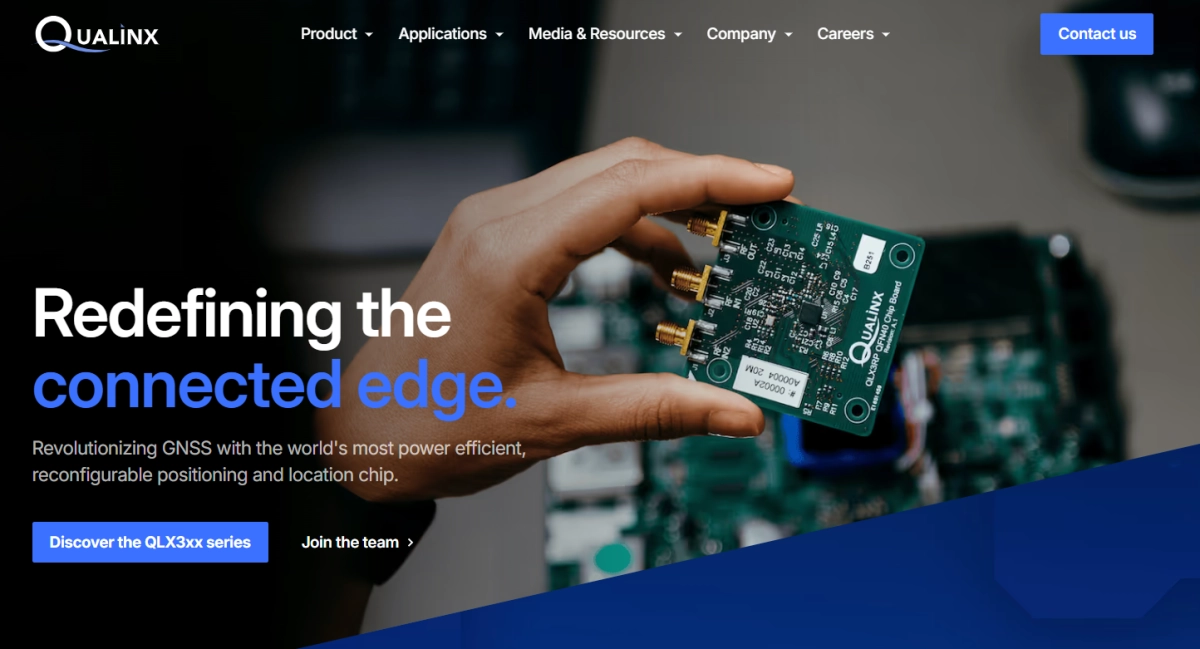
European deep-tech startup Qualinx has secured a significant €20 million investment, led by Invest-NL, to accelerate the mass production of its QLX3Gx Series GNSS chip. The funding, which brings Qualinx’s total raised to €40 million, is a direct push to scale a technology that promises to fundamentally change the economics and longevity of battery-powered connected devices.
The Qualinx GNSS chip uses up to 10 times less energy than conventional solutions while simultaneously boosting performance. For OEMs building wearables, pet trackers, IoT sensors, and asset trackers, where positioning accounts for nearly half of the total power drain, this efficiency leap could translate directly into days or weeks of extended battery life.
Qualinx CEO Tom Trill stated that the market has been "forced to accept traditional semiconductor trade-offs in GNSS for far too long," suggesting that the QLX3Gx Series eliminates the historical compromise between power consumption and positioning accuracy.
Redefining the Connected Edge
The breakthrough behind the QLX3Gx Series is Qualinx’s proprietary Digital Radio Frequency (DRF) technology. Traditionally, wireless chips rely heavily on analog components, which do not benefit from the scaling efficiencies of modern CMOS manufacturing processes. Qualinx’s DRF architecture transfers a substantial portion of these functions into the digital domain.
Furthermore, the chip is designed with hardware-level security and resilience in mind. Tracking is performed natively on-chip, mitigating reliance on cloud-based processing and improving resistance to spoofing and jamming. Qualinx has also collaborated closely with EUSPA, the European Union Agency for the Space Programme, to fully integrate the Galileo OSNMA (Open Service Navigation Message Authentication) protocols, positioning the Qualinx GNSS chip for mission-critical applications where security is non-negotiable.