

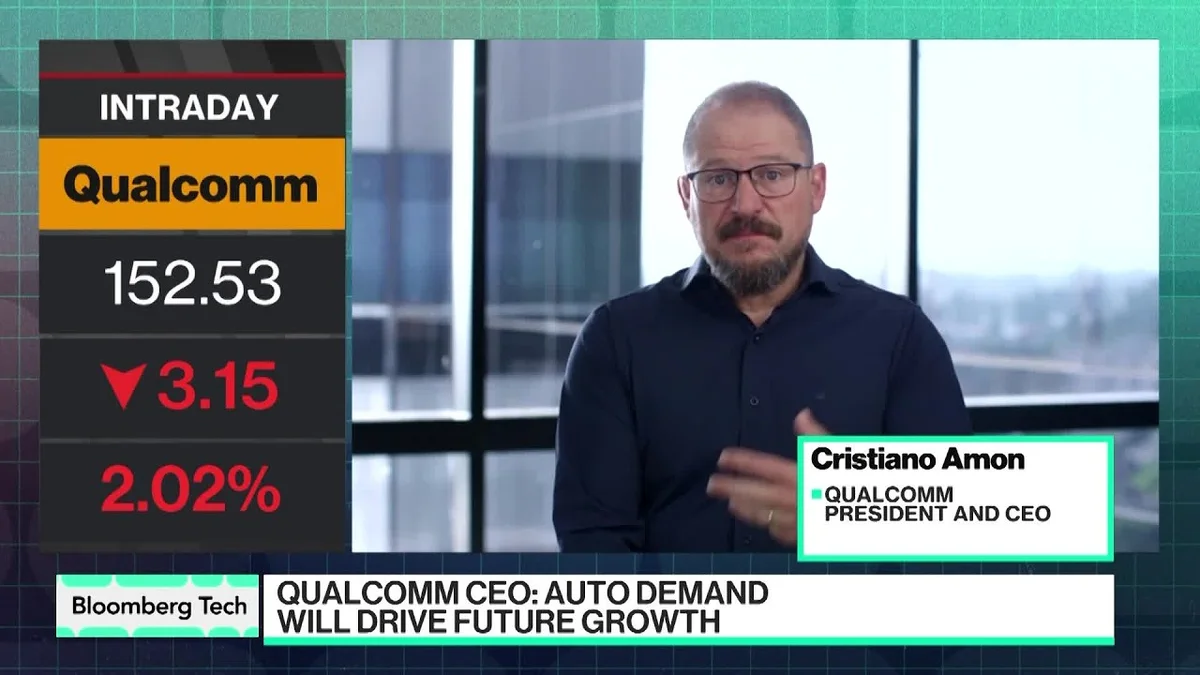
Qualcomm CEO on AI, Automotive, and Smartphone Slump

Qualcomm CEO Cristiano Amon discusses the company's diversification into automotive and data centers amidst smartphone market pressures, and the strategic importance of its AI platform.

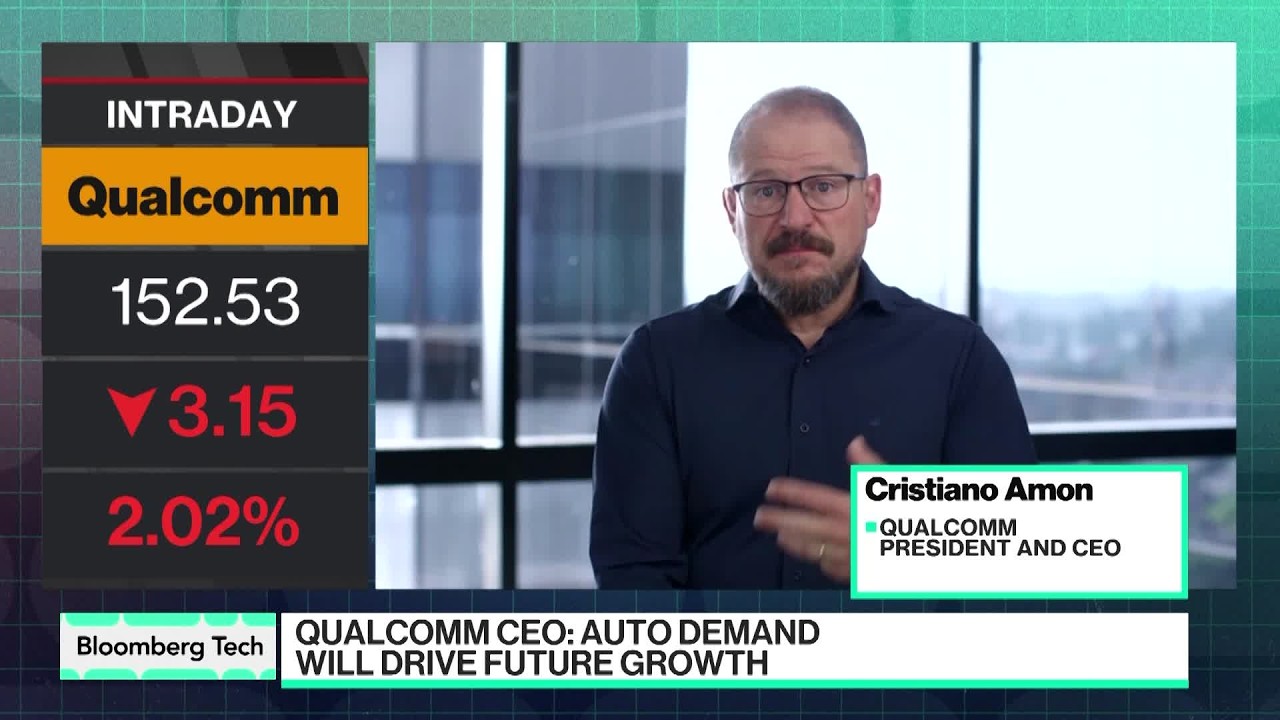
Qualcomm CEO Cristiano Amon speaking on Bloomberg Tech Live
Bloomberg Technology
Visual TL;DR
Smartphone Market DownDriver
memory price increases and supply shortages impacting unit sales, even premium tier
From the article 3 mentionsAmon acknowledged the pressure on Qualcomm's core smartphone business, noting that the market is down primarily due to supply issues related to memory chips, not a lack of consumer demand.
AI Platform VisionCore
strategic importance of AI platform across all segments, from edge to cloud
From the articleThe goal is to create an open platform for AI that scales from edge to cloud, a strategy Amon believes will benefit both Qualcomm and the broader industry.
Apple Modem ImpactDriver
From the articleHe elaborated on the impact of Apple's departure from Qualcomm's modem supply, which has accelerated due to supply chain dynamics.
Qualcomm DiversifiesContext
focusing on non-handset businesses like automotive and data centers for growth
From the article 9+ mentionsQualcomm President and CEO Cristiano Amon discussed the company's strategic transition and growth drivers in a recent Bloomberg Tech Live appearance.
Automotive GrowthEffect
design win pipeline for Snapdragon Digital Chassis reaching $30 billion
From the article 5 mentionsThe automotive sector is a key growth engine, with Qualcomm expecting an exit run rate of nearly $1 billion for fiscal year 2027.
Data Center StrategyCore
leveraging NUVIA acquisition for high-performance, power-efficient chips
From the article 4 mentionsBy fiscal year 2029, Qualcomm projects that its automotive, data center, and IoT segments will collectively represent two-thirds of its total revenue.
Future Growth DriversOutcome
automotive, data center, and AI platforms are key for long-term revenue
From the articleQualcomm President and CEO Cristiano Amon discussed the company's strategic transition and growth drivers in a recent Bloomberg Tech Live appearance.
Contents(4)

Qualcomm President and CEO Cristiano Amon discussed the company's strategic transition and growth drivers in a recent Bloomberg Tech Live appearance. Amon highlighted the challenges in the current smartphone market, citing memory price increases and supply shortages as primary factors impacting unit sales, even within the premium tier. Consumers are reportedly opting for older models or lower-tier premium devices due to higher prices, leading to a projected 20% market downturn from fiscal year 2026 to 2027.

Smartphone Market Pressures and Diversification Strategy

Amon acknowledged the pressure on Qualcomm's core smartphone business, noting that the market is down primarily due to supply issues related to memory chips, not a lack of consumer demand. He elaborated on the impact of Apple's departure from Qualcomm's modem supply, which has accelerated due to supply chain dynamics. Despite these headwinds, Qualcomm is focusing on its diversification strategy, aiming for non-handset businesses to constitute nearly 50% of its revenue by fiscal year 2027. By fiscal year 2029, Qualcomm projects that its automotive, data center, and IoT segments will collectively represent two-thirds of its total revenue.

The full discussion can be found on Bloomberg Technology's YouTube channel.

Qualcomm Sees AI Driving Its Next Growth Wave - Bloomberg Technology
Qualcomm Sees AI Driving Its Next Growth Wave, from Bloomberg Technology

Automotive and Data Center Growth Drivers

The automotive sector is a key growth engine, with Qualcomm expecting an exit run rate of nearly $1 billion for fiscal year 2027. Amon emphasized the company's strong position in advanced driver-assistance systems (ADAS) and autonomy silicon. The data center business is also ramping up, with a stated target of $5 billion in revenue by fiscal year 2027. Qualcomm is developing custom ASICs, accelerators, and CPUs for high-bandwidth compute, with silicon for high-performance computing (HPC) expected to be available for evaluation in the coming quarters. The IoT segment, particularly in industrial applications, is also showing promise, with a significant design pipeline.

Data Center Strategy and Global Exposure

Regarding the data center opportunity, Amon detailed Qualcomm's $15 billion revenue projection for fiscal year 2029. This revenue will be derived from custom ASICs for hyperscalers, accelerators, high-bandwidth compute solutions, and CPUs. He noted that the hyperscaler deals are balanced between a U.S.-based and a China-based company. Amon stated that Qualcomm's exposure to the Chinese data center market is expected to be similar to that of other major semiconductor providers, reflecting the market's GDP-driven growth.

Software Acquisition and AI Platform Vision

Qualcomm's recent acquisition of Modula was highlighted as a significant development in its software strategy. Amon expressed enthusiasm for the acquisition, noting the team's track record in areas like the Swift programming language and LLVM. The goal is to create an open platform for AI that scales from edge to cloud, a strategy Amon believes will benefit both Qualcomm and the broader industry. He also addressed the smartphone market's trajectory, confirming that the third quarter marked a bottom for China's Android segment, with sequential growth anticipated, though overall market suppression due to memory supply issues is expected to persist.

© 2026 StartupHub.ai. All rights reserved. You may not republish this article in full without a license. Search engines and AI research tools may crawl and summarize for reference. Bulk reproduction or model training requires a license. See our terms.
Daniel Singer

Written by

Daniel Singer

Editor, StartupHub.ai

Daniel Singer is the editor of StartupHub.ai, a technology expert and thought leader on AI and its applications across sectors, from fintech and healthcare to developer tooling and consumer software. He writes and tests the tools covered here thoroughly and regularly, and built StartupHub.ai to give founders, operators and buyers a clearer read on what they are actually being sold.