

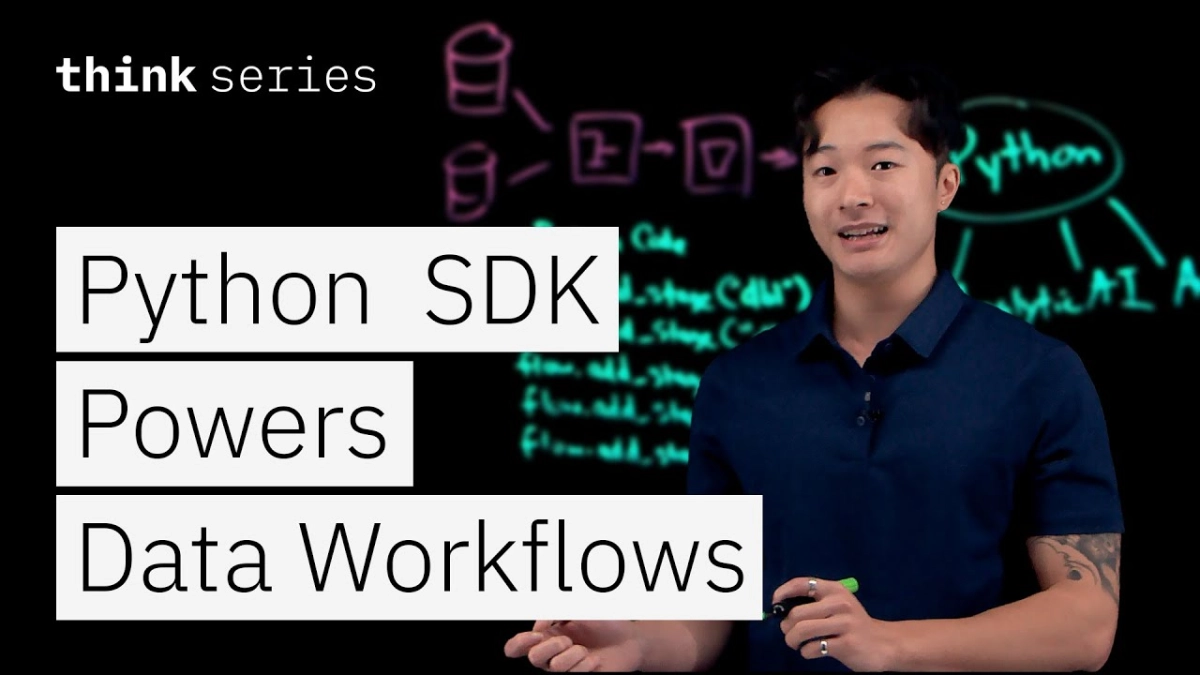
The future of data integration is not merely about human engineers writing code; it encompasses AI systems and autonomous agents actively participating in the data workflow. This profound shift was meticulously detailed by John Wen, Product Manager at IBM, in a recent presentation where he illuminated the transformative potential of Python SDKs in conjunction with Large Language Models (LLMs) and AI agents. His insights painted a clear picture of an evolving ecosystem where collaboration transcends human-machine boundaries, leading to unprecedented levels of automation and efficiency in data pipelines.
Wen began by acknowledging Python’s ubiquitous presence across data engineering, analytics, AI, and automation. However, he quickly highlighted a significant bottleneck: data integration. While visual canvas tools are popular for their intuitive, collaborative, and immediate feedback, their utility diminishes drastically at scale. As Wen succinctly put it, "scaling up workflows by modifying hundreds or thousands of pipelines quickly become a challenge." These graphical interfaces, while excellent for quick mapping and dependency spotting, fall short when faced with the need for extensive, systemic changes.
The IBM Python SDK emerges as a critical solution to this scalability dilemma. It is a Software Developer Kit that enables the design, building, and management of data pipelines entirely as code. This programmatic approach leverages Python’s inherent flexibility, allowing developers to create workflows that are versioned, tested, and deployed with the same rigor as any other software. Crucially, this strategy "bridges the gap between the code-first and visual-first workflows, enabling everyone to contribute to the same ecosystem," fostering a more unified and efficient development environment.
The SDK simplifies the intricate process of defining data sources, transformations, and targets. Wen demonstrated how "complex configurations can be reduced to just a few lines of Python code, making the SDK simple to use." This simplicity does not compromise power; Python's full capabilities are harnessed to define loops, conditionals, parameters, and reusable templates, imbuing the SDK with immense flexibility. This flexibility translates directly into scalability, allowing for bulk updates across numerous pipelines, consistent templating of common patterns, and dynamic pipeline creation based on metadata or event triggers. These are formidable challenges that visual tools cannot address alone, but in code, they become natural, scalable, and fast.
The narrative extends further into the realm of artificial intelligence. Wen provocatively stated, "Data integration isn't just about humans writing code. It's about AI systems and autonomous agents joining the team." This vision positions LLMs not just as chat interfaces but as active teammates and coaches within data engineering projects. Imagine asking an LLM to switch a PostgreSQL data source to S3 and add a data cleansing step; the LLM, powered by the SDK, can instantly generate the corresponding Python script and implement the changes. Similarly, a new team member can query the LLM on how to schedule a job, receiving not just the Python snippet but a step-by-step breakdown of the reasoning and syntax. The LLM transforms into an experienced pipeline engineer, capable of generating, explaining, and even rectifying code.
Autonomous agents represent the next frontier. Unlike humans, agents are inefficient with graphical user interfaces; they demand a programmatic interface, and the Python SDK serves as their control panel. These agents can operate independently, spinning up new pipelines at 2 AM, connecting to sources, applying transformations, and writing to targets all on their own. They continuously create flows, execute jobs, and monitor them without human intervention.
Related Reading
- Stripe's AI Backbone: Powering the Agent Economy with Financial Infrastructure
- Anthropic's Latest: Claude Code on the Web and Haiku 4.5 Reshape Developer Workflows
- AI's Relentless March: Efficiency, Autonomy, and Economic Reshaping
This level of autonomy extends to critical operational aspects. An agent can dynamically detect a new team member, using the SDK to assign appropriate permissions without the need for manual tickets or delays. Furthermore, in the event of a pipeline failure, the agent can scan logs, identify the problem, and produce the necessary SDK code to bring the flow back online, retrying runs, scaling engines, and adjusting flow logic automatically. Finally, upon job completion, agents can integrate seamlessly with external APIs, sending notifications to Slack, updating dashboards, and orchestrating further actions to maintain ecosystem synchronization.
The Python SDK, therefore, transforms into the bedrock for this advanced data integration paradigm. It enables a unified ecosystem where humans, LLMs, and autonomous agents collaborate through a single, powerful interface, orchestrating data pipelines end-to-end. This is not merely a glimpse into the future; it is already here, reshaping how organizations manage and leverage their most critical asset: data.


