

San Francisco's AI Resurgence Amidst Political Rhetoric
President Trump's recent calls for the deployment of the National Guard to San Francisco, a city undergoing a significant AI-driven resurgence, cast a peculiar shadow over its economic revitalization. CNBC's Kate Rogers reported on this development, detailing how Mark Benioff, the CEO of Salesforce, has publicly walked back some of his previous comments regarding the city's challenges. This nuanced position from a prominent tech leader comes at a time when San Francisco is experiencing a notable rebound, largely fueled by substantial investments in artificial intelligence.
Rogers spoke with the "Fast Money" panel about the dual narrative surrounding San Francisco: the political pronouncements and the underlying economic reality. The city is indeed seeing a considerable uptick in venture capital funding, with projections indicating it will surpass the 2021 high of $276 billion. Data shows that 80% of this funding, totaling $115 billion, has been concentrated in the San Francisco Bay Area through the third quarter of the current year. This influx of capital is not merely abstract; it is demonstrably impacting the city's real estate market.
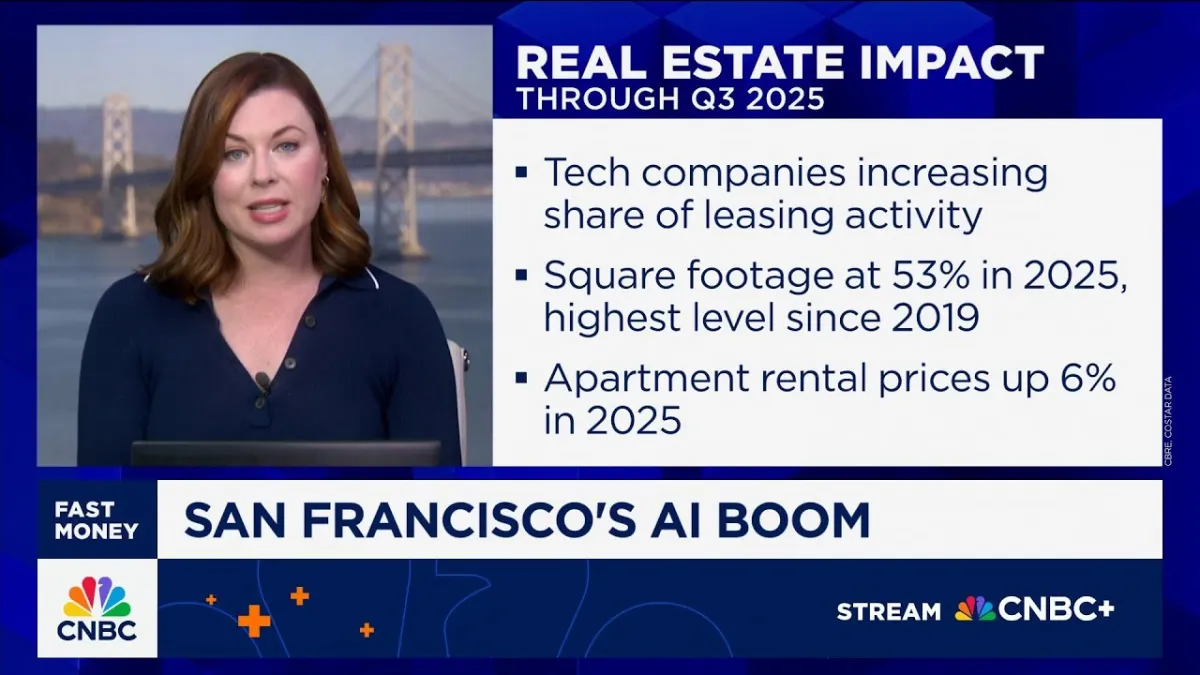
Tech companies are increasing their share of leasing activity, with projected square footage to reach 53% in 2025, the highest level since 2019. This surge in demand is also reflected in apartment rental prices, which are expected to rise by 6% in 2025. This economic momentum is a testament to the enduring strength of the region as a hub for innovation, particularly in the burgeoning field of artificial intelligence.
Despite the positive economic indicators, the city grapples with persistent issues. Crime rates, while showing a significant decrease of 30% year-over-year in homicides, still present challenges. Car break-ins, a long-standing concern, remain at 22-year lows, suggesting some localized improvements. However, the broader issues of homelessness and the fentanyl crisis continue to demand attention and effective solutions.
The dichotomy between political rhetoric and economic reality is stark. While one prominent political figure calls for drastic measures like National Guard deployment, citing issues that affect the city's image, the underlying economic engine powered by AI and venture capital appears to be gaining significant traction. This suggests a city in transition, facing both the opportunities of technological advancement and the persistent social challenges that have plagued urban centers.
The resilience of San Francisco as a tech and innovation hub is evident in the sustained investment and the return of companies to its commercial spaces. As Rogers noted, "VC investment set to surpass 2021 high of $276 billion." This indicates a strong belief in the future of the city's tech sector, with AI being a primary driver. The fact that 80% of this funding is concentrated in the Bay Area underscores its continued dominance.
Furthermore, the real estate data provides a tangible measure of this resurgence. The projection of 53% square footage for tech companies in 2025 signifies a robust return to physical office spaces, a trend that was uncertain during the peak of remote work. This renewed demand is not only boosting commercial real estate but also influencing residential markets, with apartment rental prices on the rise.
The narrative surrounding San Francisco is complex. It is a city that attracts immense capital and talent for its innovation ecosystem, particularly in AI, yet it also faces significant social and urban challenges. The call for National Guard deployment, while perhaps intended to address perceived issues, risks overshadowing the very real economic recovery and growth that the city is experiencing. The panel discussion highlighted this tension, with participants acknowledging both the improvements and the ongoing struggles.
Related Reading
- Navigating the Startup Labyrinth: YC Partners on AI, Pivots, and Growth
- The Contrarian Compass: Navigating AI's Crowded Future
- Apple's AI Crossroads and the Unseen Power of the AI Boom
The data presented by Rogers paints a picture of a city that is not only recovering but thriving in key sectors. "Totaling $115B" in VC funding through Q3 alone demonstrates the significant capital flowing into the region. This financial injection is a powerful signal of confidence in the future of San Francisco as a global center for technological advancement.
The commentary underscored that despite the political noise, the fundamental economic drivers, particularly in AI, are propelling San Francisco forward. The city's ability to attract and retain talent and capital in these high-growth sectors suggests a deep-seated resilience. While challenges remain, the current trajectory indicates a promising future, driven by innovation and investment.



