

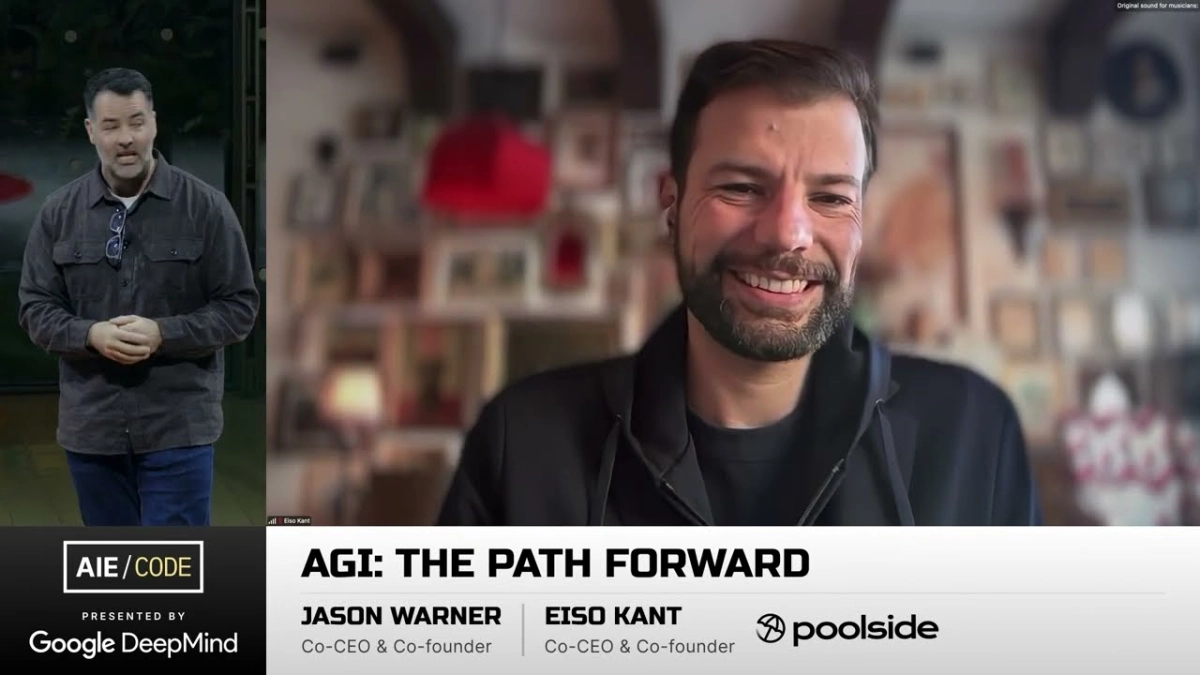
"Poolside exists to close the gap between models and human intelligence," declared Jason Warner, Co-CEO and co-founder of Poolside, setting the stage for a compelling demonstration of the company's vertically integrated approach to building autonomous AI agents. Warner and his co-CEO, Eiso Kant, presented their vision at the AI Engineer Code Summit, arguing that unlocking true Artificial General Intelligence (AGI) for knowledge work requires controlling the entire stack, from custom models trained on proprietary data to the underlying compute infrastructure itself. This strategy positions Poolside not merely as another LLM provider, but as a critical infrastructure player focused squarely on high-consequence, complex engineering tasks.
Warner and Kant walked the audience through a real-time demonstration of their second-generation model, the Malibu Agent, showcasing its ability to perform highly specialized and complex software migration. The task involved converting an in-memory database written in Ada, a legacy programming language predominantly used in defense and critical infrastructure due to its stringent safety requirements, into Rust. This choice of demonstration immediately signaled Poolside’s focus: environments where correctness, reliability, and security supersede speed or creative novelty.
The core insight underpinning Poolside’s architecture is the necessary pairing of next-token prediction, the foundation of modern large language models, with reinforcement learning (RL). This combination allows the Malibu Agent to move beyond simple code completion or chat assistance and engage in long-horizon, multi-step planning and execution. The agent is designed not just to suggest code, but to understand the context of the entire codebase, propose structural changes, implement new features, handle dependencies, and verify its own work.
The demonstration highlighted the agent’s end-to-end capability. In moments, the Malibu Agent analyzed the Ada codebase, created the foundational Rust project structure, added required dependencies like `rustylime` for command history, implemented core data structures (HashMaps for tables), and coded CRUD operations, persistence, and query parsing. The conversion of over a thousand lines of code, complete with testing scripts, was executed within minutes, illustrating the enormous potential for accelerating engineering productivity.
A crucial differentiator for Poolside, and a key insight for investors and founders, is their commitment to building proprietary models from the ground up, rather than fine-tuning existing foundation models. "We’re building our own models from scratch to do this," Warner affirmed, highlighting the strategic decision to maintain control over the entire development lifecycle, ensuring optimization for specific, high-stakes tasks rather than general creativity. This strategy extends beyond software; Kant noted their substantial investment in physical infrastructure, including a multi-gigawatt campus in West Texas dedicated to building out data centers. This full-vertical stack control, reminiscent of early tech giants, is necessary to handle the computational demands and specialized training required for true autonomous agents.