


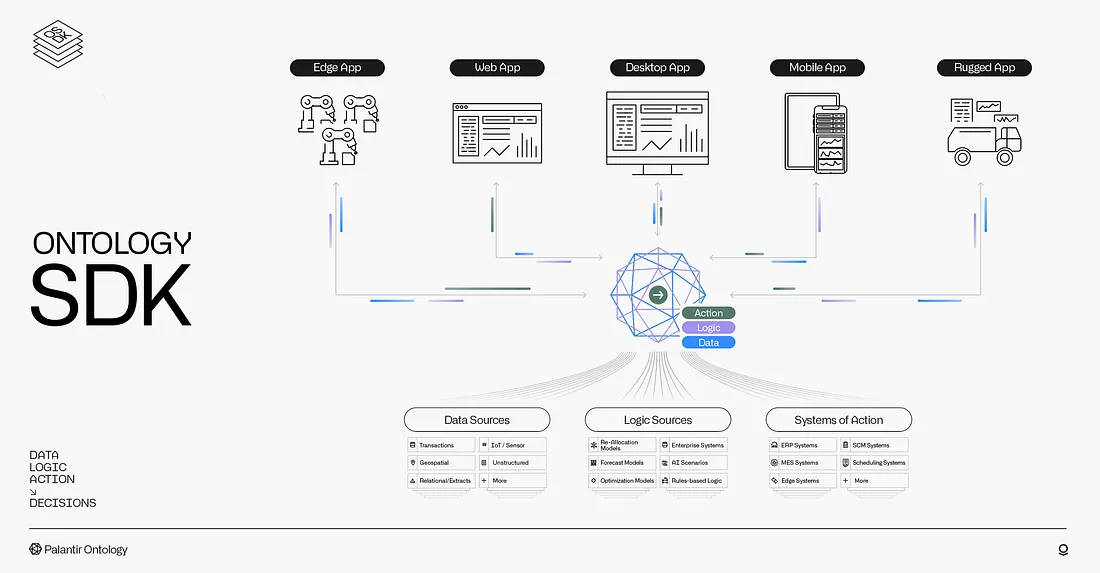
Palantir is streamlining enterprise AI development with its Ontology Software Development Kit (OSDK), a tool designed to let businesses build custom SDKs directly from their Artificial Intelligence Platform (AIP) Ontology. This approach aims to integrate an organization's core data, logic, and actions, alongside powerful Large Language Models (LLMs), into new or existing applications with unprecedented speed.
The OSDK centralizes business knowledge, abstracting complex system integrations into a unified model. This allows developers to focus on application logic, leveraging pre-existing work. As Peter Wilczynski, Product Lead for the Ontology System, notes, this method ensures that "translations from component-centric representations into the shared conceptual model happen once."
A practical demonstration involves Titan Industries, a fictional company using AIP to manage supply chain disruptions. After a fire at a distribution center, Titan utilized the OSDK to extend its existing ontology. This new capability allows them to task public satellites via a React application, using LLMs to identify the most suitable satellite for damage assessment imagery.
Accelerating Development Workflows
The OSDK operates through Palantir’s Developer Console, supporting both client-facing and backend applications. Developers can define granular permissions, ensuring data security by controlling access to specific ontology objects, actions, and LLM-backed functions. This eliminates the need to rebuild security frameworks for each new application.
SDKs are generated in popular formats like NPM for TypeScript or Pip/Conda for Python. The Developer Console also provides in-platform web hosting and automatically generates documentation, which updates dynamically with any changes to the ontology. This feature ensures developers always have current, accurate references for their custom SDKs.