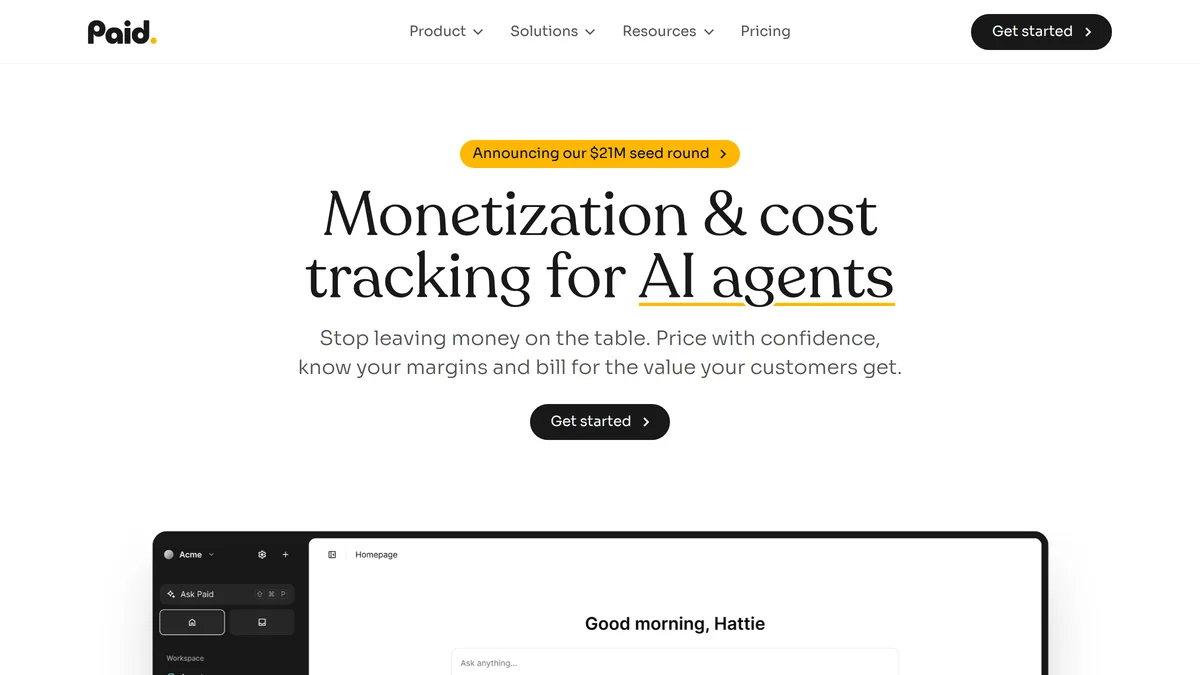
Manny Medina, best known for building the sales automation unicorn Outreach into a $4.4 billion powerhouse, is tackling one of the biggest unsolved problems in the generative AI boom: how to actually make money from it. His new London-based startup, Paid, has just closed a staggering $33.3 million in combined pre-seed and seed funding to build the financial plumbing for the AI agent economy.
The oversubscribed $21.6 million seed round, led by Lightspeed, signals massive investor confidence in a startup that hasn’t even hit its Series A. The core problem Paid is solving is that traditional billing systems are fundamentally broken for AI. Per-seat SaaS pricing makes no sense for autonomous agents, and simple usage-based billing, charging per token or API call, leaves a mountain of value on the table. It prices the raw material, not the finished product.
This is where the shift to outcome based pricing becomes critical, and it’s the future Paid is building its infrastructure for.
From Usage Fees to Value Billing
Paid’s platform is less a simple billing tool and more of a complete revenue engine for companies deploying AI agents. It starts with giving developers what they desperately need: a clear, real-time view of their costs. The platform automatically instruments AI agent workflows, tracking spend across multiple LLM vendors and APIs to provide a precise, up-to-the-second understanding of profit margins.
But cost tracking is just the entry point. The real revolution is in automating the revenue cycle around complex new pricing models. According to Paid, its system is designed to move companies beyond charging for compute and toward billing for results. Instead of invoicing a customer for 100,000 tokens used, a business using Paid could bill for one “successfully resolved customer support ticket” or five “qualified sales leads generated.”