


The residential real estate market, a colossal and fragmented industry, stands ripe for disruption, yet its inherent complexities have historically thwarted even the most ambitious innovators. This was the central theme as Kaz Nejatian, the recently appointed CEO of Opendoor, sat down with a16z General Partners Alex Rampell and Erik Torenberg on the a16z Podcast. Their wide-ranging discussion delved into Nejatian's bold vision for Opendoor, the deep-seated problems plaguing real estate transactions, and the strategic pivots necessary for building a generational company through economic turbulence.
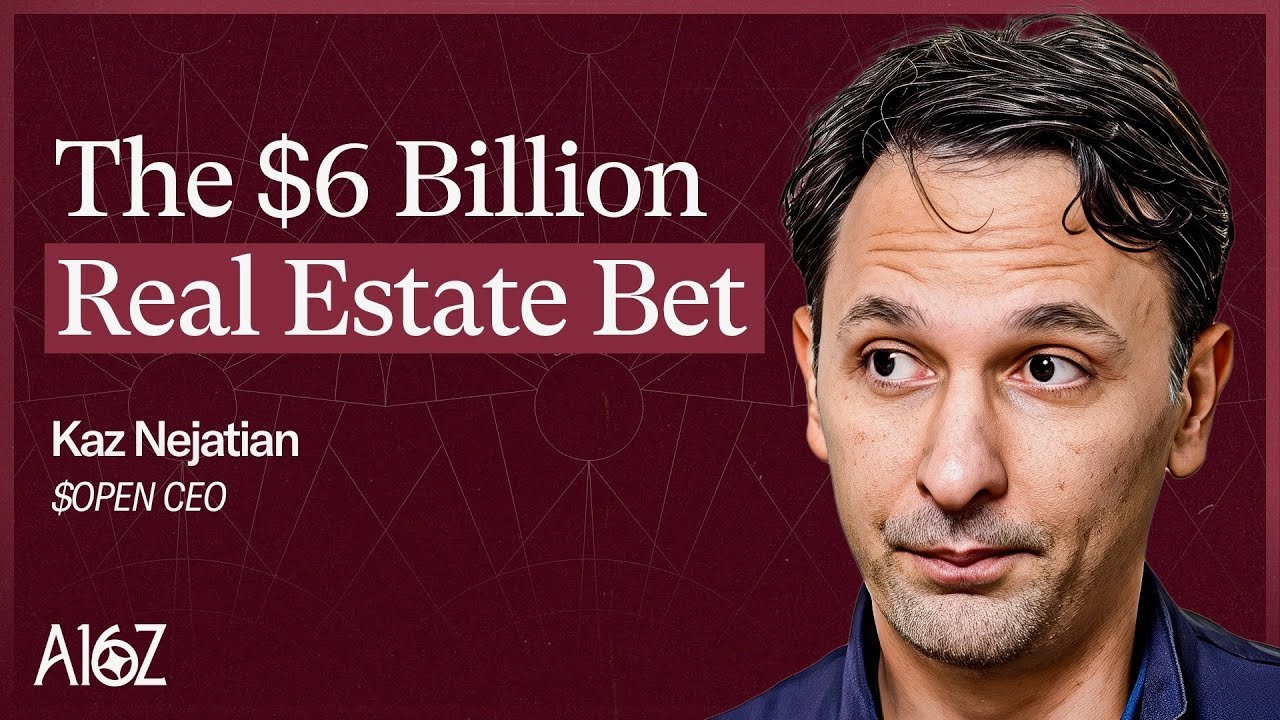
Nejatian, barely a month into his tenure when the interview was recorded, exuded a clear-eyed passion for Opendoor's mission. He posited that homeownership is inherently beneficial for society, and the process of achieving it is "objectively a broken process." His excitement stemmed from the belief that Opendoor could fix this fundamental flaw, transforming the convoluted journey of buying and selling a home into a seamless, empowering experience. This mission-driven approach, he argued, is the bedrock of truly great businesses, far more enduring than a meticulously crafted 17-page business plan.
Alex Rampell, an early investor in Opendoor, provided crucial historical context, drawing parallels between Opendoor's challenge and Amazon's early days. Amazon, he explained, initially cornered the book market by offering infinite supply, thereby attracting all the demand. Once demand was aggregated, Amazon could expand into other product categories, eventually becoming a capital-light marketplace by allowing third-party sellers. Rampell highlighted Opendoor's initial strategy in markets like Phoenix, where the uniform nature of homes allowed them to "flip" properties, effectively acting as a principal buyer to aggregate supply. This created a critical mass, making Opendoor a necessary destination for buyers. As Rampell articulated, "You don't have to get 100% of the homes in order to get 100% of the users. You get 10% of the homes... you get 100% of the demand." This market-making strategy, akin to eBay for everything except homes, positioned Opendoor to break the historical monopoly of traditional real estate agents.
A core insight emerging from the conversation was the critical "category mistake" that many companies, including Opendoor in its earlier phases, often make. Nejatian reflected on his time at Shopify, noting that Wall Street initially viewed it simply as "another e-commerce company," overlooking its true identity as a software platform. Similarly, Opendoor, he suggested, had been perceived "as essentially an investor in real estate as an asset class," rather than a technology company designed to solve the underlying transaction problems. This miscategorization led to strategic missteps, as the company repeatedly bought fewer homes each year, operating under the flawed premise that it should only acquire "mispriced" assets. The reality, Nejatian emphasized, is that not much in the world remains mispriced for very long.
The deep-seated issues within the traditional real estate ecosystem are compounded by what Rampell termed the "principal-agent problem." Real estate agents, despite their crucial role, often face misaligned incentives. A buyer's agent, for instance, earns a higher commission if their client spends more, directly conflicting with the buyer's interest in securing a lower price. Conversely, a seller's agent, while motivated to get a higher price, often prioritizes a quick close over an incrementally better offer, as their commission difference on a few thousand dollars is negligible. This creates systemic friction and opacity, where the mode number of transactions per agent per year is effectively zero, highlighting a fundamental inefficiency.