


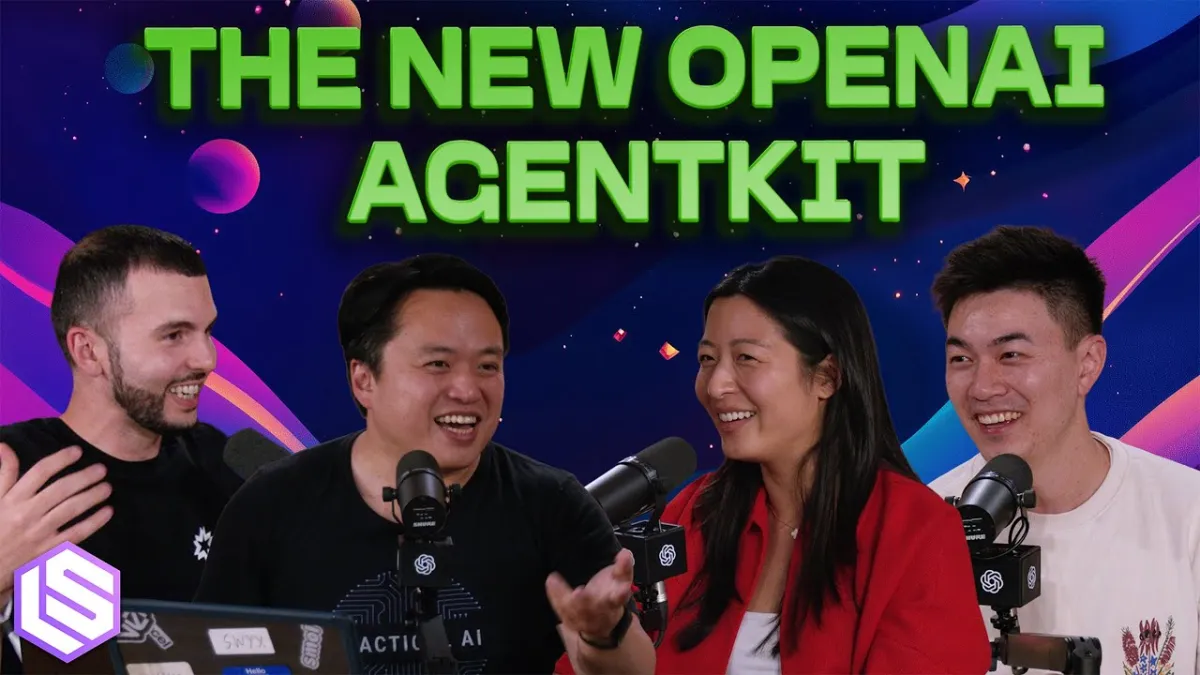
OpenAI's third DevDay brought a palpable sense of confident evolution, a stark contrast to the nascent stages of past events. Where once Sam Altman addressed a mere 30 attendees for a DALL-E hack night, this latest iteration saw millions of developers engaging with an expanding API surface area. This growth underscores a pivotal shift: OpenAI is not merely building AI; it's empowering the world to build with AI, a mission articulated by Sherwin Wu, Head of Engineering for the OpenAI Platform.
Wu, alongside Christina Cai from the Platform Experience team, shared insights at the Latent Space podcast studio during DevDay, discussing the new AgentKit and Apps SDK. The conversation, anchored by Alessio and Swyx, highlighted OpenAI's iterative approach, gathering extensive feedback to refine their offerings. This dedication to developer experience is evident in the event’s improved organization, a welcome change from previous, less structured gatherings.
A core insight from the discussion is OpenAI's commitment to "opening up our technology and bringing it out to the rest of the world," as Wu stated. This isn't just about providing powerful models; it's about creating the infrastructure for developers to integrate and distribute these capabilities broadly. The Apps SDK, for instance, inverts the traditional chatbot-website paradigm. Swyx aptly described this as moving from "a little chatbot app" on a website to "ChatGPT at the top layer, and then there's like the website embedded inside of it." This signifies a future where AI isn't an add-on but the foundational interface, enabling rich, context-aware interactions directly within ChatGPT. The seamless integration of tools like Canva, as demonstrated in the keynote, exemplifies this vision, offering an experience previously unseen.
The adoption of Anthropic's MCP (Modular Chain Protocol) for universal tool connectivity is another critical development. Cai noted that this decision, made around March, was driven by MCP's growing developer adoption and its inherent flexibility. "I really do think they treat it as an open protocol," Wu remarked, emphasizing that Anthropic’s collaborative approach made it a natural fit for OpenAI's ecosystem. This strategic alignment ensures broader interoperability and fosters a more unified developer landscape, preventing fragmentation across agent platforms.
AgentKit, a comprehensive suite for building, deploying, and optimizing AI agents, directly addresses the challenges developers face in taking agents to production. Cai, who performed a live demo building a customer support agent in just eight minutes, highlighted the difficulty of writing and optimizing prompts, and establishing robust evaluation pipelines. AgentKit's visual Agent Builder, still in its early stages, aims to democratize agent creation, abstracting away much of the underlying complexity. Wu and Cai emphasized the importance of features like human-in-the-loop approvals and automated prompt optimization, which streamline the development process and instill confidence in agent performance.
A significant takeaway is the enduring and increasing importance of prompting as a critical skill, contrary to predictions from two years ago. Wu observed that "if anything, it has only gotten more and more entrenched." This realization drives OpenAI's focus on automated prompt optimization, or "zero-gradient fine-tuning," which allows developers to refine agent behavior without direct model retraining. This iterative optimization, coupled with robust evaluation tools, empowers developers to achieve high-quality, reliable agent performance.
The discussion also touched upon the internal dogfooding of these tools, with OpenAI’s own customer support already powered by AgentKit. This internal validation provides real-world feedback, ensuring the tools are robust and effective. The evolution from plugins to GPTs to this new agent platform reflects a continuous learning process, driven by developer needs and the rapidly advancing capabilities of AI models. The emphasis on visual builders for complex agent systems, which can span dozens of nodes, underscores the need for intuitive interfaces to manage increasingly intricate AI workflows.
OpenAI is actively soliciting feedback on Agent Builder, particularly regarding the types of logical nodes and functionalities that would enhance its utility. They recognize the value of community contributions, whether through code or by modeling existing workflows to identify common patterns and gaps. The long-term vision includes supporting multi-modal evaluations and third-party models, fostering an open and inclusive ecosystem. The journey of abstracting complex AI capabilities into accessible tools is ongoing, with each iteration bringing the benefits of advanced AI closer to every corner of the world.

