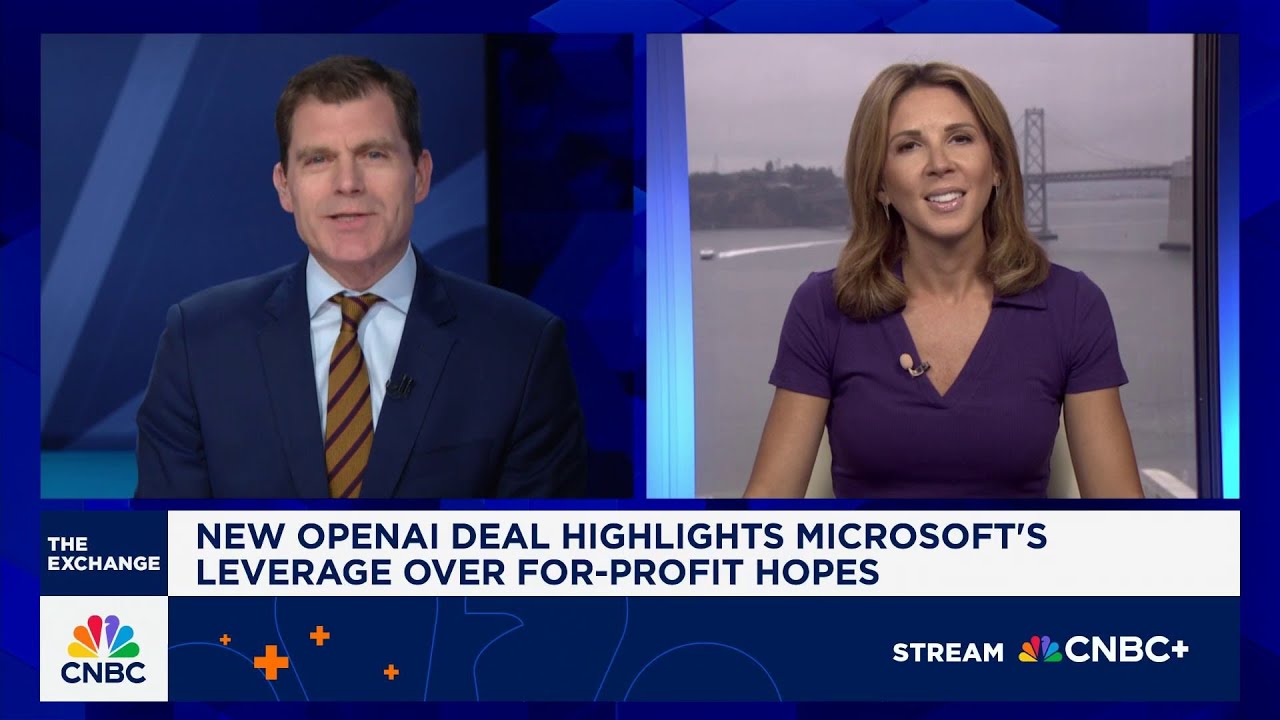
The recent preliminary agreement between OpenAI and Microsoft represents a defining moment in the rapidly accelerating artificial intelligence landscape, effectively clearing a significant hurdle for OpenAI’s long-anticipated shift to a for-profit entity and its eventual public offering. Speaking on CNBC’s "Money Movers," MacKenzie Sigalos provided sharp commentary on the intricate, often tense, dynamics of this deal, underscoring the delicate balance of power and the deep, mutual dependencies between two industry giants.
Sigalos characterized the restructuring as a "big win for OpenAI," a critical maneuver necessary to unlock an estimated $40 billion in crucial funding by year-end and to lay the groundwork for a future IPO. For over a year, Microsoft had been widely perceived as the "main bottleneck" in these complex negotiations, its deep financial and strategic ties to OpenAI forming the nexus of the AI innovator's structural and financial evolution. The newly minted package, a culmination of intense discussions that escalated over the summer, converts Microsoft's substantial investment into a conventional equity stake, while simultaneously dedicating a $100 billion stake to OpenAI’s non-profit arm. This hybrid structure aims to reconcile OpenAI's foundational mission of safe AI development with the commercial imperatives of a burgeoning, capital-intensive industry.

This agreement profoundly highlights a core insight: the strategic destinies of OpenAI and Microsoft are now inextricably linked. Microsoft's flagship cloud platform, Azure, has experienced remarkable growth, boasting a 39% year-over-year increase in its latest fiscal quarter. This surge is largely attributable to the insatiable compute demand generated by OpenAI’s groundbreaking technologies, particularly as enterprise clients integrate advanced AI capabilities. This symbiotic relationship provides Microsoft with an undeniable competitive advantage in the fiercely contested generative AI race, embedding its cloud infrastructure at the very heart of one of the world's leading AI innovators. The strategic value for Microsoft transcends mere financial investment; it solidifies Azure's position as the indispensable cloud provider for cutting-edge AI development, thereby attracting a broader ecosystem of developers and enterprises seeking to leverage OpenAI's powerful models.
However, OpenAI has not been without its own significant leverage in these high-stakes negotiations. During the protracted discussions, OpenAI strategically demonstrated its capacity for diversification, famously striking a reported $300 billion cloud deal with Oracle. This bold move was widely interpreted as a deliberate "snub to Azure," unequivocally signaling OpenAI’s intent to avoid complete reliance on any single cloud provider and to maintain critical optionality in its vast computational infrastructure. This calculated maneuver underscored the intense, global competition for AI workloads, a battle where even dominant players like Microsoft must contend with the strategic independence and evolving needs of their most valuable partners.
Microsoft, in response, has also been proactively exploring its alternatives to mitigate potential risks. Reports indicate the Redmond-based tech giant has been actively testing models from rival AI firm Anthropic and simultaneously investing substantial resources in developing its own proprietary AI models. This dual-track strategy of deepening its alliance with OpenAI while simultaneously cultivating independent capabilities reveals a meticulously cautious approach: securing its immediate position in the AI frontier while prudently hedging against potential future disruptions or increased negotiating leverage from OpenAI. The company's robust internal AI development efforts and its exploration of other foundational models serve as a critical counterweight in its ongoing relationship with OpenAI, ensuring it is not entirely beholden to its high-profile partner.
Ultimately, Microsoft extended the concessions OpenAI sought, leading investors in Silicon Valley to now anticipate "major concessions that were quietly made behind closed doors." These undisclosed terms likely encompass more than just the publicly acknowledged financial restructuring, potentially touching upon crucial aspects such as Azure exclusivity clauses, intellectual property access rights, and the intricacies of revenue-sharing agreements. OpenAI is actively pursuing greater diversification in how its products are distributed, aiming to sell its advanced models through various cloud platforms and to renegotiate existing revenue shares, especially as both Microsoft and OpenAI increasingly find themselves competing directly for lucrative enterprise contracts.
Despite clearing this significant financial and structural hurdle, OpenAI's ambitious path to an IPO remains far from entirely unobstructed. Legal challenges, most notably from co-founder Elon Musk, continue to cast a shadow over its future. Musk, who now spearheads rival AI company xAI, has initiated multiple lawsuits against OpenAI, with one prominent case reportedly slated for a jury trial in the spring. These ongoing legal battles, coupled with persistent scrutiny from State Attorneys General in Delaware and California regarding the unique non-profit-to-for-profit conversion structure, introduce elements of considerable uncertainty. The conversion to a public benefit corporation is a stated prerequisite for its public listing, and the finalization of all commercial agreements and regulatory approvals are expected within the next one to two months. Only after these complex processes are complete will SoftBank financing be unlocked, thereby paving the way for OpenAI to finally embark on its IPO journey. This intricate web of legal, regulatory, and commercial considerations underscores the exceptionally high stakes involved in transforming a pioneering AI research laboratory into what could become a publicly traded, trillion-dollar enterprise.