

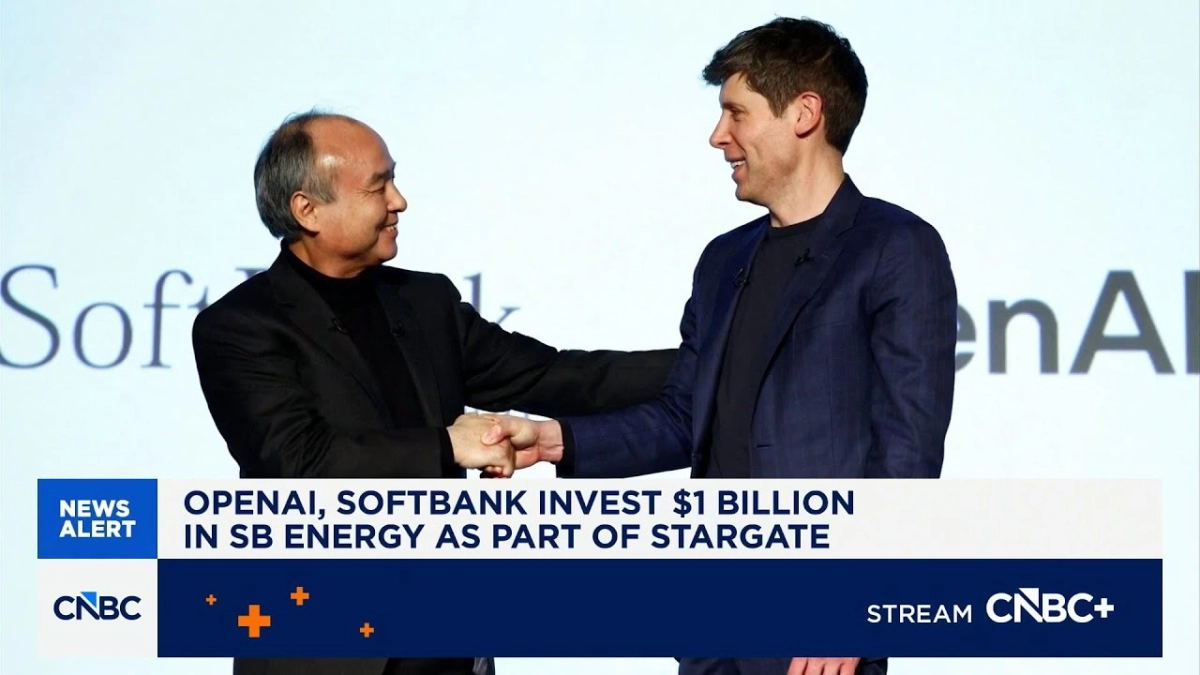
The global race for artificial intelligence dominance is rapidly shifting from a compute battle to an energy infrastructure arms race. This fundamental reality was underscored by the recent announcement that OpenAI and SoftBank are jointly investing $1 billion into SB Energy, a privately held company focused on building out the massive power infrastructure required for the next generation of AI data centers.
CNBC’s Kate Rooney reported on the investment, detailing how the partnership involves a $500 million contribution from each entity. This capital infusion is directly tied to the development of a 1.2 gigawatt data center in Texas specifically for OpenAI. The move is a critical component of what many analysts now see as the core constraint in scaling general AI: securing reliable, immense, and sustainable power sources.
The deal, which builds upon existing relationships between SoftBank, OpenAI, and other partners like Oracle, is part of the larger, highly ambitious Stargate initiative. This multi-phase project, conceptualized by Sam Altman, aims to construct a network of massive AI data centers globally. The sheer scale of the Stargate vision is staggering; SoftBank and its partners are reportedly planning to spend up to $500 billion on AI data centers, a figure that dwarfs most historical infrastructure projects.
This investment is not merely about capital allocation; it represents a strategic pivot toward vertical integration of the energy supply chain. AI companies are recognizing that relying solely on existing grid infrastructure is insufficient to meet the exponential growth in power consumption driven by large language models and advanced training workloads. The power requirements for these advanced systems are measured not in megawatts, but in gigawatts—the scale of small cities.
Rooney noted that the timing of this announcement highlights a broader trend among tech giants. She referenced Meta, which recently announced deals tied to securing over 6 gigawatts of nuclear power capacity. This collective movement by the industry's heaviest hitters—OpenAI, Microsoft, Google, and Meta—to secure dedicated, massive power supplies "really just underlines the all-out energy demand we see from AI."
The challenge is twofold: quantity and sustainability. Training the most advanced AI models demands continuous, high-density power, often 24/7. Simultaneously, the public and regulatory pressure to maintain green energy commitments means that this power must increasingly come from low-carbon sources. SB Energy, which focuses on renewable energy solutions, provides a key pathway for OpenAI to address both concerns, ensuring that the infrastructure supporting Stargate aligns with broader sustainability goals.
For founders and VCs in the startup ecosystem, this development signals a necessary shift in investment focus. The focus is no longer exclusively on better chips or more efficient algorithms; it is now fundamentally about the foundational physics of computation. The bottleneck for AI scaling is power, and the companies that control the electrons will control the future of AI.
The investment confirms that the cost of building foundational AI is rapidly escalating beyond the reach of traditional venture capital. The half-trillion-dollar price tag associated with Stargate positions it as a geopolitical-scale endeavor, requiring the deep pockets and long-term infrastructure vision of players like SoftBank and sovereign wealth-level capital. SoftBank's existing deep relationship with OpenAI, including a reported $41 billion investment, makes it a natural partner for this infrastructure buildout.
SoftBank’s role extends beyond mere financing. They bring expertise in large-scale infrastructure deployment and complex international partnerships, which is essential for realizing the global ambitions of Stargate. This joint venture is a clear example of how the largest AI developers are bypassing traditional cloud providers and power utilities to build bespoke, optimized infrastructure.
The $1 billion funding for SB Energy directly addresses the immediate need for a 1.2 gigawatt data center in Texas. This specific project, while massive, is just the first step in a much larger planned buildout. It establishes a template for how OpenAI intends to secure its power and physical hosting requirements across the globe, leveraging strategic partnerships rather than relying entirely on hyperscalers like Microsoft, despite their substantial existing relationship.
This pivot underscores the increasing maturity of the AI sector. Early competition centered on models and talent; the current phase is defined by the struggle for physical resources—GPUs, data center space, and, most critically, power. The players who solve the energy dilemma first will gain a decisive advantage in the race toward true artificial general intelligence.



