

Octonous Opens Beta for AI Workflow Automation

Octonous AI assistant launches into open beta, offering enhanced workflow automation with expanded integrations and user-chosen AI models.

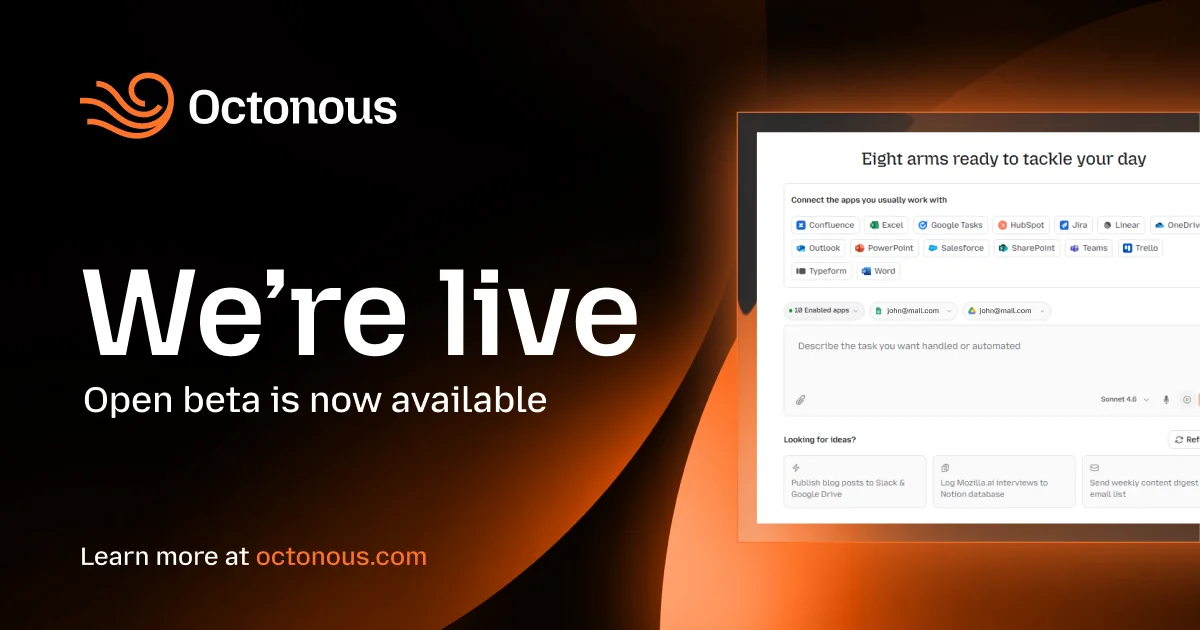
Screenshot of the Octonous AI assistant interface showing connected apps and workflow options.
The Octonous AI assistant aims to streamline workflows across connected applications.· Mozilla Blog

The AI assistant Octonous has officially moved into open beta, making its workflow automation tools available to everyone. The Mozilla Blog announced the move today, detailing lessons learned from its earlier closed beta phase.

Initially, Octonous aimed to reduce busywork across connected applications without adding management overhead. Early testing revealed that the AI's broad capabilities could be overwhelming, making it difficult for users to identify the best starting workflows and establish consistent usage patterns.

Lessons from the Closed Beta

User engagement centered around specific interaction models. The most popular workflows began in chat, allowing users to draft and refine automations through conversation.

Transparency was paramount; users valued seeing every step of an automation's process to build trust.

Approval flows also proved critical, giving users explicit control over when actions were executed.

Key takeaways from user feedback included a desire for greater control over the AI's access and actions, clearer logs, and improved methods for refining automations before deployment.

Related startups

Personalization emerged as another significant theme. Users sought an AI that remembered preferences, adapted to individual work styles, and avoided repetitive context requests.

Teams with specific infrastructure needs also voiced a preference for choosing their AI model provider rather than being tied to a single option.

Improvements Since Closed Beta

Octonous has since incorporated substantial improvements based on this feedback.

Integrations have expanded significantly, now including HubSpot, Notion, Linear, GitHub, Google Workspace, Salesforce, and Typeform, among others.

Automations can now be triggered by a wider array of events, such as new emails, Slack messages, or form submissions, in addition to scheduled runs.

The platform now features a choice-first architecture. Users have fine-grained control over integration access scopes, ensuring Octonous only acts with explicit authorization.

Users can select from major LLM providers like Anthropic, Google Gemini, and OpenAI, or even bring their own custom models.

Human-in-the-loop processes have been refined for speed and clarity. Users can manually edit the content of any write action before Octonous executes it, maintaining control without sacrificing efficiency.

Onboarding has been streamlined with example workflows and suggested starting points to help new users discover their first AI workflow automation quickly.

Octonous now features memory capabilities, allowing it to retain user preferences and work habits over time.

What Open Beta Means

The open beta signifies that Octonous is now universally accessible without a waitlist or invitation.

The developers emphasize that the platform is still evolving and encourage users to provide feedback via the in-app button.

Future Development

Upcoming features will focus on team collaboration, enabling shared and managed automations across workspaces.

The team is also working on adding more integrations and enhancing the AI's ability to handle complex, multi-step workflows.

The overarching goal remains to reduce app juggling and free up user time for more critical tasks.

Users can get started for free at octonous.com and receive 1000 credits upon signup.

© 2026 StartupHub.ai. All rights reserved. Do not enter, scrape, copy, reproduce, or republish this article in whole or in part. Use as input to AI training, fine-tuning, retrieval-augmented generation, or any machine-learning system is prohibited without written license. Substantially-similar derivative works will be pursued to the fullest extent of applicable copyright, database, and computer-misuse laws. See our terms.