

The traditional silos that have long defined high-performance computing (HPC), separate clusters for simulation, distinct environments for data analytics, and often an afterthought for emerging AI workloads, are no longer fit for purpose. As scientific discovery and enterprise innovation increasingly rely on a seamless, iterative dance between predictive models, vast datasets, and machine learning, these architectural divides become bottlenecks. This fundamental challenge is precisely what NVIDIA aims to address with its Vera Rubin architecture, now confirmed as the computational bedrock for two of the world’s most ambitious new supercomputers: Germany’s Blue Lion and the U.S. Department of Energy’s Doudna.
This isn't just another incremental spec bump in the supercomputing arms race. It’s a strategic pivot, signaling NVIDIA’s intent to redefine the very fabric of high-end compute, moving beyond individual accelerators to a holistic platform where AI is not an add-on, but an intrinsic, foundational component. The implications extend far beyond academic research, offering a tantalizing glimpse into the future of enterprise-scale AI and data processing.
The core promise of NVIDIA’s Vera Rubin platform, set to launch in the second half of 2026, is its ability to "collapse simulation, data and AI into a single, high-bandwidth, low-latency engine for science." This isn't marketing fluff; it describes a profound architectural shift. Imagine a system where the output of a complex physical simulation can immediately feed into an AI model for analysis, which then in turn informs the next iteration of the simulation, all without data moving across disparate networks or memory spaces. This is achieved through a combination of shared memory, coherent compute, and in-network acceleration, capabilities that drastically reduce the latency and overhead typically associated with moving massive datasets between different processing units.
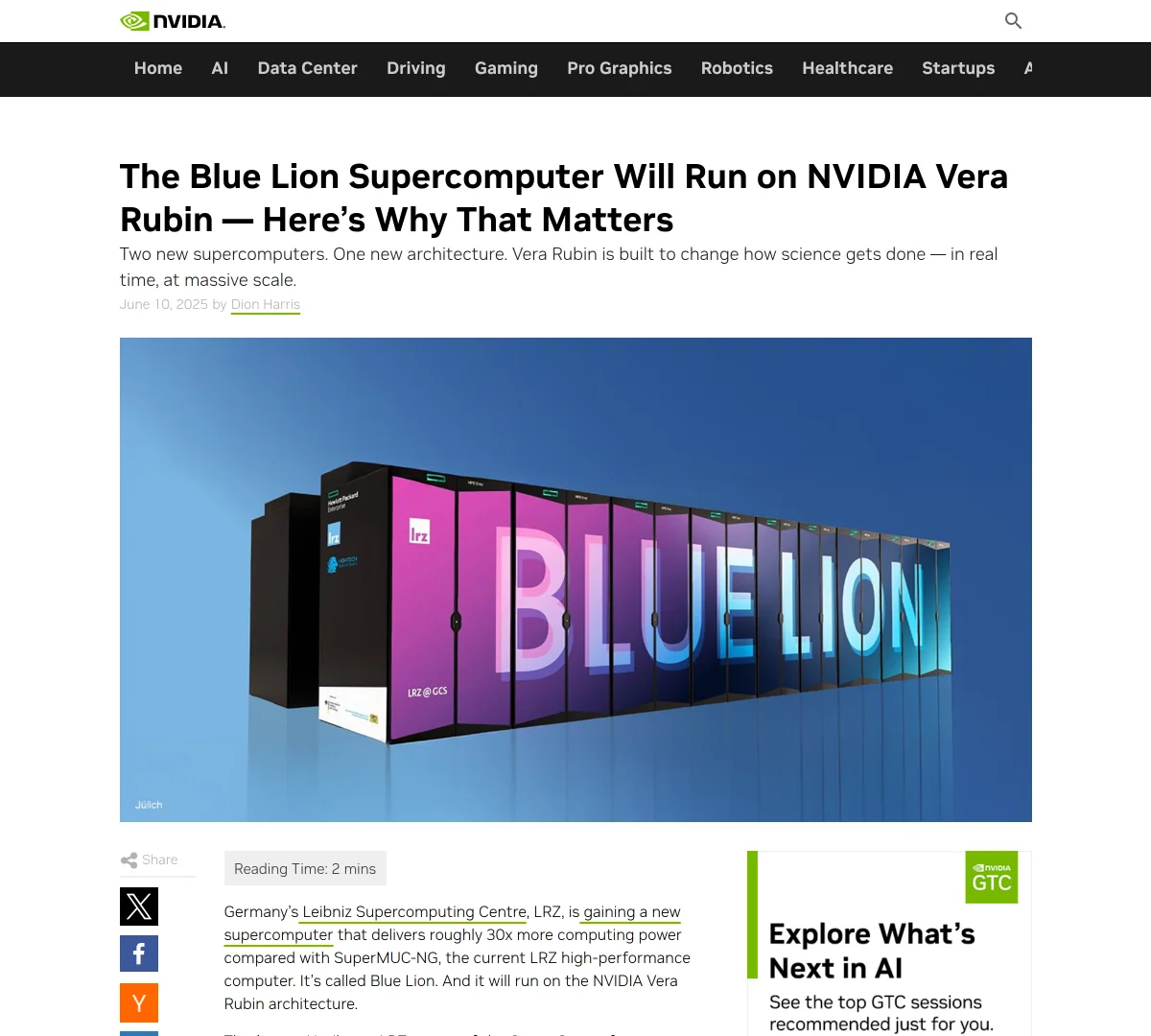
Consider the U.S. Department of Energy’s Doudna supercomputer, built by Dell Technologies and named for Nobel laureate Jennifer Doudna. It's designed for real-time workflows, where data streams directly from sources like telescopes, genome sequencers, and fusion experiments into the system via NVIDIA Quantum-X800 InfiniBand networking. Processing begins instantly, enabling live feedback loops crucial for rapidly advancing fields like fusion energy, materials discovery, and biology. The performance claims are compelling: Doudna is expected to deliver 10x more application performance than its predecessor, while using only 2-3x the power, translating to a remarkable 3-5x improvement in performance per watt. Blue Lion, being built by HPE with next-generation HPE Cray technology, echoes this emphasis on efficiency, featuring 100% fanless direct liquid-cooling systems that even reuse waste heat to warm nearby buildings. These are not just machines; they are statements on sustainable, converged computing.
For enterprises grappling with increasingly complex data landscapes and the imperative to embed AI into core operations, the architectural principles underpinning Vera Rubin are highly instructive. Think about manufacturing: a digital twin of a factory floor could leverage real-time sensor data, run high-fidelity simulations of production processes, and then use AI to optimize throughput or predict equipment failure, all within a unified, low-latency environment. In financial services, this could mean real-time risk assessment models that integrate vast market data streams with complex Monte Carlo simulations and AI-driven anomaly detection, offering instantaneous insights. Drug discovery, logistics optimization, even large-scale climate modeling for business planning, the applications are boundless where massive data, complex simulation, and intelligent AI need to converge. The integration challenge, however, is substantial; such systems demand a rethinking of existing data pipelines and application architectures, requiring specialized skills and a significant upfront investment.