Visual TL;DR
Diffusion ModelsContext
iteratively denoising random noise to generate images or videos
From the article 9+ mentionsThe presentation focused on optimizing diffusion models to reduce their computational demands and improve inference speed, making them more practical for real-time applications.
High Step CountDriver
typically 20-50 steps, leading to high computational demands
From the articleThe primary challenge Ilan addressed is the high number of diffusion steps required by these models.
Nvidia's Ziv IlanCore
researcher presenting optimization strategies for diffusion models
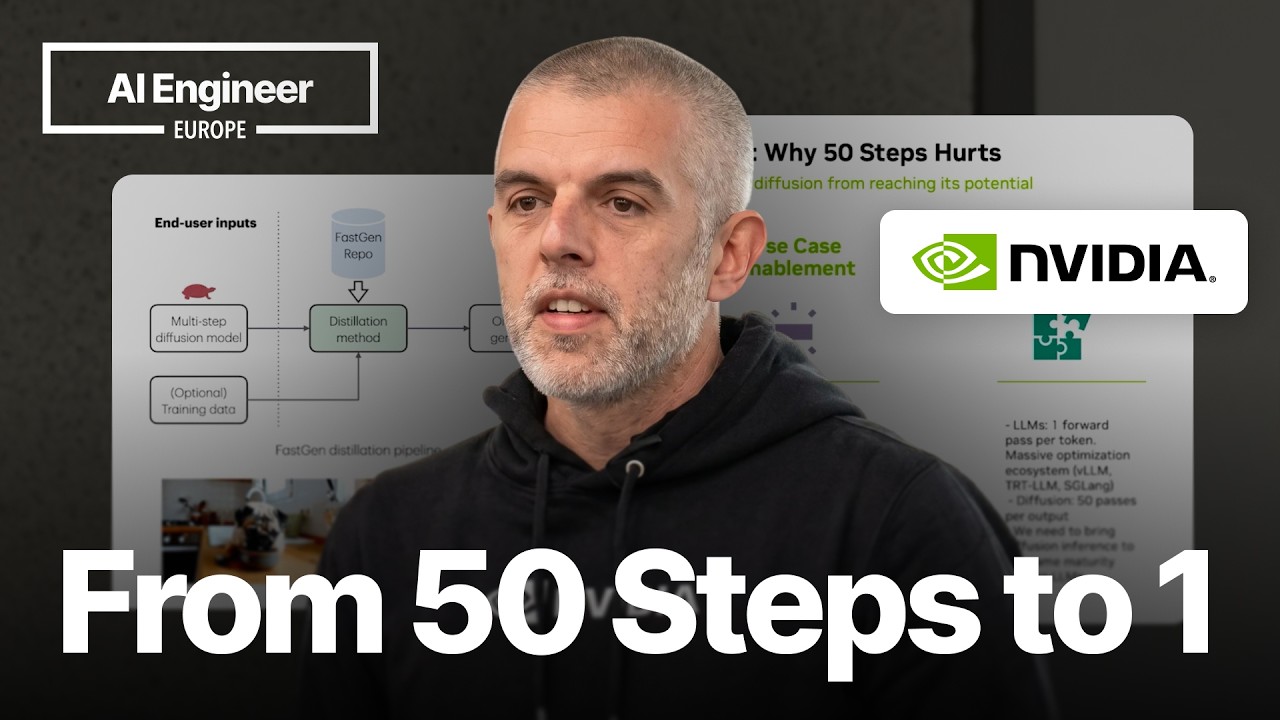
From the articleZiv Ilan, an AI Labs researcher at Nvidia, presented a talk titled "You Might Not Need 50 Diffusion Steps" at AI Engineer Europe.
Optimization StrategiesCore
From the article 3 mentionsTo address these challenges, Ilan discussed three key optimization strategies: quantization, caching, and distillation.
QuantizationCore
making each diffusion step computationally cheaper
From the article 7 mentionsQuantization involves reducing the precision of the model's parameters, leading to faster computations, lower memory usage, and often preserving quality.
CachingCore
skipping redundant computations across diffusion steps
From the article 3 mentionsCaching involves reusing previously computed results when the input has not changed significantly.
DistillationCore
compressing multiple steps into fewer, 1-8 steps
From the article 4 mentionsDistillation involves training a smaller, "student" model to mimic the behavior of a larger, "teacher" model.
FastGen LibraryEffect
new library enabling faster diffusion model inference
From the article 5 mentionsTo facilitate these optimizations, Nvidia has released FastGen, a unified library for all these methods.
Reduced LatencyEffect
faster inference for practical real-time applications
From the articleThe Latency Wall: Generating an image or video with 50 steps can take 30-60 seconds.