

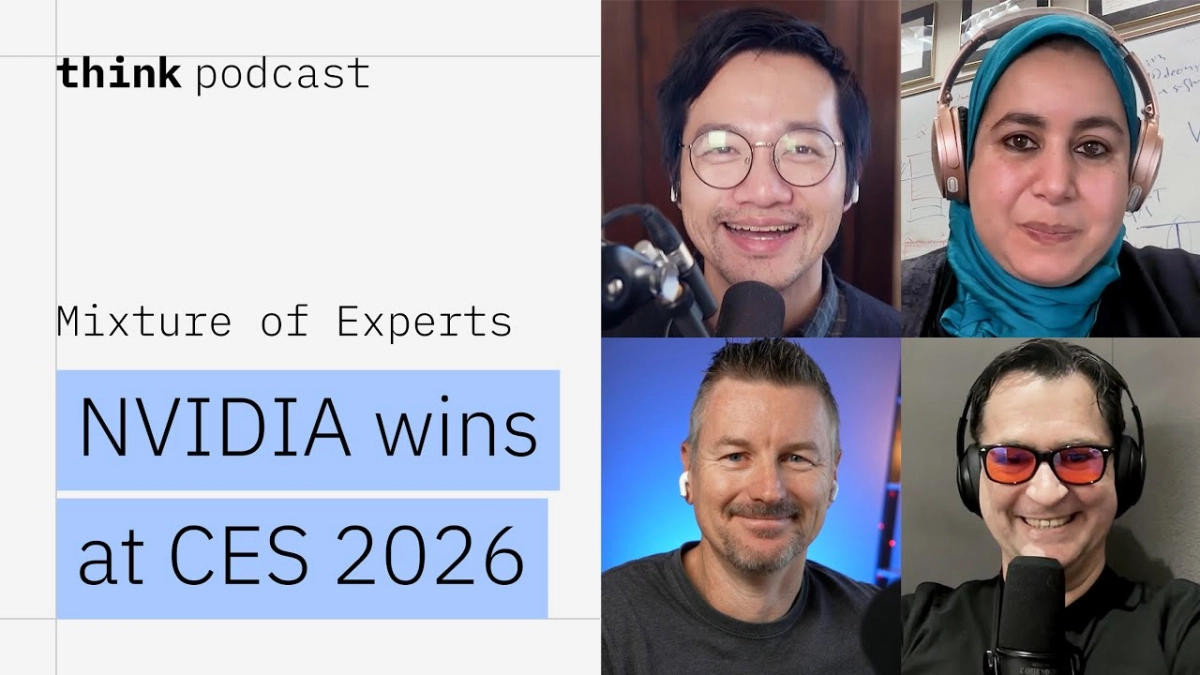
The most significant takeaway from CES 2026 was not merely the speed of innovation, but the strategic inflection point it revealed: the industry’s shift from brute-force scaling to architectural efficiency and agentic platforms. This dynamic was the central theme unpacked by host Tim Hwang, Distinguished Engineer Chris Hay, Principal Research Scientist Kaoutar El Maghraoui, and Master Inventor Martin Keen on the latest episode of Mixture of Experts. The panel dissected major announcements from NVIDIA, Meta’s aggressive acquisition strategy, and the cutting edge of model architecture research, positioning these developments for an audience focused on the commercial and engineering realities of advanced AI.
The conversation kicked off with Jensen Huang’s keynote, revealing the NVIDIA Rubin platform. This new architecture promises a formidable leap over its predecessor, Blackwell, claiming five times the performance and a staggering tenfold reduction in inference token costs. This aggressive move confirms that the GPU giant is keenly aware of the rising competition, particularly from custom silicon like Google’s TPUs and offerings from AMD and Intel. Chris Hay noted that NVIDIA’s intensified focus on inference is a logical strategic response, driven by the realization that while training models garners headlines, inference—the act of running deployed models—is where the real cost optimization battle is fought.
NVIDIA is determined to keep its vast ecosystem locked into its hardware stack. This is a critical defensive maneuver in a market increasingly commoditized by foundational model releases.
However, the hardware story was quickly complicated by the software and services landscape. Meta’s recent $2 billion acquisition of Singapore-based agents lab, Manus AI, signals a major strategic pivot toward agentic platforms. Martin Keen characterized the technology—an autonomous, multi-agent system capable of running complex tasks on its own virtual machine—as simultaneously thrilling and terrifying. “There is nothing more terrifying than watching an AI agent basically do your job,” Keen remarked, emphasizing the immediate productivity implications. Kaoutar El Maghraoui reinforced this view, stating that the acquisition marks a significant shift: “This is marking the shift from conversational chatbots to AI agents that can really perform real work.” Meta is looking past the current conversational AI paradigm, betting that true enterprise value lies in autonomous agents seamlessly executing complex workflows, potentially positioning the acquired technology as a key internal productivity tool before commercializing it for the broader enterprise market.
Beyond corporate strategy, the technical frontier itself is undergoing a fundamental change, shifting away from sheer parameter count toward efficiency. DeepSeek’s recently published paper on Manifold-Constrained Hyperconnections (MHC) illustrates this trend perfectly. This work proposes an improved model architecture that stabilizes training and prioritizes data efficiency over raw computational power. Hay explained that previous models often struggled with training stability due to the "exploding or vanishing problem," where minor errors amplify through layers. The MHC approach solves this by parallelizing data flow and carefully constraining the hyperconnections, making training more stable and less prone to costly failures.
This architectural evolution is crucial because, as Hay pointed out, “The cost of training is absolutely huge… they need to be able to do that as cheap as possible.” DeepSeek’s methodology allows smaller labs and companies access to frontier model capabilities without the necessity of multi-billion dollar GPU clusters. El Maghraoui framed this as a necessary evolution for scaling: the future is “architectural and system-level, not just purely mathematical,” ensuring better computational utilization and fewer wasted training steps. This systemic focus on co-designing hardware and software for efficiency challenges the prevailing narrative that only the largest organizations can afford to build next-generation models.
Finally, the discussion turned to public perception, examining polling data that revealed a complex relationship Americans have with AI. While a majority remain optimistic about the benefits of AI, a significant portion is deeply concerned about who controls the technology. The public sentiment reflects a sophisticated understanding of the economic contract surrounding AI—that productivity gains without shared ownership or control could lead to societal instability. El Maghraoui concluded that the public is elevating the discussion beyond mere fear of automation, asking foundational questions about control: “If AI replaces human labor... am I still going to have control or not?” This suggests that future regulatory and public discourse will center not just on safety, but on equitable distribution of AI-driven productivity gains. The underlying tension between innovation and control remains a defining characteristic of the current technology cycle.



