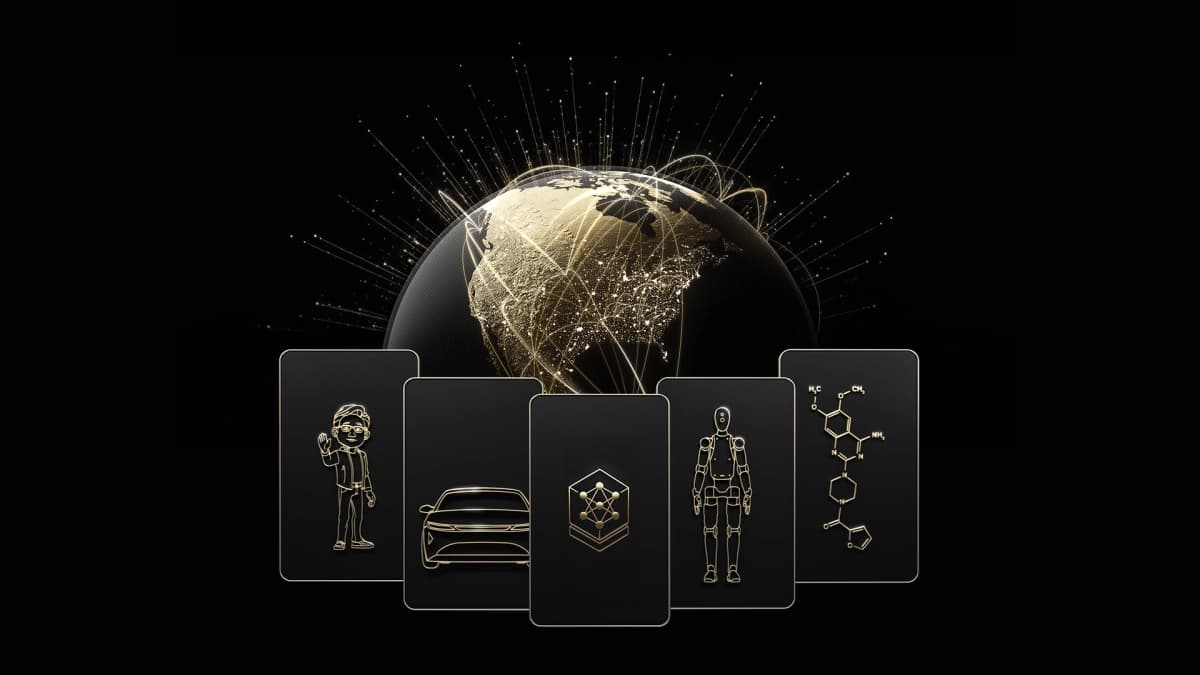
NVIDIA is significantly expanding its open-source AI contributions, releasing a suite of new open models and data across language, robotics, and biology. This strategic move aims to democratize access to advanced AI capabilities, fostering innovation and strengthening the broader AI ecosystem. According to the announcement, these contributions underscore NVIDIA's deep commitment to open source, empowering developers and accelerating economic growth through efficient reasoning and interactive physical AI systems.
The core of this release includes the NVIDIA Nemotron family, designed for ultra-efficient reasoning in specialized AI agents. Nemotron Nano 3, utilizing a hybrid mixture-of-experts architecture, enhances reasoning throughput for critical areas like software development and customer service. Nemotron Nano 2 VL provides robust document intelligence and multimodal analysis, while Nemotron Safety Guard introduces culturally aware moderation across multiple languages. These NVIDIA open models, alongside new Nemotron datasets and NeMo tools, equip developers with powerful resources for building sophisticated, agentic AI.
Leading software and services companies are already leveraging NVIDIA Nemotron to transform their platforms. ServiceNow, for instance, introduced its Apriel 2.0 multimodal reasoning model, built on Nemotron, to power cross-enterprise workflows in regulated sectors. Palantir, Cadence, CrowdStrike, PayPal, Zoom, and Synopsys are also integrating Nemotron to accelerate chip design, enhance cybersecurity, boost AI service throughput, and develop customized agentic capabilities. This widespread adoption signals a clear industry shift towards open, adaptable AI models for enterprise transformation.
Expanding AI's Reach: Physical AI, Robotics, and Healthcare
Beyond language, NVIDIA's open models now extend to physical AI and robotics with major updates to Cosmos and Isaac GR00T. Cosmos Predict 2.5 unifies models for rapid world simulation, generating 30-second videos from a single frame, while Cosmos Transfer 2.5 produces high-quality, photorealistic data more efficiently. Isaac GR00T N1.6 enhances reasoning and whole-body control for humanoid robots, supported by the world's largest open-source dataset for physical AI. Companies like Agility Robotics, Amazon Robotics, and Figure AI are adopting these NVIDIA open models to teach robots new behaviors and deploy real-world AI agents at scale.
In healthcare and life sciences, new NVIDIA Clara open models are accelerating scientific discovery. Clara CodonFM learns RNA rules to improve therapy design, with NVIDIA contributing these models to the Chan Zuckerberg Initiative’s virtual cells platform. Clara La-Proteina creates complex 3D protein structures, enabling better medicine and material design, and Clara Reason advances explainable AI in medical imaging. These specialized NVIDIA open models provide critical tools for researchers and developers in high-stakes fields.
NVIDIA's comprehensive release of open models and data solidifies its position as a foundational enabler of AI innovation, moving beyond hardware to shape the software layer. By making these advanced tools accessible on platforms like Hugging Face and various cloud providers, NVIDIA is not just contributing to open source; it is actively democratizing cutting-edge AI. This strategy ensures broader participation in AI development, fostering a more transparent, responsible, and rapidly evolving technological landscape.