

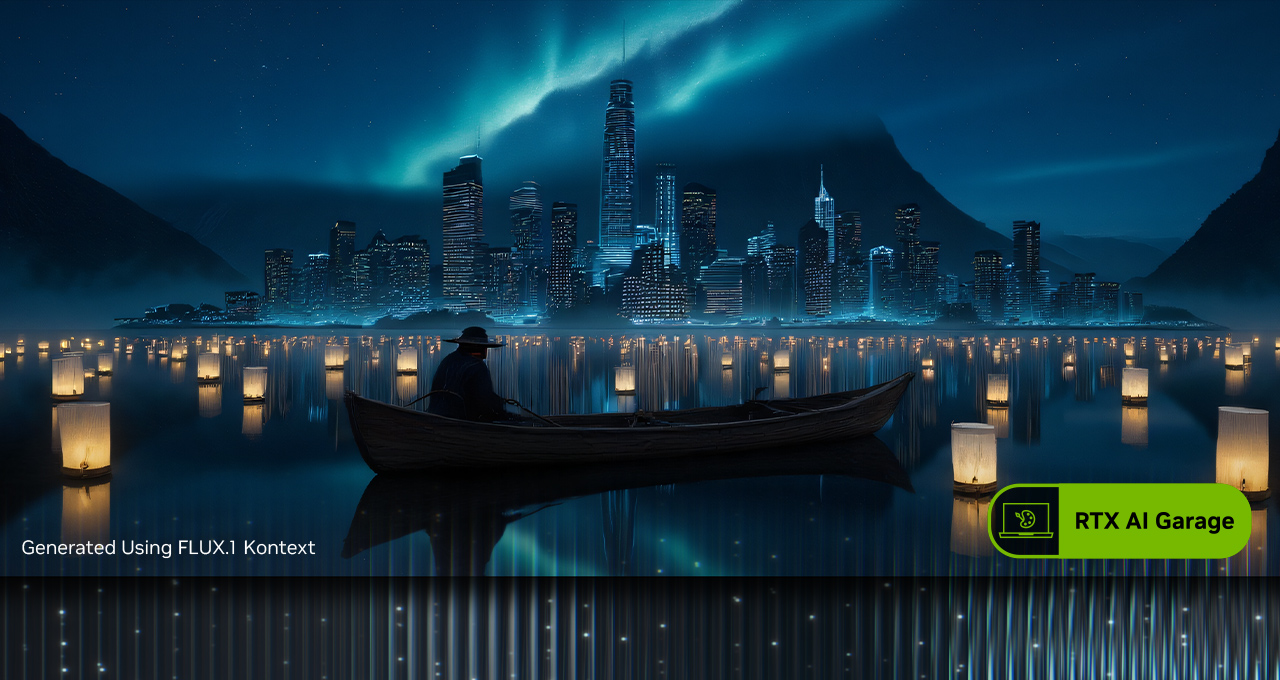
Black Forest Labs’ FLUX.1 Kontext [dev] image editing model is now available as an NVIDIA NIM microservice, marking a significant step towards democratizing advanced generative AI.
This integration simplifies the deployment and use of a powerful AI model that allows users to edit existing images with simple language prompts, eliminating the need for complex fine-tuning or intricate workflows. The move makes sophisticated AI image manipulation more accessible to a broader audience, particularly those with NVIDIA RTX-powered PCs.
Traditionally, deploying powerful AI models has been a complex endeavor, requiring specialized knowledge in model curation, data management, and optimization techniques like quantization to reduce memory footprint. In a recent announcement on its blog, NVIDIA detailed how the FLUX.1 Kontext [dev] NIM microservice streamlines this entire process. It provides prepackaged, optimized files that are ready for one-click download through ComfyUI NIM nodes, making advanced AI workflows significantly more user-friendly.
FLUX.1 Kontext [dev] is an open-weight generative model specifically designed for image editing. Its core strength lies in its guided, step-by-step generation process, which offers users precise control over how an image evolves. Whether refining minute details or transforming an entire scene, the model allows for intuitive adjustments. By accepting both text and image inputs, users can reference visual concepts directly, ensuring coherent and high-quality edits that maintain the integrity of the original idea.
The collaboration between NVIDIA and Black Forest Labs has yielded impressive technical optimizations. They worked together to quantize FLUX.1 Kontext [dev], dramatically reducing its memory requirements. The original 24GB model has been shrunk to 12GB for FP8 precision, optimized for NVIDIA Ada Generation GPUs like the GeForce RTX 40 Series, which leverage FP8 accelerators in their Tensor Cores. Further optimization for NVIDIA Blackwell architecture, including the upcoming GeForce RTX 50 Series, brings the model down to a mere 7GB using a new method called SVDQuant, which remarkably preserves image quality.