

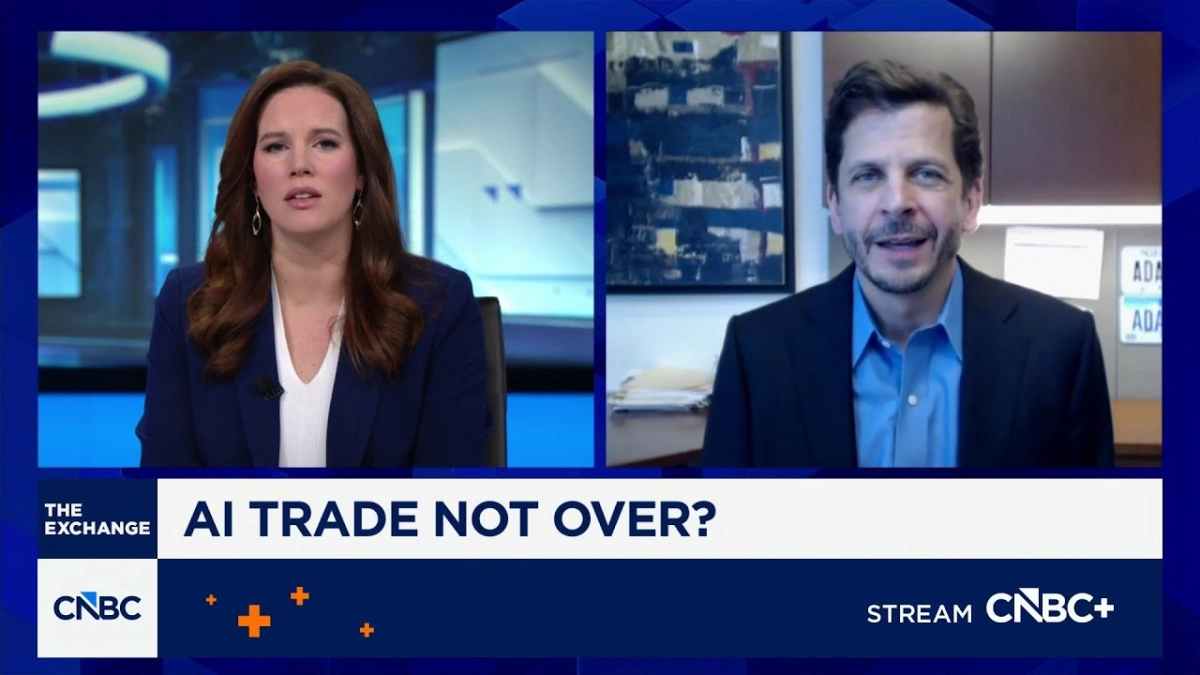
The consensus among top growth investors suggests that while the burgeoning artificial intelligence trade is expanding to encompass a wider array of players, Nvidia remains the undisputed sovereign of the enabling hardware stack. This was the central thesis delivered by Michael Sansoterra, Chief Investment Officer at Silvant Capital, during an interview on CNBC’s The Exchange, where he analyzed the early movements in the semiconductor and software sectors shaping the 2024 technology landscape. Sansoterra spoke with the CNBC team, discussing market reactions to recent announcements from CES and reaffirming his conviction in Nvidia and other strategically positioned hyperscalers like Alphabet.
Sansoterra acknowledged that the high expectations surrounding Nvidia meant that its recent commentary regarding sustained demand was "somewhat expected," preventing the stock from seeing immediate, explosive surges. Crucially, however, the underlying fundamentals of its technological dominance remain intact. Nvidia continues to solidify its moat by consistently delivering faster, more efficient chips, exemplified by the upcoming Vera Rubin architecture. The market is buzzing about the prospects of this next-generation architecture, which is slated to ship sooner than anticipated.
The competitive edge is not merely measured in raw speed, but in efficiency metrics essential for large-scale AI deployment. Sansoterra highlighted the dramatic cost improvements Nvidia is delivering, noting they are talking about "10 times cost savings per token per watt." This massive leap in efficiency translates directly into lower operational costs for hyperscalers and enterprises training and running large language models, locking customers deeper into the Nvidia ecosystem regardless of the high sticker price of the hardware.
While competitors such as Advanced Micro Devices (AMD) are actively pushing their own competitive chipsets, and the emergence of custom silicon (ASICs) and Google’s Tensor Processing Units (TPUs) threatens to chip away at market share, Silvant Capital views the overall market expansion as beneficial for a select group of leaders. The rising tide of AI demand is lifting all semiconductor boats, but the market is clearly differentiating between the foundational leaders and the fast followers. Michael Sansoterra affirmed that Nvidia remains "clearly the leader, no question."
The CIO emphasized that the investment strategy at Silvant is focused on capturing value across the entire AI stack, not just the hardware layer. This necessitates holding positions in companies driving the software innovation and model development. Alphabet, with its strong position in search and the rapid advancement of its Gemini models, is viewed as a critical component. Sansoterra noted that these models "tend to leapfrog one another," indicating that the current race for AI model supremacy is dynamic and requires investors to hold positions in firms demonstrating true technological superiority, even if their valuations appear high. He stressed that "Our goal is to have a little bit of all of the winners," recognizing that the scale of the AI revolution is too large for a single company to capture all value.
The conversation naturally expanded to the memory sector, which is experiencing extreme volatility and massive price hikes driven by the insatiable demand for high-bandwidth memory (HBM) required by AI accelerators. Reports of server DRAM prices increasing by 60 to 70 percent in the first quarter alone underscore the severity of the supply shortages. Rather than chasing the volatile memory producers directly, Silvant Capital adopts a more structural approach by focusing on the core equipment providers.
ASML Holding, the exclusive supplier of Extreme Ultraviolet (EUV) lithography machines essential for manufacturing cutting-edge chips, is deemed the superior play. Sansoterra described ASML as "the litho king," emphasizing that the company is perfectly positioned to profit from the necessary capacity expansion across the entire semiconductor industry. The massive capital expenditures required by memory makers and foundries to increase production through 2026 and 2028 directly benefit ASML, which provides the critical tools regardless of which specific chip or memory provider wins the market share battle. This approach allows the firm to gain exposure to the foundational growth of the AI hardware buildout while mitigating the cyclical risks inherent in commodity memory pricing. The current environment, marked by sequential acceleration in semiconductor and memory performance across quarters, validates this strategy of investing in the indispensable infrastructure providers that underpin the entire ecosystem.



