

The viability of large language models in production hinges not merely on their accuracy in development but on the intricate economics of their operation. This was the central tenet illuminated by Kyle Kranen of NVIDIA in a recent session, where he unveiled NVIDIA Dynamo, a distributed inference framework engineered to fundamentally alter the cost-performance landscape for AI applications. Kranen’s presentation focused on the critical challenge of moving LLMs from successful evaluations to scalable, real-world deployment, a transition he aptly described as stepping into a "minefield."
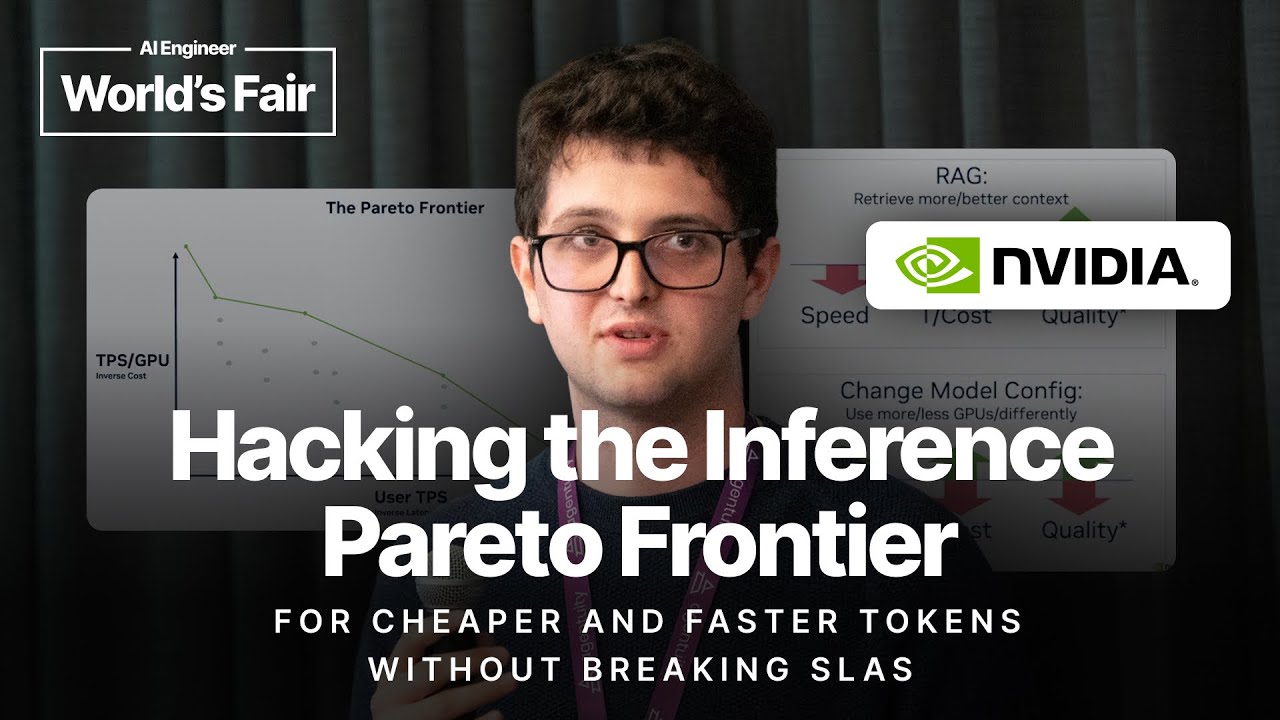
For many AI professionals, the true hurdle emerges post-training: inference. It’s a delicate balance where insufficient latency leads to "choppy experience" and user churn, high costs erode profitability, and compromised output quality renders systems unusable. Kranen articulated this multifaceted challenge as the "Pareto frontier," a curve representing the optimal trade-offs between cost, throughput, latency, and quality. Operating "outside of the Pareto frontier? You’re back to square one," he emphasized, underscoring the existential threat these constraints pose to LLM system adoption.
NVIDIA Dynamo is designed precisely to address this bottleneck, offering a suite of bleeding-edge techniques aimed at "hacking the Pareto frontier." One core innovation is disaggregation, which involves "separating phases of LLM generation to make them more efficient." This architectural shift allows for specialized optimization of distinct components, enhancing overall system throughput and reducing latency. Another key technique is speculation, enabling the system to predict and process "multiple tokens per cycle," a significant leap in efficiency for sequential token generation.
Beyond these, Dynamo leverages advanced KV routing, storage, and manipulation to ensure that the system "don’t redo work that has already been done," minimizing redundant computations and optimizing memory usage. Pipelining improvements for agents further accelerate workflows by incorporating contextual information about the agent’s task. These technical advancements are not incremental tweaks; they represent a concerted effort to fundamentally reshape the underlying economics of LLM inference.
The implications for founders and VCs are profound. A model's theoretical prowess means little if its operational costs prohibit scale or its performance lags user expectations. Dynamo provides a pathway to unlock new applications previously deemed too expensive or too slow. It offers a tangible mechanism to shift the balance, making more ambitious LLM deployments financially and technically feasible.