

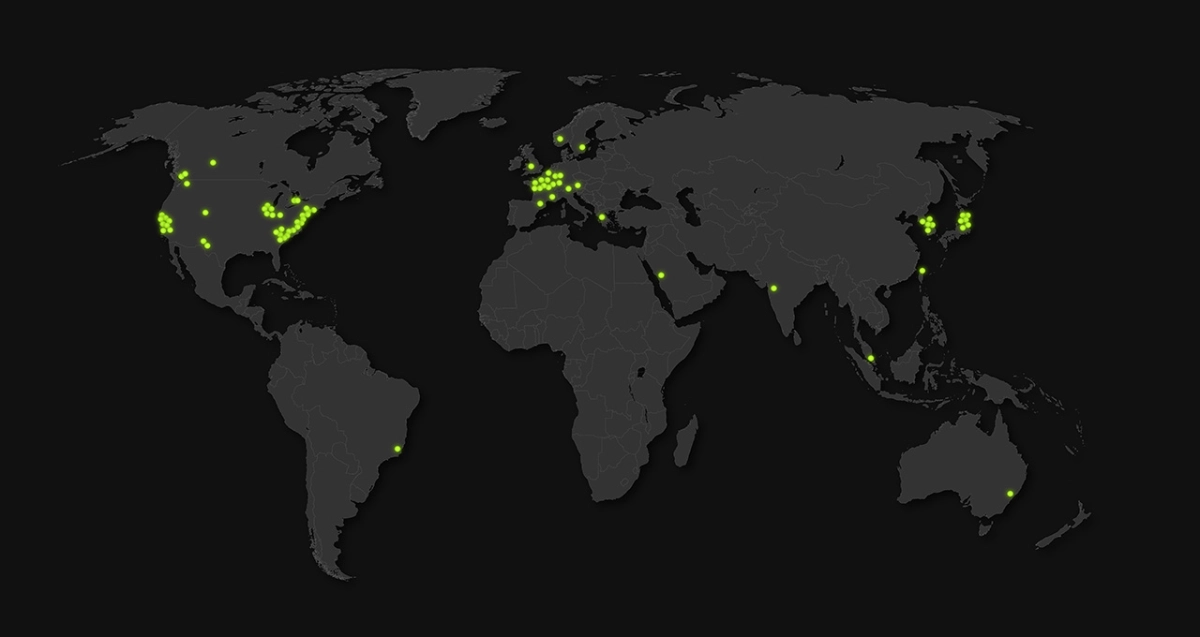
NVIDIA’s recent SC25 announcement signals a massive global acceleration in scientific research, driven by its AI supercomputing platform. Over 80 new systems, contributing 4,500 exaflops of AI performance, underscore a critical shift in how nations and institutions approach discovery. According to the announcement this isn't merely about raw compute; it's about democratizing access to unprecedented capabilities for tackling humanity's most complex challenges.
The United States is significantly bolstering its research infrastructure with a wave of new NVIDIA AI supercomputers. America’s largest academic system, the 300-petaflop Horizon at the Texas Advanced Computing Center (TACC), set to launch in 2026, will leverage NVIDIA GB200 NVL4 and Vera CPU servers to accelerate breakthroughs in disease mechanics, astrophysics, and seismic modeling. Concurrently, the Department of Energy is deploying seven new AI supercomputers across Argonne and Los Alamos National Laboratories, including Argonne’s Solstice, which promises an unprecedented 1,000 exaflops of AI training compute with 100,000 Blackwell GPUs. These national investments, from open science initiatives like LANL’s Vision to specialized projects like Lawrence Berkeley’s Doudna for fusion energy, underscore a strategic national imperative to lead in AI-driven scientific discovery. The sheer scale of these deployments signals a fundamental re-tooling of US research capabilities, positioning the nation at the forefront of global scientific innovation.
Across the Atlantic, Europe is rapidly establishing its own formidable AI supercomputing capabilities, with Germany’s Jülich Supercomputing Centre’s JUPITER system leading the charge as the continent’s first exascale computer. JUPITER, featuring 24,000 NVIDIA GH200 Grace Hopper Superchips, has already achieved over 1 exaflop on the HPL benchmark, enabling critical high-resolution global climate simulations. This exascale performance is a game-changer for European researchers, allowing them to tackle complex AI models and simulations across diverse scientific disciplines with unprecedented detail. Further investments, such as Germany’s Blue Lion, Denmark’s Gefion, and the UK’s Isambard-AI, highlight a concerted effort to build sovereign AI capacity and drive specialized research in areas from quantum computing to multimodal foundation models for healthcare. These systems are not merely computational assets; they are strategic national infrastructure designed to secure Europe's competitive edge in the global AI landscape.
Global Expansion of NVIDIA AI Supercomputers
Asia is equally aggressive in its adoption of NVIDIA AI supercomputers, demonstrating a clear commitment to sovereign AI and advanced scientific research. Japan’s RIKEN is integrating NVIDIA Blackwell into new systems for AI for science and quantum computing, while also codesigning FugakuNEXT for earth systems modeling and drug discovery. South Korea’s ambitious plan to deploy over 50,000 NVIDIA GPUs across sovereign clouds and AI factories, complemented by private sector initiatives from Samsung and Hyundai, illustrates a comprehensive national strategy to embed AI across its economy. Taiwan’s partnership with Foxconn to build a 10,000 Blackwell GPU AI factory further solidifies the region's intent to become a global AI powerhouse, fostering innovation across industries and research institutions. This regional surge in AI infrastructure investment reflects a deep understanding of AI's transformative potential for economic growth and scientific leadership.
NVIDIA's pervasive influence in this global supercomputing build-out stems from its comprehensive, full-stack accelerated computing platform. Beyond just powerful GPUs, the company delivers a unified architecture encompassing CPUs, DPUs, NICs, and high-speed InfiniBand networking, all optimized by CUDA-X libraries and NVIDIA AI Enterprise software. This integrated ecosystem simplifies the deployment and maximizes the efficiency of complex scientific workloads, allowing researchers to focus on discovery rather than infrastructure challenges. The platform's versatility is evident in its application across molecular dynamics, large language models, digital twins, and quantum computing research, showcasing its foundational role in modern scientific inquiry. This holistic approach is critical for scaling AI to exaflop levels and sustaining the pace of innovation required for cutting-edge research.