

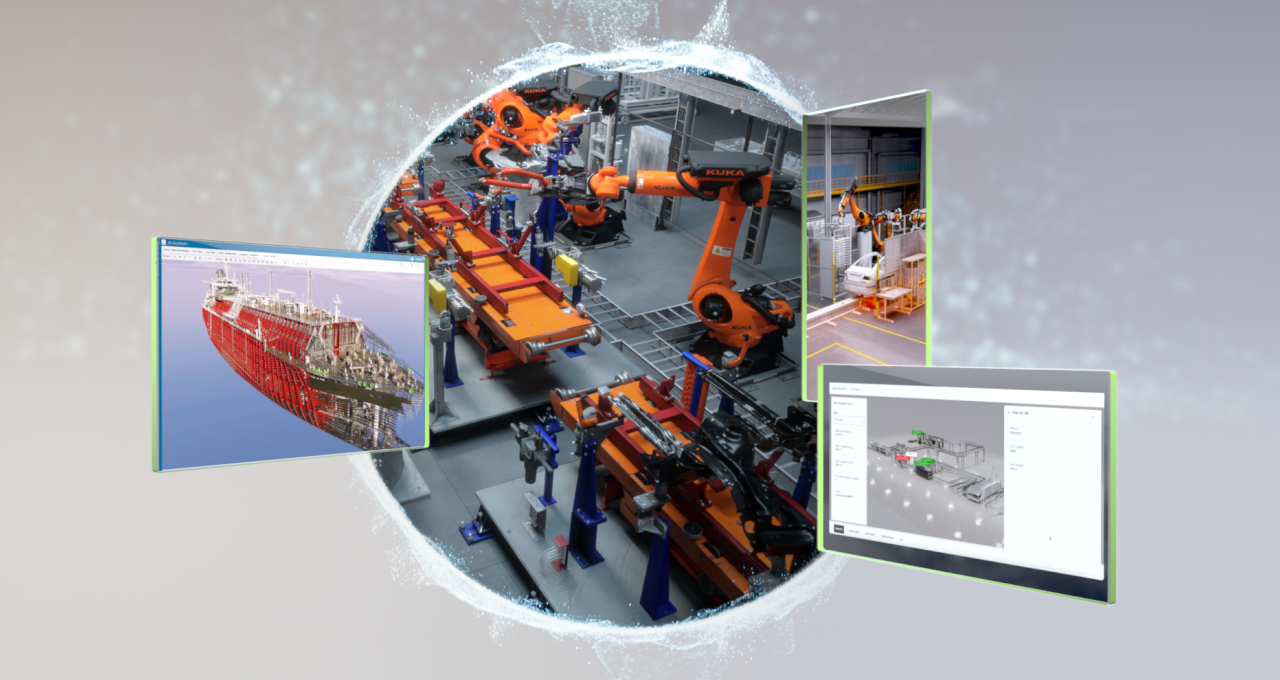
NVIDIA has unveiled a suite of advancements aimed at accelerating the development and deployment of industrial and physical AI, primarily through the expansion of its OpenUSD and Omniverse platforms. In a recent blog post detailing its SIGGRAPH announcements, the company highlighted how these technologies are driving the creation of sophisticated digital twins, which are becoming critical for training AI agents, autonomous systems, and robot fleets.
The core premise is that physically accurate virtual replicas of real-world environments, facilities, and processes are essential not just for optimizing operations but also for safely and efficiently training AI. Historically, building these high-fidelity simulation environments required significant manual effort. NVIDIA's latest push leverages OpenUSD, an open standard for describing and connecting complex 3D worlds, alongside improvements in rendering, neural reconstruction, and world foundation models (WFMs) to streamline this process.
NVIDIA's SIGGRAPH announcements included new research, expanded Omniverse libraries, Cosmos WFMs, and robust AI infrastructure like NVIDIA RTX PRO Servers and NVIDIA DGX Cloud. Key software development kits (SDKs) now bridge MuJoCo and OpenUSD, opening up robot simulation capabilities to over 250,000 MJCF robot learning developers. The new Omniverse NuRec libraries and AI models introduce RTX ray-traced 3D Gaussian splatting, enabling developers to capture, reconstruct, and simulate real-world environments in 3D using sensor data.
Further enhancing robotics development, NVIDIA Isaac Sim 5.0 and Isaac Lab 2.2, both open-source robot simulation and learning frameworks, are now available on GitHub. Isaac Sim integrates NuRec neural rendering and new OpenUSD robot and sensor schemas, significantly narrowing the gap between simulation and real-world performance. For synthetic data generation and reasoning in physical AI, Cosmos WFMs, including Cosmos Transfer-2 and NVIDIA Cosmos Reason, deliver substantial improvements.
Real-World Impact and Ecosystem Growth
OpenUSD is rapidly solidifying its position as a foundational ecosystem for digital twin and physical AI development, enabling seamless integration of industrial and 3D data. The Alliance for OpenUSD (AOUSD) continues to grow, recently welcoming new general members such as Accenture, Esri, HCLTech, PTC, Renault, and Tech Soft 3D. This expansion underscores the industry's commitment to unifying 3D workflows. To support this demand for expertise, NVIDIA has also launched an industry-recognized OpenUSD development certification and a free digital twins learning path.