

Neoclouds: AI's New Infrastructure Play

Neoclouds, born from crypto mining, are repurposing infrastructure for AI compute, driving rapid growth but facing profitability hurdles.

Diagram showing interconnected servers and GPUs in a data center, representing AI infrastructure.
a16z Blog
Visual TL;DR
AI Compute Gold RushDriver
insatiable demand for AI training and inference driving rapid growth
Crypto Infrastructure PivotCore
From the article 2 mentionsThese companies, once focused on energy-intensive crypto mining, are now repurposing their substantial compute power, GPU farms, and data center infrastructure to meet the insatiable demand for AI training and inference.
Neoclouds EmergeCore
new class of players like CoreWeave, Nebius, Applied Digital leading this trend
From the article 5 mentionsThe infrastructure powering the artificial intelligence revolution is rapidly evolving, and a new class of players, dubbed "neoclouds," are emerging from the ashes of the cryptocurrency boom.
Rapid Revenue GrowthEffect
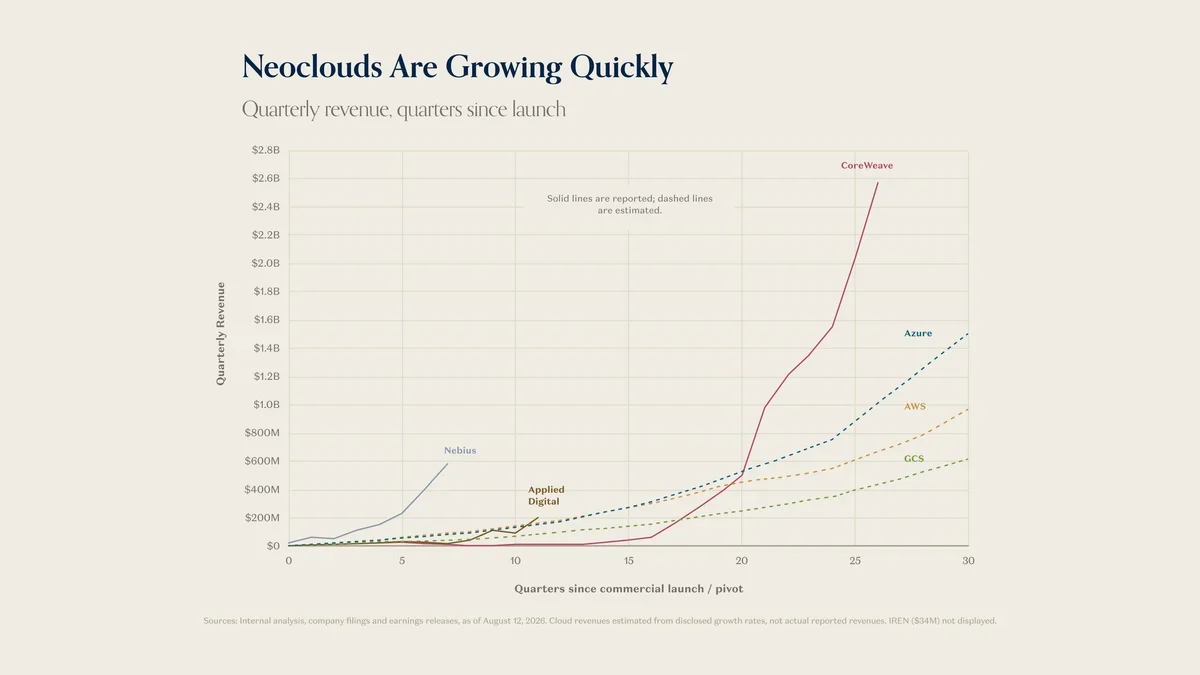
astonishing revenue growth outperforming early trajectories of established cloud providers
From the article 3 mentionsHowever, this rapid growth is not without its challenges.
Talent WarsDriver
intense competition for skilled AI engineers and researchers in labs
From the article 4 mentionsBeyond infrastructure, the fierce competition for talent continues.
New AI InfrastructureOutcome
neoclouds becoming critical infrastructure for the evolving AI revolution
From the article 5 mentionsThis pivot mirrors historical shifts where existing infrastructure, like railroad rights-of-way or gas pipelines, was adapted for new communication technologies, as detailed in analysis from a16z Blog.
Profitability HurdlesDriver
despite growth, neoclouds face challenges in achieving sustainable profitability
From the article 2 mentionsWhile neoclouds are experiencing impressive revenue expansion, the path to sustained profitability remains a key question.
Contents(4)

The infrastructure powering the artificial intelligence revolution is rapidly evolving, and a new class of players, dubbed "neoclouds," are emerging from the ashes of the cryptocurrency boom. These companies, once focused on energy-intensive crypto mining, are now repurposing their substantial compute power, GPU farms, and data center infrastructure to meet the insatiable demand for AI training and inference. This pivot mirrors historical shifts where existing infrastructure, like railroad rights-of-way or gas pipelines, was adapted for new communication technologies, as detailed in analysis from a16z Blog.

Companies like CoreWeave, Nebius, and Applied Digital are at the forefront of this trend. They possess the critical elements for AI compute: access to significant power, specialized hardware like GPUs, and the operational expertise to manage large-scale computational demands. This has led to astonishing revenue growth, outperforming even the early trajectories of established cloud giants like Amazon Web Services (AWS). For instance, CoreWeave achieved $2.6 billion in revenue in approximately 25 quarters, a pace faster than AWS in its early stages.

The AI Compute Gold Rush

The AI boom has dramatically repriced compute capacity. What was once a niche market for cryptocurrency miners has become a strategic necessity for AI developers and enterprises. Neoclouds offer a compelling alternative to hyperscale cloud providers, often providing more specialized or cost-effective solutions for specific AI workloads. StartupHub.ai data indicates the competitive intensity in this space: Coreweave holds a StartupHub score of 67/100, while competitors like Nebius score higher at 85/100, and Applied Digital at 70/100.

However, this rapid growth is not without its challenges. The capital expenditure required to build and maintain these GPU-heavy data centers is immense. CoreWeave, for example, shows substantial capital expenditures alongside its revenue growth. Costs associated with chip depreciation and rising interest expenses on debt used for buildouts add further financial pressure. This capital intensity makes traditional sales multiples a less reliable valuation metric for these businesses.

Profitability: The Next Frontier

While neoclouds are experiencing impressive revenue expansion, the path to sustained profitability remains a key question. The high cost of acquiring and maintaining cutting-edge GPUs, coupled with significant energy consumption, means that operational efficiency and strategic cost management are paramount. Investors are keenly watching how these companies navigate the balance between aggressive expansion and long-term financial health. The market's reaction has been mixed; despite strong growth, Coreweave's stock performance has seen a decline over the past year, suggesting that much of the growth may already be priced in by the market.

The demand for AI compute is not monolithic. Companies are increasingly looking for optimized solutions, leading to sophisticated "token-maxxing" strategies. Platforms like Databricks are developing smart routers that direct tasks to the most appropriate models, reducing average task costs by over 30%. This pursuit of efficiency across a spectrum of models, from high-end to less powerful ones, expands the overall addressable market for AI services. As cheaper open-source models gain traction, the cost intensity of token spend declines, even as overall consumption rises.

Talent Wars in AI Labs

Beyond infrastructure, the fierce competition for talent continues. Leading AI labs are drawing heavily from established tech giants and other AI firms. Data suggests that leading AI companies are willing to offer significant compensation to attract top engineering talent. For instance, Anthropic engineers receive substantially higher compensation compared to their counterparts at companies like Google and Tesla, indicating a premium placed on specialized AI expertise.

The talent pool shows distinct hiring patterns. While both OpenAI and Anthropic recruit from major tech players, their sourcing differs. Anthropic draws more from SaaS companies, whereas OpenAI has a broader intake from consumer tech, marketplace, and ad-tech sectors. This competition for skilled personnel is a critical factor in the pace of AI development and deployment across the industry.

Why This Matters

The rise of neoclouds signifies a maturing AI market where specialized infrastructure providers are becoming indispensable. They offer a vital counterpoint to the dominance of hyperscalers, fostering competition and potentially driving down costs for AI development. For startups, this means more accessible and tailored compute options. For established enterprises, it provides flexibility and alternatives for scaling their AI initiatives. The ongoing battle for talent also highlights the human capital as a key bottleneck and driver of innovation. The success of these neoclouds will depend on their ability to manage their capital-intensive operations while demonstrating a clear path to profitability in a rapidly growing, yet demanding, market.

© 2026 StartupHub.ai. All rights reserved. You may not republish this article in full without a license. Search engines and AI research tools may crawl and summarize for reference. Bulk reproduction or model training requires a license. See our terms.
Daniel Singer

Written by

Daniel Singer

Editor, StartupHub.ai

Daniel Singer is the editor of StartupHub.ai, a technology expert and thought leader on AI and its applications across sectors, from fintech and healthcare to developer tooling and consumer software. He writes and tests the tools covered here thoroughly and regularly, and built StartupHub.ai to give founders, operators and buyers a clearer read on what they are actually being sold.