

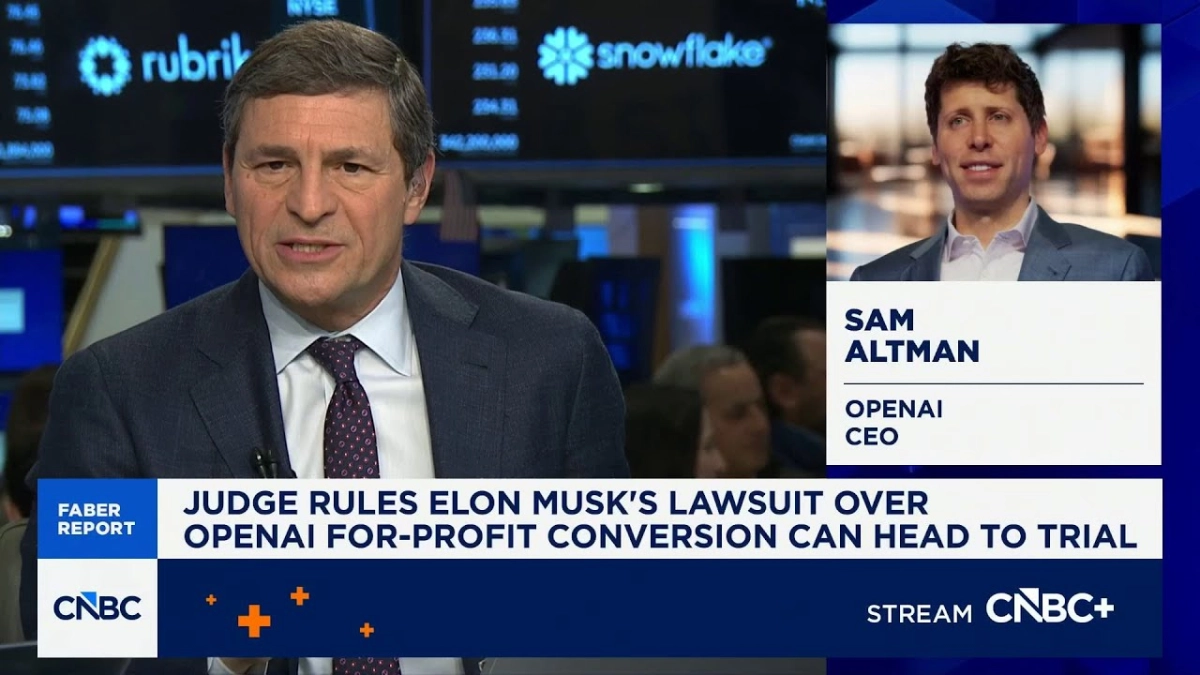
The legal battle over OpenAI's founding principles—the tension between developing Artificial General Intelligence (AGI) for humanity’s benefit and the staggering pursuit of profit—has just escalated dramatically. A federal judge has cleared the path for Elon Musk’s lawsuit against OpenAI, Sam Altman, and Greg Brockman to proceed to a jury trial, signaling that the core claims surrounding the company’s conversion from a non-profit entity to a multi-billion-dollar commercial powerhouse hold sufficient merit to be tested in court. The forthcoming litigation promises to be a foundational test of mission integrity in the hyper-capitalized world of frontier AI development.
CNBC’s David Faber, reporting on the “Faber Report,” detailed the significant development from the Federal Court in the Northern District of California. Judge Yvonne Gonzalez Rogers denied OpenAI’s motion for summary judgment, thereby allowing key elements of Musk’s complaint—which centers on the alleged abandonment of the company’s original charitable mission—to move forward. The case pits Musk, a co-founder who provided substantial early funding, against the current leadership, including CEO Sam Altman, over fundamental questions of corporate governance and fiduciary duty in the burgeoning AI sector. This ruling ensures that the internal conflicts and contractual ambiguities surrounding OpenAI’s 2015 formation and subsequent pivot will be aired in a public forum.
Musk’s original complaint alleges he was "deliberately induced to co-found and fund OpenAI" based on explicit promises that the entity would remain a non-profit, prioritizing AI safety and openly sharing its research "for the benefit of humanity." Faber noted that the complaint asserts that once the technology advanced and approached AGI, Sam Altman abandoned that commitment, "engineering a shift toward profit and control." This alleged shift, moving from a mandate focused on communal benefit to one driven by investor returns and commercial advantage, is the central pillar of the litigation. The court’s decision means four specific claims will now proceed to the Phase 1 trial, scheduled to begin on March 30th: constructive fraud, breach of charitable trust, and unjust enrichment.
The sheer complexity of OpenAI’s current structure—a capped-profit subsidiary governed by a non-profit board—makes the legal interpretation of its original founding documents a high-stakes affair. The outcome will not only determine the financial fate of one of the world’s most valuable private companies but will also establish precedents for how charitable trusts and mission-driven entities navigate the transition to commercial viability in high-tech fields. For the startup ecosystem, this case represents the ultimate stress test of whether a mission statement can function as an enforceable contract when billions of dollars are on the line.
This development is a significant setback for OpenAI and Microsoft. The outcome could potentially impact OpenAI’s entire for-profit structure and valuation.
OpenAI, of course, maintains a robust defense, viewing the legal challenge as purely retaliatory. Faber presented the company’s statement: “Mr Musk’s lawsuit continues to be baseless and a part of his ongoing pattern of harassment, and we look forward to demonstrating this at trial.” They further stressed their commitment to their foundational structure, noting, “We remain focused on empowering the OpenAI Foundation, which is already one of the best resourced nonprofits ever.” While the non-profit wing retains a 27% stake in the for-profit entity, the core of Musk’s argument is that the pursuit of massive commercial returns, particularly through its deep partnership with Microsoft, fundamentally violates the original charter intended to prevent the technology from being captured by a single corporate interest.
For sophisticated investors and founders watching this litigation, the case is a crucial study in the enforceability of mission drift. The legal standard of "breach of charitable trust" is complex, but if Musk prevails, the precedent could send shockwaves through the hybrid corporate structures increasingly favored by high-growth, mission-oriented tech companies. The implications extend far beyond monetary damages; if the court rules that OpenAI breached its charitable trust, it could force a fundamental restructuring of the company, potentially unwinding the multi-billion dollar valuation derived from its for-profit conversion. Musk’s lead counsel, Marc Toberoff, framed the situation in dramatic terms, quoting Macbeth: “Now their ‘false faces must hide what their false hearts doth know’ and the stakes could not be higher.” This theatrical flourish underscores the gravity of the ethical and financial breach alleged, suggesting a conflict rooted in betrayal.
The trial is set to be an extraordinary public examination of the ethical compromises inherent in the race for AGI dominance. The legal focus will hinge on the intent of the founders at OpenAI's inception versus the subsequent actions taken by its leadership to monetize its groundbreaking technology. Should the jury find in favor of Musk on the core claims, the resulting remedies could range from substantial financial penalties to judicial mandates requiring OpenAI to adhere more closely to its original non-profit mandate, potentially forcing a radical re-evaluation of its commercial strategy and its critical relationship with Microsoft.



