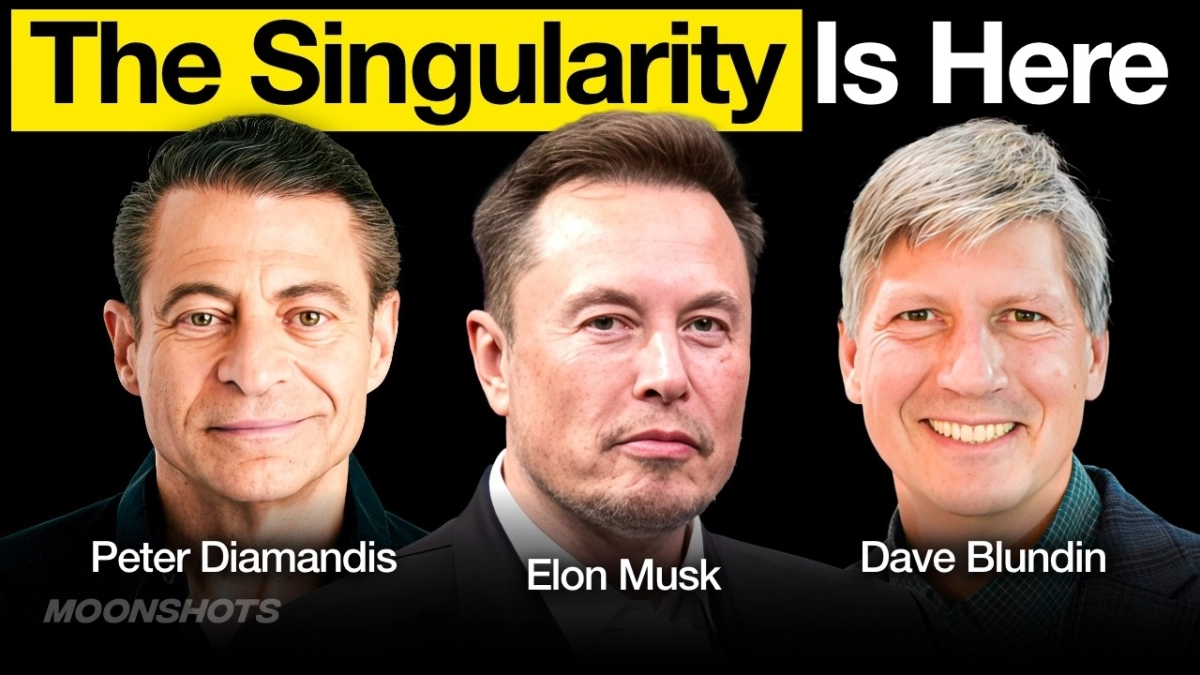
"I call AI and robotics the supersonic tsunami. We’re in the singularity." This stark, yet characteristically dramatic, assessment from Elon Musk framed a wide-ranging conversation with Peter Diamandis and Dave Blundell at Tesla’s Gigafactory in Austin, Texas. The discussion, part of the Moonshots series, focused on the immediate future of Artificial General Intelligence (AGI), the global competitive landscape—particularly the U.S. vs. China—and the foundational challenges of achieving sustainable abundance. For founders and VCs operating at the bleeding edge of technology, the interview offered key insights into Musk’s current strategic focus and his timeline for civilizational transformation.
Musk’s core message centered on the imminent arrival of AGI, which he believes will usher in an era of unprecedented productivity and resource abundance. However, this transition will not be seamless. When discussing the impact of AI on the labor market, Musk was unequivocal about the scale of disruption. "Anything short of shaping atoms, AI can do half or more of those jobs right now," he stated, referring particularly to white-collar work. This suggests that the impact of current large language models (LLMs) and generalized AI systems is already substantial, and the pace of displacement is accelerating. Diamandis noted the societal anxiety surrounding this, particularly the fear of rogue AI and job loss, asking, "How do we head towards Star Trek and not Terminator?"

The critical insight here is that the transition itself, not the final state of abundance, represents the greatest near-term risk. Musk conceded that the shift "will be bumpy," predicting a period of significant social unrest before the benefits of AGI are fully realized. This perspective is vital for policymakers and tech leaders, suggesting that efforts should be focused less on stopping AI and more on managing the inevitable societal fallout, ensuring a framework exists for universal high income rather than widespread unemployment and social discord.
Beyond AGI, the conversation pivoted to the geopolitical race for technological supremacy, particularly between the U.S. and China. Diamandis observed that China has done "an incredible job" in scaling critical technologies, noting they are "running circles around us." Musk agreed, asserting that based on current trends, China will far exceed the rest of the world in AI compute capabilities. This competitive dynamic is driven by a focus on fundamental resources, primarily energy and compute power.
Musk emphasized that the future currency of progress will be "wattage," positing that the capacity to generate and store massive amounts of energy is the inner loop driving all technological advancement. He sees solar power as the ultimate solution, noting that the sun is "everything," and that all other energy sources pale in comparison. When pressed on the timeline for scaling energy solutions, Musk challenged the conventional view of energy scarcity, stating that the sheer amount of solar energy available is massive. He cited Tesla’s work in scaling battery production and solar roofs, contrasting this with inefficient, outdated energy infrastructure.
Musk’s vision extends beyond terrestrial energy solutions, touching upon space infrastructure as the next great frontier. He revealed ambitious plans for Starlink, aiming for a million tons of payload to orbit per year, which would enable solar-powered AI satellites capable of generating 100 gigawatts annually. This scale of deployment—requiring reusable launch systems like Starship—is the "Holy Grail" of aerospace, a necessary precursor to achieving a Kardashev Type 1 civilization (harnessing all energy available on Earth) and eventually Type 2 (harnessing the entire output of a star).
The sheer scale of this ambition underscores a core philosophical principle guiding Musk: the necessity of tackling seemingly impossible challenges to drive human progress. When discussing his own journey, Musk recalled arriving in North America with minimal resources, driven by a desire to work on things that truly mattered. He implicitly criticized the current academic structure, which he sees as producing "useless" PhDs, contrasting this with the urgency of building real-world solutions.
Musk’s relentless optimism, which Diamandis jokingly noted he might even be "monetizing," is fundamentally rooted in a first-principles engineering approach: identifying the bottlenecks to abundance—intelligence and energy—and attacking them with massive, scalable solutions. The primary takeaway for the audience of VCs and tech founders is clear: the future is being built now, and success will belong to those who commit to solving the hardest, most foundational challenges at an exponential scale, rather than those who seek incremental improvements within existing systems. The supersonic tsunami of AI is coming, and it demands decisive action and vast resource commitment.