

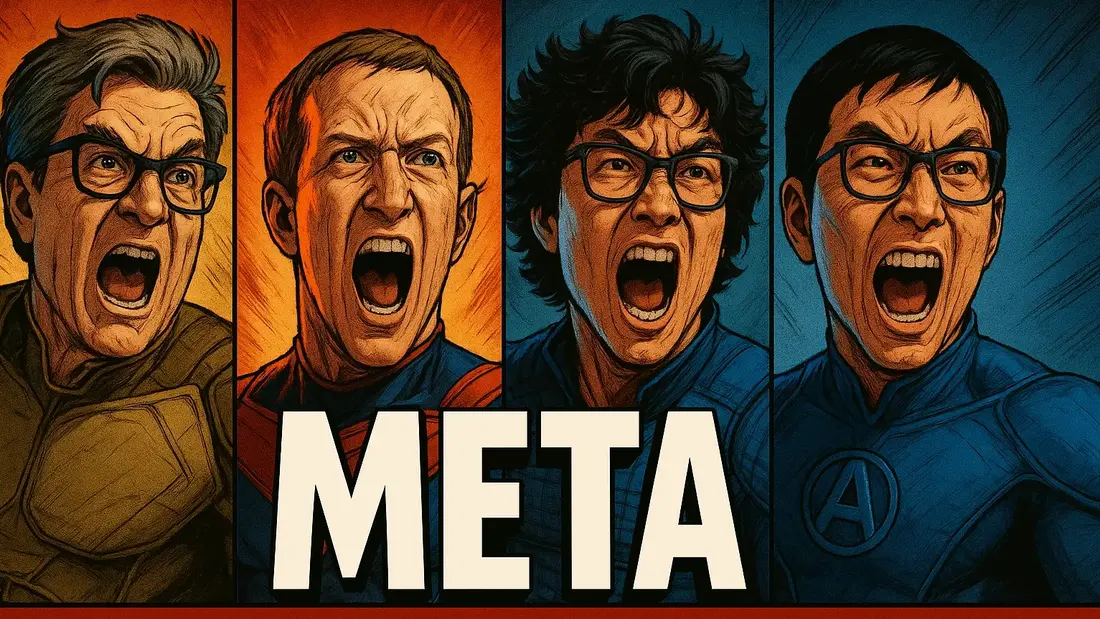
Meta's ambitious launch of Meta Superintelligence Labs (MSL) in June 2025 represents the most aggressive AI talent acquisition campaign in tech history, fundamentally reshaping the competitive landscape through unprecedented compensation packages and strategic hires from every major AI laboratory. The only comparison was China's efforts to recruit Chinese researchers studying in the US, paying a million dollars as an incentive, back to China. The Thousands Talent Plan was a dangerous force in the industry, and little comparison to it in the wake of Zuckerberg's recruitment signals most reporters in the industry are simply new to the topic of AI, with absolutely no qualification at all.
But this new initiative signals Mark Zuckerberg's determination to achieve artificial superintelligence by consolidating the industry's top researchers under one roof, backed by unlimited financial resources and cutting-edge infrastructure investments exceeding $65 billion annually.
This comprehensive analysis reveals how Meta has successfully recruited elite AI researchers from OpenAI, Google DeepMind, Anthropic, Apple, and other leading organizations through compensation packages reaching $300 million over four years, while simultaneously triggering industry-wide controversies about market concentration, talent inflation, and the sustainability of such extreme financial incentives in driving breakthrough innovations.
As it happens, StartupHub.ai is the first and only AI database to report and collect AI researchers, ranking them by their level and area of expertise.
Leadership powerhouse driving Meta's AI transformation
Meta Superintelligence Labs operates under a carefully constructed leadership hierarchy designed to compete directly with established AI leaders.

- Alexandr Wang, the 28-year-old former Scale AI CEO, serves as Chief AI Officer following Meta's $14.3 billion investment to acquire a 49% stake in his company. Wang, who became the world's youngest self-made billionaire before age 25, brings deep expertise in AI training data and infrastructure, having built Scale AI into a company involved in developing almost all leading AI models across the industry.
- Nat Friedman, former GitHub CEO and accomplished AI investor, co-leads MSL with focus on AI products and applied research. Friedman's extensive background includes co-founding Ximian and Xamarin, leading GitHub's growth from $7.5 billion to $16.5 billion valuation, and running the influential NFDG AI investment firm. His strategic partnership with Daniel Gross, who joined MSL after co-founding Safe Superintelligence with Ilya Sutskever, demonstrates Meta's ability to attract proven technology leaders with deep industry networks.
The most significant appointment came July 25, 2025, when Shengjia Zhao was named Chief Scientist of MSL. Zhao, co-creator of ChatGPT, GPT-4, and OpenAI's groundbreaking o-series reasoning models, represents Meta's most strategically important acquisition. His foundational contributions to synthetic data generation and reasoning systems, alongside his role as a lead scientist in OpenAI's most advanced projects, positions him to directly compete with his former employer's technological advantages.
Daniel Gross completes the senior leadership team, bringing experience from co-founding Safe Superintelligence, leading machine learning efforts at Apple including Siri development, and serving as Partner at Y Combinator. His transition from Safe Superintelligence to Meta highlights the company's success in recruiting from cutting-edge AI safety organizations.
Technical talent acquired from industry leaders
Meta Superintelligence Labs has systematically recruited top researchers across specialized domains, creating what industry observers describe as an "AI dream team" assembled through unprecedented financial incentives.
OpenAI defections reshape reasoning capabilities
The most damaging blow to OpenAI came through Meta's acquisition of 11 key researchers responsible for the company's most advanced models. Trapit Bansal, pioneer of reinforcement learning for chain-of-thought reasoning and co-creator of o-series models, brings critical expertise in Meta's quest to develop reasoning capabilities comparable to OpenAI's o1 and o3 systems.
Hongyu Ren, who led OpenAI's post-training group and co-created GPT-4o, 4o-mini, o1-mini, o3-mini, and o3 models, represents a massive knowledge transfer in model optimization techniques. His departure, alongside Jiahui Yu (co-creator of o3, o4-mini, GPT-4.1, GPT-4o) and Shuchao Bi (co-creator of GPT-4o voice mode), effectively transplants OpenAI's multimodal expertise directly into Meta's organization.
The acquisition of the OpenAI Zurich office leadership trio - Lucas Beyer, Alexander Kolesnikov, and Xiaohua Zhai - delivers proven computer vision capabilities, including the foundational Vision Transformer (ViT) architecture that revolutionized image processing in AI systems.
Google DeepMind losses strengthen foundational research
Meta successfully recruited Jack Rae, a Distinguished Scientist at Google DeepMind with 7.5 years of experience leading pre-training efforts for Gemini and Gemini 2.5 reasoning capabilities. Rae's foundational work on Gopher and Chinchilla large language models provides Meta with critical insights into large-scale pre-training strategies that have powered Google's most advanced AI systems.
Pei Sun brings unique dual expertise from Google DeepMind and Waymo, having created multiple generations of autonomous vehicle perception models while contributing to Gemini's post-training, coding, and reasoning capabilities. His cross-industry experience in real-world AI applications adds practical deployment expertise to Meta's theoretical research capabilities.
Apple intelligence team systematically dismantled
Meta's most strategically damaging recruitment success involved systematically dismantling Apple's Foundation Models team. Ruoming Pang, who led a 100-person team responsible for AI models powering Apple Intelligence features, joined Meta in July 2025 for a reported compensation package exceeding $200 million over several years. His departure was followed by Mark Lee and Tom Gunter, two of Pang's most senior team members, effectively gutting Apple's internal AI capabilities and forcing the company to consider using external models from OpenAI and Anthropic for Siri functionality.
Specialized domain expertise across AI frontiers
- Johan Schalkwyk, former Google Fellow with extensive experience in language technologies for over 1,000 languages, leads Meta's voice technology efforts. His background includes foundational work on speech recognition systems and multilingual AI, supported by Meta's acquisition of PlayAI startup to strengthen voice synthesis capabilities.
- Joel Pobar returns to Meta after 11 years, bringing Anthropic's inference systems expertise and deep knowledge of large-scale AI infrastructure optimization. His previous Meta experience with HHVM, Hack, Flow, and machine learning systems provides continuity with existing technical architecture.
- Huiwen Chang from Google Research contributes generative AI expertise as co-creator of GPT-4o's image generation capabilities and inventor of MaskGIT and Muse text-to-image architectures, positioning Meta to compete directly with OpenAI's DALL-E and Google's Imagen systems.
Unprecedented compensation reshapes industry economics
Meta Superintelligence Labs has fundamentally altered AI talent economics through compensation packages that exceed CEO salaries at major global corporations. Elite researchers receive $200-300 million over four years, structured as base salary, signing bonuses, and Meta stock equity with extended vesting periods tied to performance metrics.
Confirmed compensation details include Ruoming Pang's $200+ million package from Apple, representing the highest publicly verified AI researcher compensation in history. Industry reports suggest Meta has offered packages ranging from $100-450 million over four years, with at least one reported $1.25 billion offer declined by an unnamed researcher.
The compensation structure typically includes $100 million signing bonuses for top-tier talent, though these figures have been disputed by some recipients. OpenAI CEO Sam Altman confirmed Meta offered "$100 million signing bonuses" to his researchers, while Meta CTO Andrew Bosworth initially downplayed but later acknowledged "the market's hot."
This extreme compensation has forced industry-wide recalibration, with OpenAI implementing retention bonuses exceeding $2 million annually and equity packages surpassing $20 million to prevent further defections. The talent war has created unsustainable inflation in AI researcher salaries, with average compensation at top labs increasing 40-60% year-over-year.
Organizational structure consolidates AI efforts
Meta Superintelligence Labs represents a fundamental reorganization of the company's AI capabilities, consolidating previously separate units under unified leadership reporting directly to Mark Zuckerberg. The structure integrates FAIR (Fundamental AI Research), foundation model teams including Llama development, product AI teams across Meta's platforms, and a new dedicated superintelligence research lab.
This consolidation addresses previous organizational fragmentation where AI teams were embedded across product divisions without coordinated strategy. FAIR, previously under Reality Labs with reduced compute allocation, now operates under MSL's umbrella while maintaining Yann LeCun as Chief AI Scientist in a separate role from Zhao's Chief Scientist position.
The reporting hierarchy flows from Chief AI Officer Alexandr Wang through co-lead Nat Friedman for applied research and Chief Scientist Shengjia Zhao for fundamental research direction. This structure enables rapid decision-making and resource allocation across the company's $65-70 billion annual AI infrastructure investment.
Infrastructure investments support talent retention
Meta's talent acquisition strategy succeeds partly through unprecedented infrastructure commitments that provide researchers with computing resources exceeding those available at pure-play AI labs. The company's Prometheus cluster, launching in 2026 with over 500,000 GPUs and 1 gigawatt power consumption, will provide MSL researchers with industry-leading compute access.
The Hyperion cluster in Louisiana represents the world's largest planned AI training facility, scaling from 1.5 gigawatts in Phase 1 to 5 gigawatts over several years. These multi-gigawatt facilities, supported by dedicated natural gas generation through partnerships with Williams, provide competitive advantages that pure-play AI labs cannot match.
Total infrastructure investment reaches $64-72 billion in 2025, representing a 2.5x increase from 2023 baseline spending. This compute advantage, combined with Meta's 3+ billion user base providing training data and feedback, creates unique research environments that justify extreme compensation packages through resource access unavailable elsewhere.
Recent developments accelerate competition
Since the official MSL launch on July 25, 2025, Meta has continued aggressive recruitment while facing internal challenges and strategic decisions. The appointment of Shengjia Zhao as Chief Scientist represents the most significant development, providing MSL with proven leadership in breakthrough AI research and direct competitive knowledge of OpenAI's most advanced projects.
Strategic discussions about abandoning open-source approaches for the "Behemoth" model indicate potential philosophical shifts that could fundamentally alter Meta's competitive positioning. While the company maintains its position on open source remains "unchanged," internal discussions about developing closed models suggest recognition that open-source strategies may limit competitive advantages against proprietary systems from OpenAI and Google.
Additional Apple acquisitions of Mark Lee and Tom Gunter demonstrate Meta's systematic approach to dismantling competitor capabilities, while Apple's failure to provide counter-offers signals recognition that competing financially with Meta's packages is unsustainable for companies without comparable revenue streams.
The departure of Joelle Pineau from FAIR leadership in May 2025, coinciding with controversy over rushed Llama 4 releases, indicates internal challenges in balancing research excellence with commercial pressures that MSL's structure aims to address.
Competitive landscape reveals strengths and vulnerabilities
Meta's aggressive strategy faces significant challenges despite financial advantages. Retention rates of 64% trail competitors like Anthropic (80%) and Google DeepMind (78%), suggesting compensation alone cannot ensure talent loyalty. The company loses experienced researchers to organizations offering stronger research cultures and mission-driven environments.
OpenAI maintains competitive advantages through market-leading position, equity upside potential, and cultural emphasis on breakthrough research, despite Meta's higher cash compensation. The company's response including "recalibrating compensation" and emphasis on "missionaries versus mercenaries" demonstrates effective counter-strategies that resonate with research-focused talent.
Anthropic emerges as an unexpected winner, attracting talent through mission-driven culture, researcher autonomy, and safety-first positioning. The company's 80% retention rate, despite lower compensation than Meta or OpenAI, demonstrates that cultural factors significantly influence researcher decisions beyond financial incentives.
Google DeepMind leverages academic reputation and fundamental research focus to maintain talent despite losing high-profile researchers to Meta. The company's merger of Google Brain and DeepMind creates organizational scale and resources that provide competitive research environments, though startup-like cultures at Anthropic and OpenAI often prove more attractive.
Industry controversies challenge long-term sustainability
Meta's talent acquisition strategy has triggered unprecedented industry controversy and regulatory scrutiny. Senator Ron Wyden advocates for antitrust investigations into market concentration through talent acquisition, while DOJ and FTC analyze whether tech giants are fortifying AI dominance through employment practices that potentially stifle competition.
OpenAI's characterization of Meta's approach as "distasteful" reflects broader industry concern about financial incentives undermining mission-driven research culture. Chief Research Officer Mark Chen's description of feeling "as if someone has broken into our home and stolen something" demonstrates the emotional and competitive impact of Meta's systematic poaching strategy.
Academic institutions warn of brain drain as leading university researchers accept private sector offers that exceed entire department budgets. This concentration of AI expertise in private companies raises concerns about research independence, intellectual freedom, and the broader ecosystem's ability to maintain innovation diversity.
EU regulatory resistance, including Meta's refusal to sign the AI Code of Practice citing "legal uncertainties," suggests potential geographic limitations to the company's talent consolidation strategy. Market fragmentation due to regulatory compliance could limit MSL's global effectiveness despite domestic success.
Strategic implications for AI industry transformation
Meta Superintelligence Labs represents a fundamental shift in how technology companies compete for human capital and technological leadership. The initiative's success in recruiting elite researchers from every major competitor demonstrates the power of unlimited financial resources combined with world-class infrastructure and direct CEO involvement in strategic hiring.
However, sustainability challenges persist around whether extreme compensation translates into breakthrough innovations. Historical analysis suggests weak correlation between executive compensation and company performance, while cultural concerns about prioritizing financial incentives over mission-driven work create retention risks even after successful recruitment.
The industry-wide talent inflation created by Meta's strategy may ultimately prove self-defeating if compensation becomes the primary competitive factor rather than research environment, technical resources, or intellectual challenge. Companies with strong cultures and clear missions may maintain advantages in attracting and retaining researchers who prioritize scientific impact over financial rewards.
Regulatory and societal implications extend beyond immediate competitive effects to fundamental questions about AI capability concentration, innovation diversity, and the balance between corporate competition and broader societal interests in AI development. Meta's approach, while effective in short-term talent acquisition, may face long-term constraints from government oversight and industry backlash.
The ultimate success of Meta Superintelligence Labs will depend not just on assembling elite talent, but on creating sustainable research culture, delivering breakthrough innovations, and navigating increasing regulatory scrutiny while maintaining the intellectual freedom and scientific excellence that originally attracted researchers from competitor organizations. The next 12-24 months will determine whether this unprecedented investment in human capital generates the superintelligence breakthroughs that justify its revolutionary approach to AI talent competition.

