For the past year, the artificial intelligence narrative has been dominated by the cinematic spectacle of Sora, the ability to generate hyper-realistic video clips from a single text prompt. But for game developers, that technology has remained a beautiful, frustrating window: you can look, but you can’t touch. The core issue is state. Games demand interaction, and passive video models simply cannot handle the fundamental requirement of a live, stateful simulation.
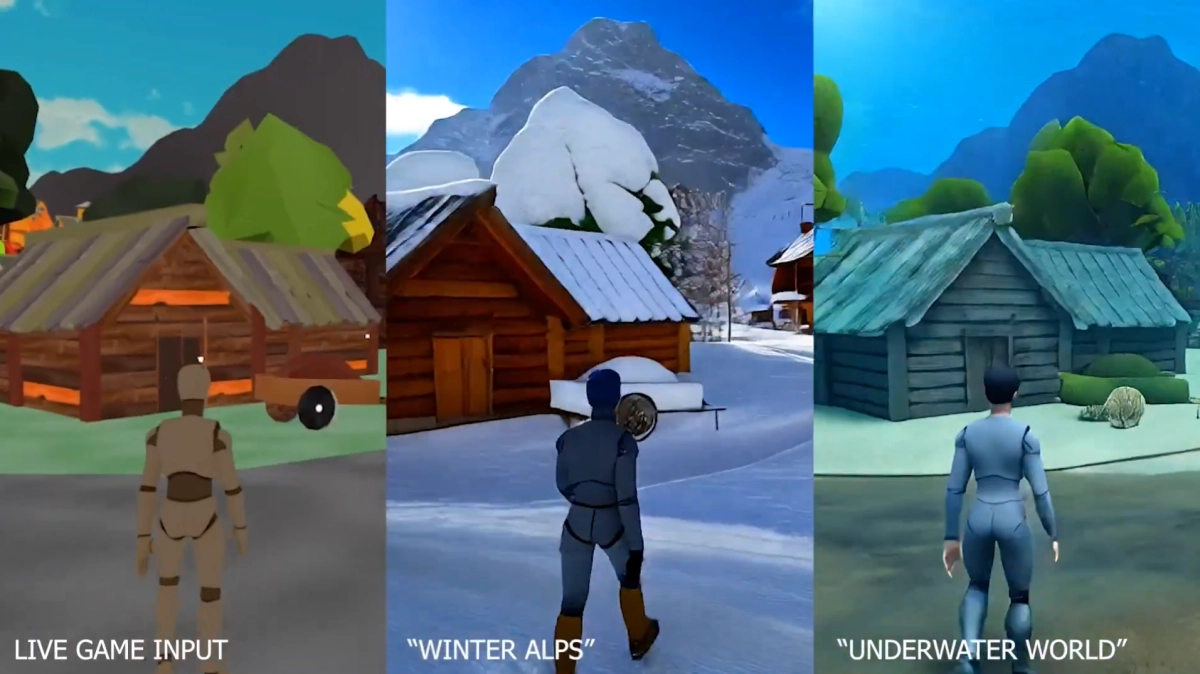
Enter Moonlake. The frontier research lab has officially unveiled Reverie, a game-native diffusion model that aims to move generative AI from producing passive sequences to driving live, playable worlds. If Moonlake succeeds, we aren’t just looking at better graphics; we’re looking at the birth of "vibe coding", a world where interactive environments are dreamed into existence in real-time.
The reason traditional generative AI has struggled with gaming boils down to the latency wall. Games are simulations that run at "frame time." In a fast-paced action game, a delay of even 100 milliseconds between a button press and a visual reaction is enough to break immersion and make the mechanics feel "mushy." Most generative models are computationally heavy, taking seconds or even minutes to render a single sequence.
Moonlake’s technical thesis is built on the reality that for AI to be game-native, it must respond at the speed of play. Reverie is architected for real-time generation, ensuring that the diffusion process doesn't block the gameplay loop. It treats the generation not as a final export, but as a living, low-latency layer of the game engine itself. This is the crucial architectural difference that separates Reverie from its video-focused predecessors.
Beyond the Vanishing Door: Solving AI's Memory Problem
The second, equally critical hurdle Moonlake is tackling is Unbounded Runtime. Unlike a short video clip, games do not end after a few seconds. They require persistence. If you ask a standard video AI to generate a person walking through a door, it might do so beautifully. But if the camera turns around and then turns back, the door might have vanished, or the person might have changed clothes entirely.