

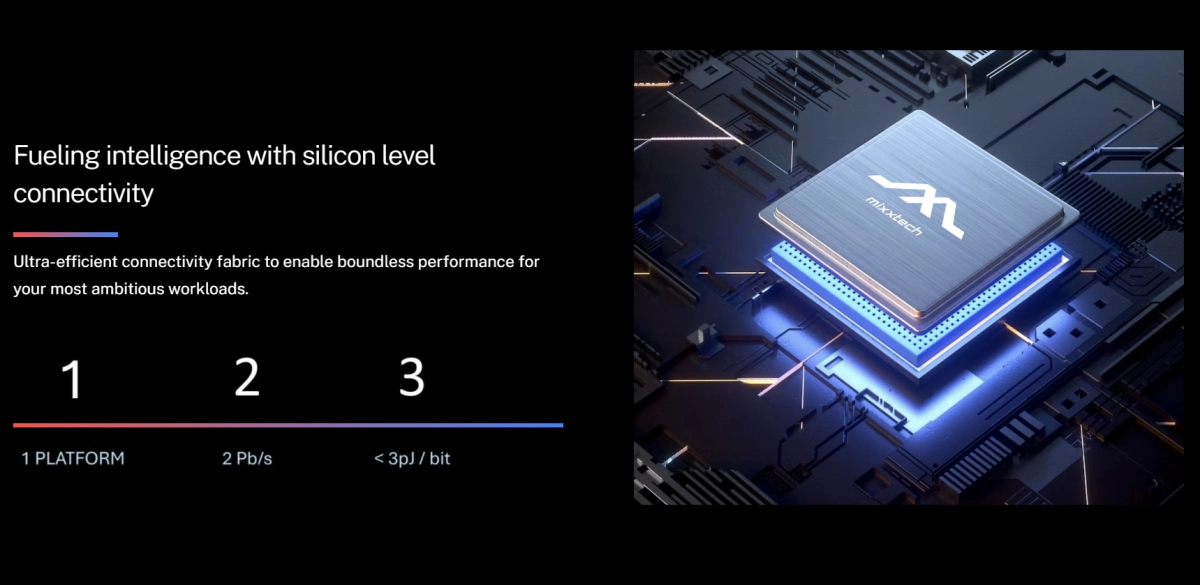
Mixx Technologies, a firm developing system-scale optical connectivity for artificial intelligence infrastructure, announced the close of a $33 million Series A funding round. The financing was led by ICM HPQC Fund, with participation from TDK Ventures, Systemiq Capital, and several other strategic investors. This oversubscribed round underscores investor focus on fundamental infrastructure challenges impeding AI scaling.
The company’s founders originate from teams that previously delivered Intel’s silicon photonics transceivers and Broadcom’s co-packaged optics solutions for networking switches. Mixx is now focused on eliminating the interconnect bottleneck that currently limits the performance and scalability of large AI deployments.
Their platform integrates photonics, advanced packaging techniques, and system architecture to establish a foundation for more parallelized and faster AI systems.
The newly secured capital will fund further product development and expand research and development centers located across the U.S., India, and Taiwan.
Concurrently, the company plans to scale operations and deepen existing collaborations within the broader ecosystem.
This expansion indicates an immediate commitment to moving beyond the prototype phase into broader deployment. At the core of Mixx’s offering is HBxIO™, a silicon-integrated optical engine designed to serve as a comprehensive communication platform for next-generation AI hardware.
This architecture pairs open standards with proprietary orchestration algorithms and a high-radix connector to bridge the computational needs of front-end and back-end networks with superior speed.
Consequently, the technology promises higher bandwidth, reduced power draw, and a lower total cost of ownership for data center operators.
The technological implications are substantial, particularly concerning scale-up AI inference clusters where current copper SerDes-based solutions introduce limitations. Mixx claims its ultra-high radix connectivity can boost port counts by up to four times over existing CPOs, leading to a potential 32x improvement in compute efficiency through a flattened network topology. This approach directly challenges incumbent interconnect suppliers struggling to meet the demands of increasingly dense compute fabrics.
Furthermore, the company emphasizes its 3.5D integration strategy, which embeds optics directly onto or adjacent to the ASIC, minimizing the physical data path distance.
This streamlined design reportedly yields up to 75% power savings and halves the latency compared to state-of-the-art interconnects currently deployed in hyperscale environments.
Such efficiency gains are crucial as power consumption becomes a primary constraint in AI buildouts. Investor commentary reflects a belief that connectivity, rather than raw compute processing power, is the emergent constraint defining the next era of AI infrastructure development. The firm’s focus on a system-level optical architecture is positioned to optimize both operational power and the overall economics of massive AI deployments.
This aligns with broader market trends prioritizing energy efficiency alongside raw performance metrics. Mixx Technologies is explicitly targeting the realization of disaggregated intelligence, where compute, memory, and acceleration resources can be dynamically orchestrated across a unified, composable fabric.
By developing the HBxIO™ engine around open standards, the company aims to ensure multi-protocol support and seamless integration, thereby accelerating the industry's transition toward silicon-integrated optics as the standard for high-performance AI connectivity.

