

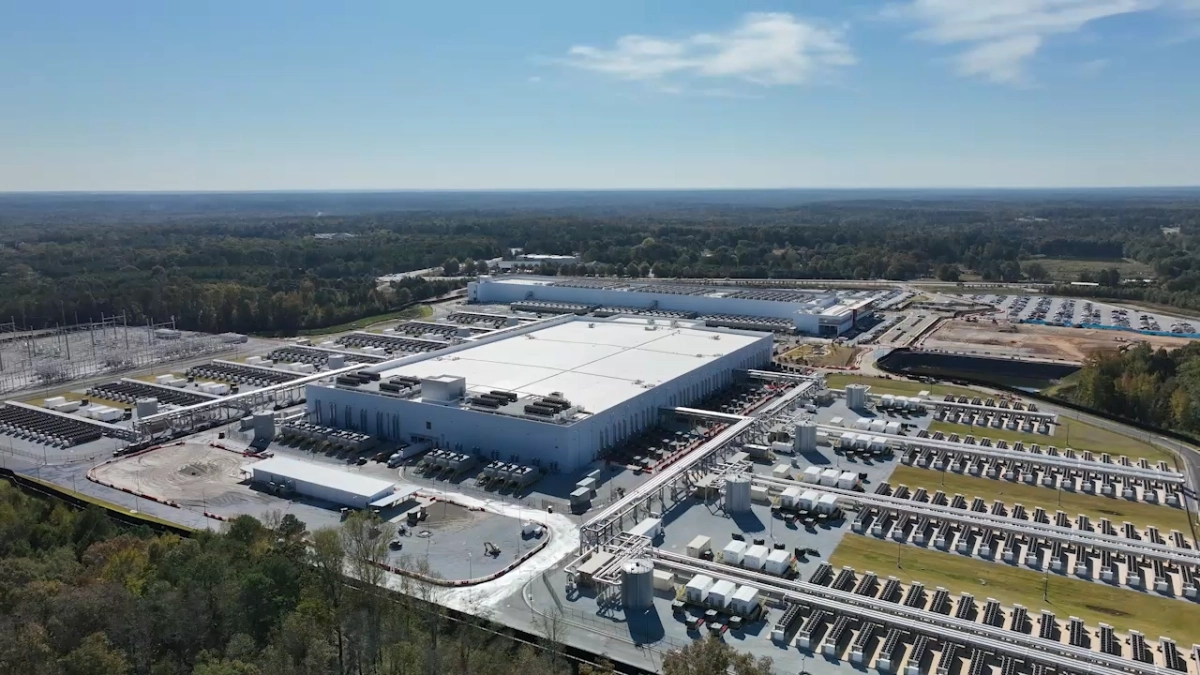
Microsoft has officially fired up a new breed of datacenter, the Fairwater family, marking a significant step in scaling AI infrastructure. The Atlanta facility, operational since October, isn't a standalone building but part of a dedicated, high-speed network connecting to other sites like the one in Wisconsin. Microsoft is calling this interconnected system its first AI superfactory.
The core innovation here isn't just denser silicon or better cooling, though Fairwater boasts both, including NVIDIA GB200 NVL72 racks and near-zero water consumption cooling. The real game-changer is the dedicated network, an AI WAN built on repurposed and new fiber, allowing these geographically separate facilities to function as a single, massive virtual supercomputer. According to Alistair Speirs, Microsoft GM for Azure infrastructure, this allows them to tackle complex AI training jobs in weeks that previously took months.
This distributed approach is a direct response to the escalating demands of training frontier AI models. Mark Russinovich, Microsoft Azure CTO, notes that training models with hundreds of trillions of parameters now necessitates infrastructure spanning multiple data centers, not just one. The tight integration, both within each two-story Fairwater site and across the AI WAN, is designed to keep hundreds of thousands of GPUs synchronized and working efficiently, minimizing the idle time that plagues large-scale distributed computing. Scott Guthrie, EVP of Cloud + AI, emphasizes that leading in AI is about making the infrastructure work as a cohesive system, not just adding more chips.
The Distributed Compute Paradigm Shift
This move signals a clear industry pivot. Traditional cloud datacenters are built for fungibility, running millions of disparate customer applications. The Microsoft AI superfactory, however, is purpose-built for singular, massive compute jobs, training OpenAI models, powering the AI Superintelligence Team, and enhancing Copilot. The tight coupling across states, facilitated by low-latency networking optimized for AI workloads, means Microsoft is treating its compute fabric as a single, geographically distributed machine. This infrastructure strategy is crucial for maintaining pace in the AI arms race, where model size and training complexity are growing exponentially. It’s a massive bet on distributed architecture solving the physical limitations of building single, monolithic compute centers.