

Microsoft's AI Growth: Discovery Value Still Unlocking, Says Goldman

Goldman Sachs analyst Gabriela Borges discusses Microsoft's AI strategy, Copilot adoption, and its relative market position, suggesting significant value is still to be discovered.

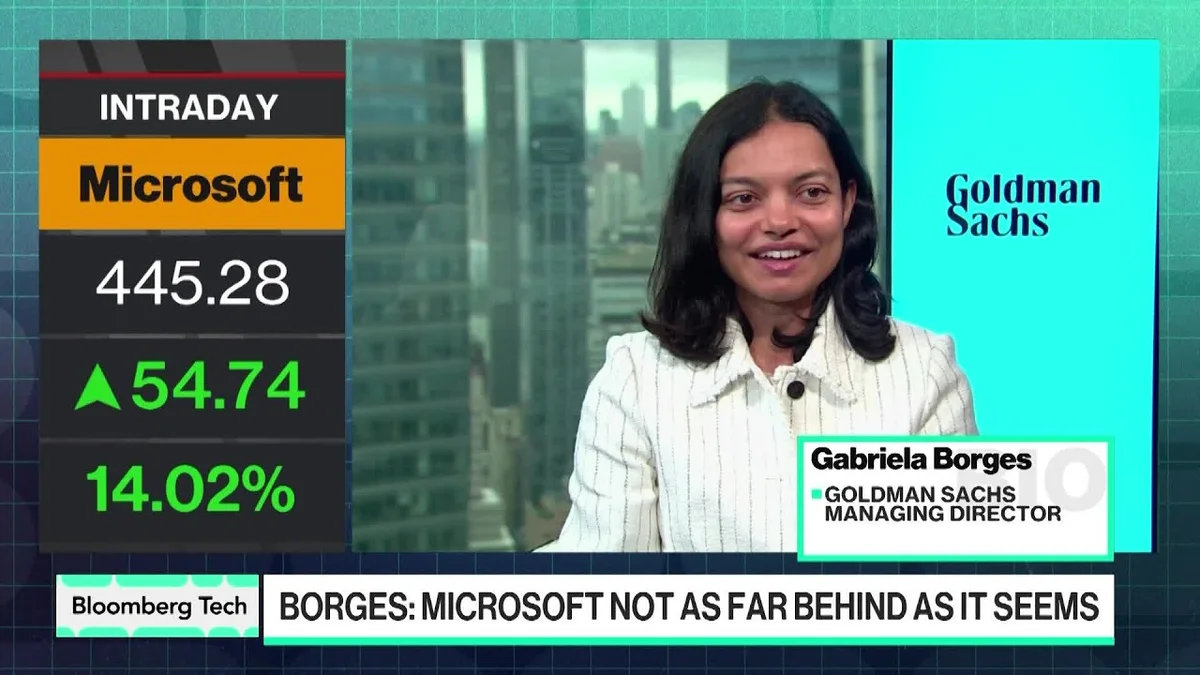
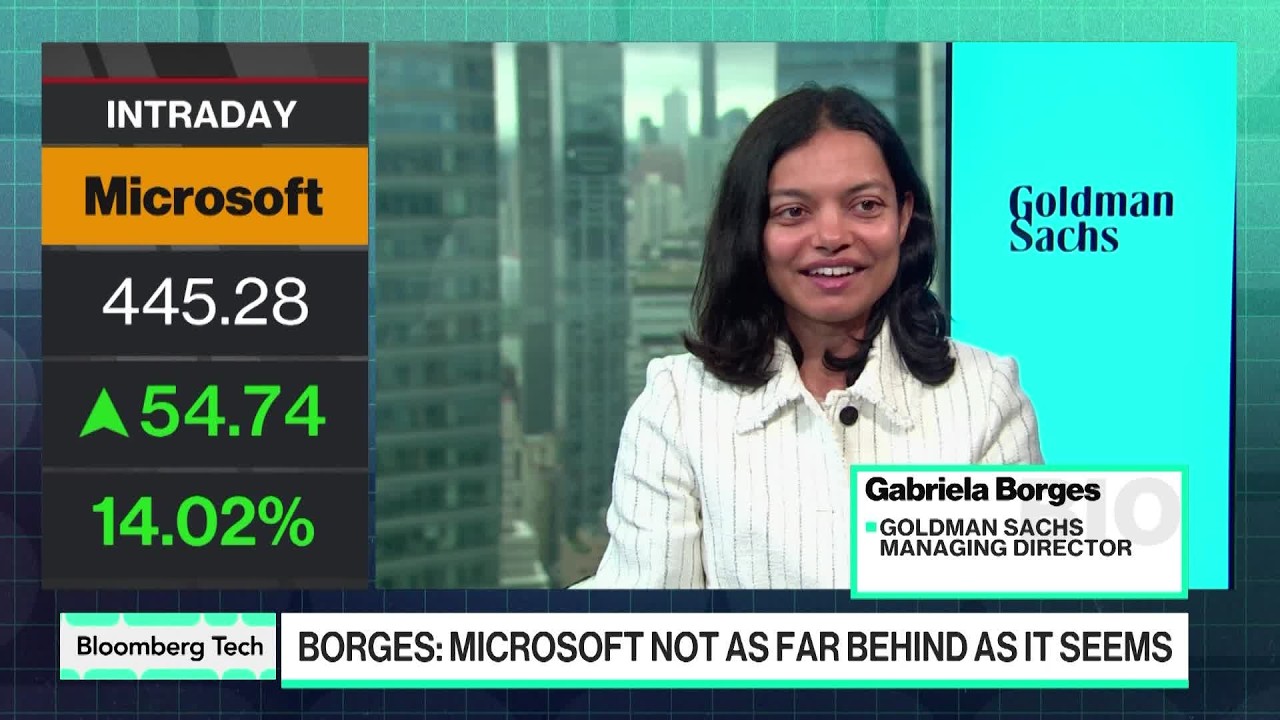
Gabriela Borges of Goldman Sachs speaks on a Bloomberg Tech segment about Microsoft's AI strategy.
Bloomberg Technology
Visual TL;DR
Microsoft AI StrategyContext
From the article 9+ mentionsGabriela Borges, a Senior Software Equity Research Analyst at Goldman Sachs, offered a nuanced perspective on Microsoft's (NASDAQ:MSFT) artificial intelligence strategy during a recent Bloomberg Tech appearance.
AI Monetization GrowthEffect
true measure of ROI in AI lies within Azure business and emerging strategies
From the article 5 mentionsBorges sees this growth as a positive indicator of Copilot's increasing traction.
Copilot TrajectoryCore
Copilot adoption and product improvements are key to future AI revenue streams
From the article 5 mentionsA key metric discussed was the adoption of Microsoft Copilot, which reached 30 million installed seats by the end of the quarter, up from 20 million in the prior quarter.
CapEx & CapacityDriver
significant investments in AI infrastructure and capacity expansion are ongoing
From the article 4 mentionsBorges pointed out that while external indicators like component pricing and CapEx announcements offer some insight, the true measure of Microsoft's return on investment in AI lies within its Azure business.
Azure Business ROIEffect
return on investment in AI is measured through the performance of Azure
From the articleBorges pointed out that while external indicators like component pricing and CapEx announcements offer some insight, the true measure of Microsoft's return on investment in AI lies within its Azure business.
GitHub Consumption ModelEffect
From the articleShe noted emerging monetization strategies, such as GitHub's shift to a consumption-based model for power users, which directly ties increased value for customers to increased revenue for Microsoft.
Discovery Value UnlockingOutcome
significant value in Microsoft's AI advancements is still unfolding for investors
From the article 3 mentionsShe suggested that the company's AI story has "discovery value" that is yet to be fully realized by investors.
Contents(5)

Gabriela Borges, a Senior Software Equity Research Analyst at Goldman Sachs, offered a nuanced perspective on Microsoft's (NASDAQ:MSFT) artificial intelligence strategy during a recent Bloomberg Tech appearance. While acknowledging the significant investments in AI infrastructure, Borges highlighted that the full monetization and market perception of Microsoft's AI advancements are still unfolding. She suggested that the company's AI story has "discovery value" that is yet to be fully realized by investors.

Assessing Microsoft's AI Monetization and Growth

Borges pointed out that while external indicators like component pricing and CapEx announcements offer some insight, the true measure of Microsoft's return on investment in AI lies within its Azure business. She noted emerging monetization strategies, such as GitHub's shift to a consumption-based model for power users, which directly ties increased value for customers to increased revenue for Microsoft. "As customers get more value out of it, well, Microsoft directly gets more monetization out of it," Borges stated, indicating a more dynamic approach to extracting value from its AI products.

The full discussion can be found on Bloomberg Technology's YouTube channel.

Microsoft's AI Story Is Still Being Discovered, Says Goldman - Bloomberg Technology
Microsoft's AI Story Is Still Being Discovered, Says Goldman, from Bloomberg Technology

Copilot's Trajectory and Product Improvements

A key metric discussed was the adoption of Microsoft Copilot, which reached 30 million installed seats by the end of the quarter, up from 20 million in the prior quarter. Borges sees this growth as a positive indicator of Copilot's increasing traction. She also emphasized the continuous improvements being made to the product, citing integrations like Work IQ for organizational context and enhanced semantic search. The recent addition of premium AI models into the Microsoft ecosystem further strengthens Copilot's capabilities. "Industry feedback is getting better on Copilot, and to see it in the numbers just sort of reinforces that positive feedback loop on, okay, we're starting to move in the right direction and that's momentum that's picking up," she commented.

Capital Expenditures and Capacity Expansion

Regarding capital expenditures, Borges referenced comments from Microsoft's leadership, including CEO Satya Nadella, about the company's aggressive expansion of data center capacity. Microsoft is on track to double its overall capacity in two years, having already reduced GPU delivery times in its largest regions by nearly 50%. Borges noted the accounting changes that affected CapEx figures but stated that the underlying mechanics of depreciation schedules are straightforward to model. The focus, she added, is on how Microsoft is leveraging its software platform to maximize the monetization of this significant infrastructure investment, a conversation that has gained momentum in the industry.

Microsoft's Relative Position in the AI Race

When comparing Microsoft to competitors like Alphabet Inc. (NASDAQ:GOOGL) and Amazon, Borges acknowledged that while Microsoft might not always lead in headline-grabbing AI product launches, its overall platform strategy offers substantial "discovery value." She suggested that the market has, at times, placed Microsoft in a "penalty box," perhaps due to a perception that rivals like Google are ahead with offerings like Gemini. However, Borges believes that behind-the-scenes improvements are significant, and the next 12 months could see the market re-evaluate Microsoft's position. "I think there's a lot of discovery value to unlock in Microsoft as we learn more about the progress they're making on their AI strategy," she explained.

The Individual Utility of Microsoft's AI

Addressing the personal and enterprise utility of Microsoft's AI offerings, Borges shared her own experience with Copilot appearing on her smart TV. She acknowledged the current phase as one of experimentation, where companies are testing various approaches to find product-market fit. "We're in this period of discovery where, by necessity, you have to throw a lot of spaghetti at the wall in order to find good product market fit in order to innovate," she said. Borges expressed confidence that as use cases mature and product-market fit solidifies, users will see greater utility, referencing the progress already made at Goldman Sachs in integrating these tools into daily workflows.

© 2026 StartupHub.ai. All rights reserved. You may not republish this article in full without a license. Search engines and AI research tools may crawl and summarize for reference. Bulk reproduction or model training requires a license. See our terms.
Daniel Singer

Written by

Daniel Singer

Editor, StartupHub.ai

Daniel Singer is the editor of StartupHub.ai, a technology expert and thought leader on AI and its applications across sectors, from fintech and healthcare to developer tooling and consumer software. He writes and tests the tools covered here thoroughly and regularly, and built StartupHub.ai to give founders, operators and buyers a clearer read on what they are actually being sold.