

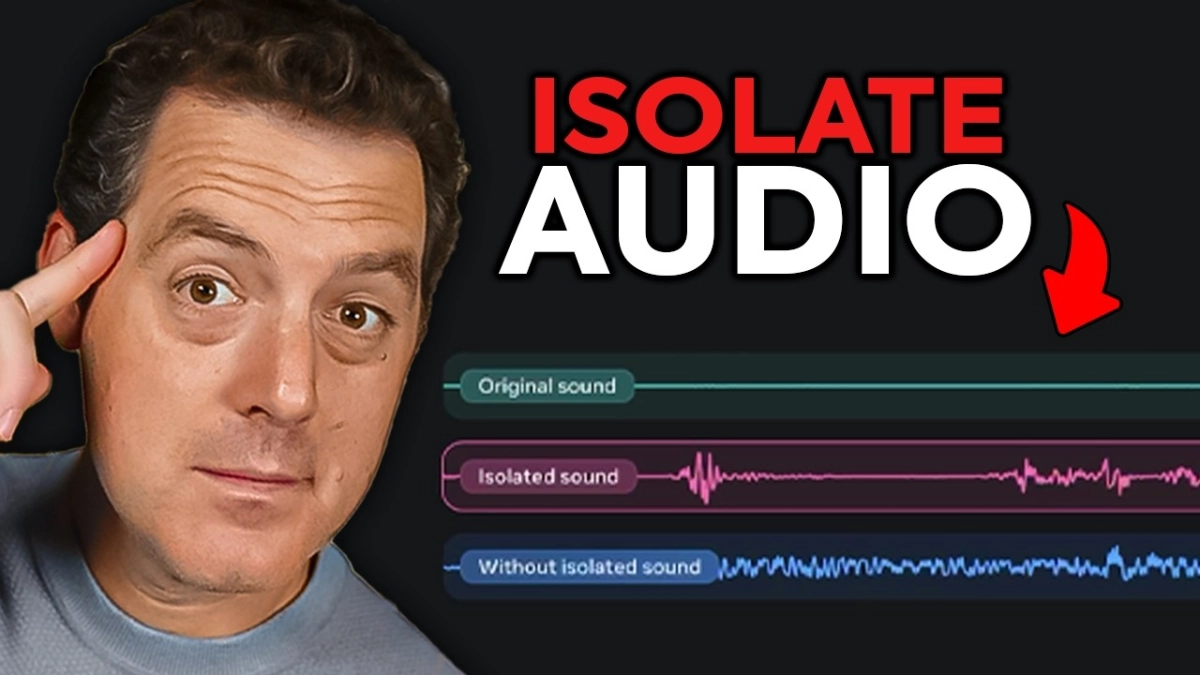
Meta has quietly released a new open-source AI model, SAM Audio, that translates the powerful "Segment Anything" philosophy into the auditory domain, offering granular, prompt-driven sound isolation from complex audio and video sources. The capability is nothing short of revolutionary for content creators and audio engineers, allowing the extraction of a single voice or instrument from a chaotic soundscape with simple text input. This technology signals Meta’s continued strategy of leveraging open-source distribution to accelerate AI adoption and establish foundational models that underpin future application development across the industry.
In a recent video demonstration, host Matthew Berman showcased the functionality of SAM Audio, highlighting its integration within Meta’s broader family of open-source Segment Anything models (SAM 3). This release is significant not just for its performance but for Meta’s ongoing commitment to open-weight AI, providing professional-grade tools previously confined to specialized, expensive software to the public for free download and modification. The core mechanism allows users to upload a video or audio file and simply type a natural language description—such as "woman," "footsteps," or "guitar"—to instantaneously generate isolated audio tracks.
The most compelling aspect of SAM Audio is its technical precision in noisy, real-world environments. In one demonstration, a clip featuring a woman talking on the phone in a crowded, noisy café was subjected to the model. With the single prompt "voice," SAM Audio instantaneously separated her dialogue from the bustling background chatter, the clanking of utensils, and the sound of people walking past. Berman noted the difficulty of this task even for professional audio engineers, underscoring the AI’s immediate utility for content cleanup: "This stuff is not easy to do."
This functionality extends far beyond simple noise reduction. The model generates three separate tracks: the original sound, the isolated sound, and the inverse—everything without the isolated sound. This inverse track capability is critical for post-production, enabling creators to remove specific elements, such as background music, or to isolate a sound effect like footsteps, as demonstrated in the café scenario. Furthermore, the model allows for sound effects and vocal enhancements to be applied directly to the isolated track, transforming a clean voice isolation into a "Studio Sound" effect with a single click. The ability to isolate specific instruments, such as a guitar, from a full musical track using only a prompt, as shown in a final demo, marks a seismic shift in accessibility for music production and remixing.
Meta’s decision to release this powerful tool as an open model is a major factor in its impact. This democratizes high-fidelity audio engineering, making advanced capabilities available for modification and integration by any developer globally.
Beyond media production, the technology hints at profound applications in consumer devices, particularly in assistive technology. Berman speculated on the integration of SAM Audio into small devices, like specialized earbuds or hearing aids. The capacity to selectively filter and amplify sound based on semantic prompts could effectively grant a user "super hearing," allowing them in a loud environment to isolate and focus solely on a conversation partner’s voice while suppressing surrounding noise like traffic or restaurant din. As Berman observed, "all of a sudden, you can isolate different sounds and you kind of have super hearing all of a sudden." This moves beyond traditional frequency-based noise cancellation toward intelligent, context-aware auditory processing, presenting an enormous commercial opportunity for hardware startups.
The core innovation here is the robust generalization of the Segment Anything approach to the audio domain. By allowing users to define and isolate any sound based on a natural language prompt, Meta is accelerating the convergence of multimodal AI tools. The speed and quality of the segmentation, even when dealing with complex audio overlapping with video (as seen in the Tomb Raider clip where a woman’s scream was isolated from rushing floodwaters), demonstrate a highly sophisticated understanding of sound context and source material. For founders and VCs, SAM Audio represents a new foundational layer for audio-centric startups—from advanced transcription services to real-time communication enhancement platforms, all built upon a freely available, high-performance architecture. The open-source availability ensures rapid iteration and integration across the consumer and enterprise tech stack, cementing Meta’s position as a key driver of open AI innovation.



