

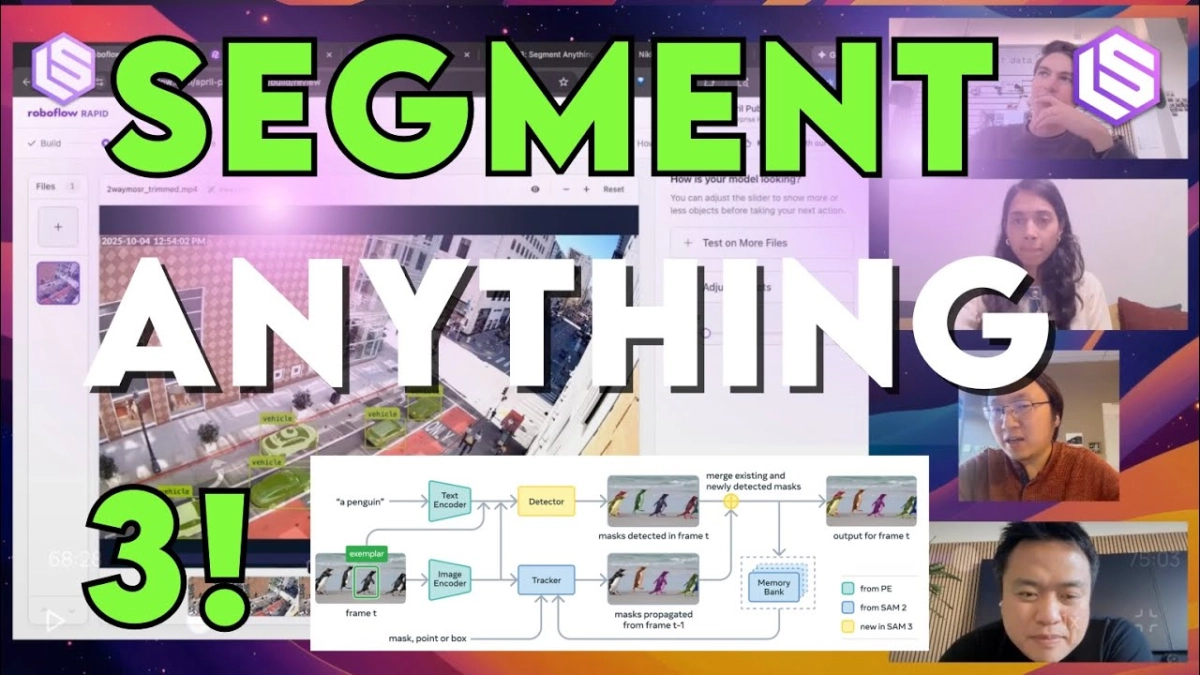
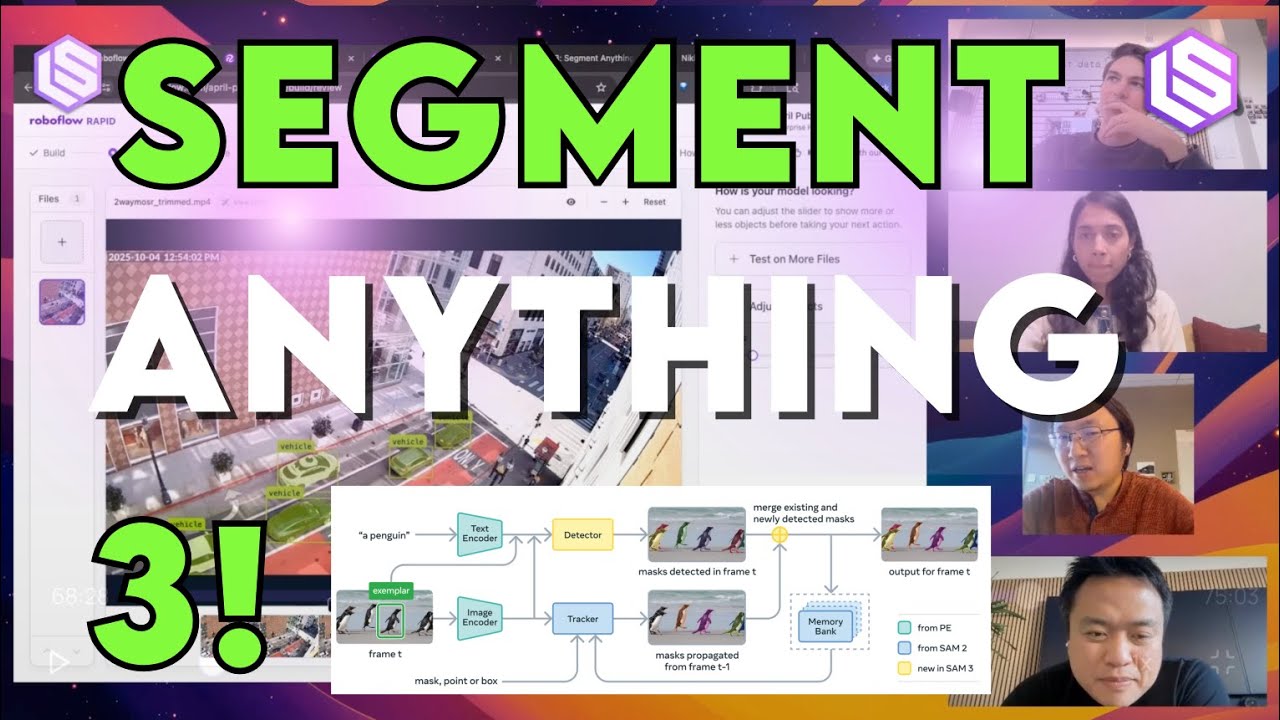
Meta’s latest breakthrough in computer vision, Segment Anything Model 3 (SAM 3), marks a pivotal advancement, moving beyond conventional object recognition to an unprecedented level of understanding and interaction with visual data. This new iteration unifies concept-prompted segmentation, detection, and tracking across images and video in real-time, fundamentally reshaping how AI perceives the world. During a recent discussion on Latent Space, Nikhila Ravi, SAM lead at Meta, Pengchuan Zhang, a senior staff research scientist on the SAM team, and Joseph Nelson, CEO of Roboflow, unpacked the technical innovations and profound real-world implications of this powerful new model.
The conversation quickly honed in on the core capabilities of SAM 3, which Nikhila Ravi clarified is distinct from its 3D counterparts (SAM 3D Objects and SAM 3D Body). At its heart, SAM 3 introduces "concept prompts," allowing users to identify, segment, and track every instance of an object category using natural language phrases like "yellow school bus" or "tablecloth," rather than relying on manual clicks or bounding boxes. This leap from interactive segmentation to open-vocabulary concept segmentation is a significant stride towards human-level exhaustivity in visual understanding.
A key differentiator underpinning SAM 3’s capabilities is its revolutionary data engine and the new SACO (Segment Anything with Concepts) benchmark. As Nikhila Ravi explained, "The data engine really was a very novel and critical component... we put a lot of effort in SAM 3 specifically to try and automate that process a lot." This engine has drastically streamlined the annotation process, reducing the time from two minutes per image (all-human) to a mere 25 seconds (AI verifiers fine-tuned on Llama 3.2). Such efficiency in data generation is crucial for scaling to the SACO benchmark's 200,000+ unique concepts, a massive expansion from previous benchmarks that typically featured only around 1,200 categories. This extensive and diverse dataset enables SAM 3 to truly understand and segment objects based on nuanced natural language descriptions, mirroring human cognitive processes.
The real-world impact of SAM 3 is already proving transformative across a multitude of industries. Joseph Nelson of Roboflow highlighted the practical utility, stating, "Computer vision is where AI meets the real world." He further elaborated on the tangible benefits: "It's not exaggeration to say, like, models like SAM are speeding up the rate at which we... solve global hunger or find cures to cancer or make sure critical medical products make their way to people all across the planet." Roboflow alone has facilitated the creation of 106 million "smart polygons" powered by SAM, saving humanity an estimated 130 years of manual labeling time. This ranges from accelerating cancer research by automating neutrophil counting to improving autonomous drone navigation, underwater trash cleanup, and optimizing logistics for electric vehicle production.
A critical architectural innovation in SAM 3 is the explicit decoupling of its detector and tracker components, alongside the introduction of a "presence token." This token serves to separate the tasks of recognition ("is this concept in the image?") from localization ("where is it in the image?"), simplifying the model's learning process. As Nikhila Ravi clarified, "The other place where negatives play a big role is just 'is it in the image or not'." This allows the model to differentiate between the presence and absence of a concept, leading to more robust and accurate segmentations. Furthermore, SAM 3 Agents integrate the model as a visual tool for multimodal large language models (LLMs) like Gemini, enabling sophisticated visual reasoning tasks such as identifying distinguishing features between similar objects or locating specific items based on complex queries.