


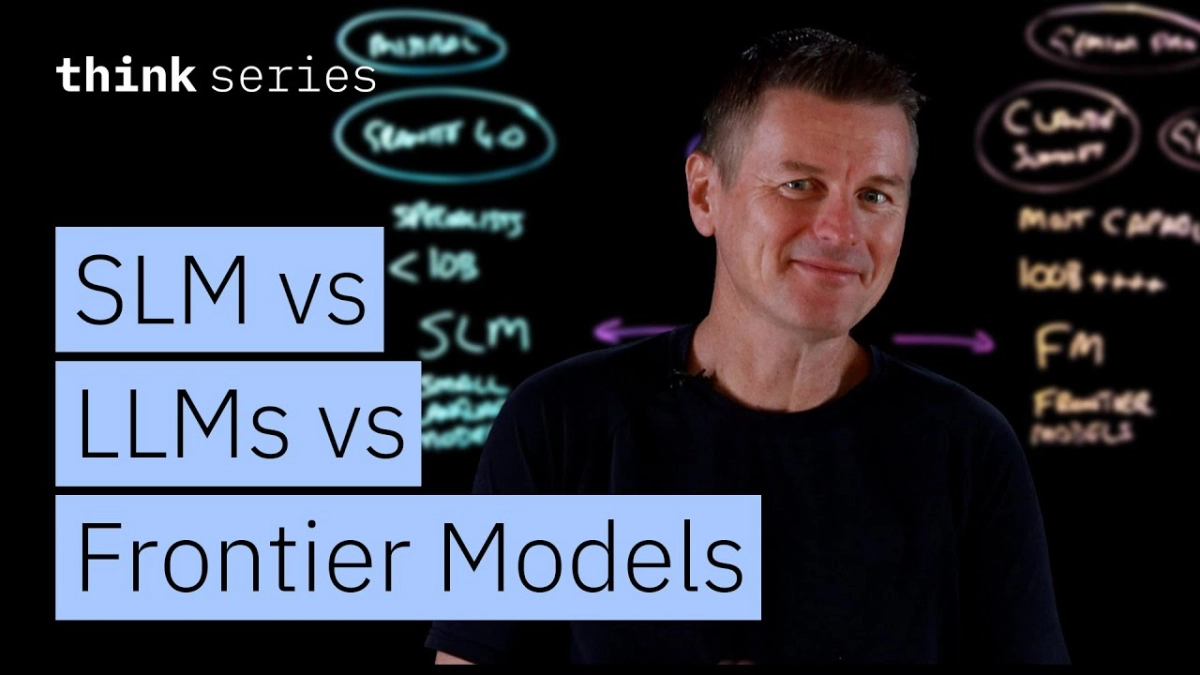
"The choice of AI model is use case-specific." This concise statement from Martin Keen, Master Inventor at IBM, cuts through the current hype surrounding large language models (LLMs) to provide a clear, actionable framework for enterprise leaders navigating the sprawling landscape of generative AI. Keen’s presentation, aimed at demystifying the differences between Small Language Models (SLMs), LLMs, and Frontier Models (FMs), provides sharp analysis on how to strategically match model capability, cost, and governance requirements to specific business needs.
Keen began by positioning LLMs—the models most people associate with AI, boasting tens of billions of parameters—as generalists. These are the broad, open-source workhorses capable of sophisticated, back-and-forth conversations and complex reasoning across multiple domains. However, they are computationally expensive, typically requiring cloud or SaaS environments due to their large GPU memory and processing needs. In contrast, SLMs, with fewer than 10 billion parameters, are presented not as inferior versions, but as efficient specialists. Keen points out that a well-tuned SLM can often "match or even beat these bigger models at focused tasks," operating faster and cheaper. Frontier Models (FMs), the most capable tier, are defined by their sheer scale—often exceeding hundreds of billions of parameters—and deep tool integration, making them the best choice for highly complex, multi-step tasks.
The strategic insight here is that bigger does not always mean better; optimization is key. For many high-volume, repetitive enterprise tasks, the agility and cost-efficiency of SLMs far outweigh the generalist capabilities of LLMs. Keen illustrated this using the example of document classification and routing, a common workflow in industries like insurance or customer service. When a company receives thousands of documents daily, each requiring classification and routing, speed, cost, and governance become paramount concerns. An SLM, fine-tuned for this specific pattern-matching exercise, offers "fast inference from fewer parameters" and "predictable infrastructure costs." Furthermore, for regulated sectors like finance and healthcare, running an SLM on-premise ensures data never leaves the environment, solving critical compliance issues—a non-negotiable advantage.
For more complex applications, like advanced customer support systems, LLMs step into their own. Keen outlined a scenario where a customer support query requires synthesizing data from multiple sources—billing databases, configuration logs, and ticket history—to generate a nuanced solution. Here, the LLM’s inherent "breadth" and capacity for "generalization" become critical. Trained on diverse datasets spanning technical documentation and customer interactions, an LLM can understand the complex relationships between these disparate data points. This allows the model to "generalize to scenarios it hasn’t explicitly seen before" and handle the high variability and edge cases common in customer support, delivering sophisticated, context-aware reasoning that a specialized SLM would struggle to achieve.
The third use case, autonomous incident response, demands the ultimate in reasoning and planning capability, making it the exclusive domain of Frontier Models. In a high-stakes scenario, such as a critical system alert triggered at 2 a.m., the FM needs to perform a multi-step investigation: querying monitoring systems and logs, identifying the root cause, determining the appropriate fix, and then autonomously executing the solution via API calls (e.g., restarting services or rolling back a deployment). Keen stressed that this complex decision-making, which involves maintaining a coherent reasoning chain across extended steps, falls squarely in the "agentic capabilities" wheelhouse of FMs. While today these FMs often operate as "AI co-pilots with some guardrails built in and human sign-off," the underlying capability to plan and execute complex workflows is housed within the most powerful models. For founders and analysts looking at the future of fully autonomous operations, FMs represent the current state-of-the-art required to manage dynamic, high-consequence environments.
Ultimately, Keen’s presentation provides a clear mandate for enterprise AI strategy: match the model to the task. SLMs offer speed, cost control, and governance benefits for straightforward, high-throughput tasks; LLMs provide the necessary breadth and generalization for complex, data-synthesis problems like customer support; and FMs deliver the agentic reasoning required for autonomous, multi-step incident response. The strategic deployment of these different model types—rather than a singular focus on the largest, most powerful AI—is the key to unlocking scalable, cost-effective, and compliant generative AI solutions within the enterprise.


