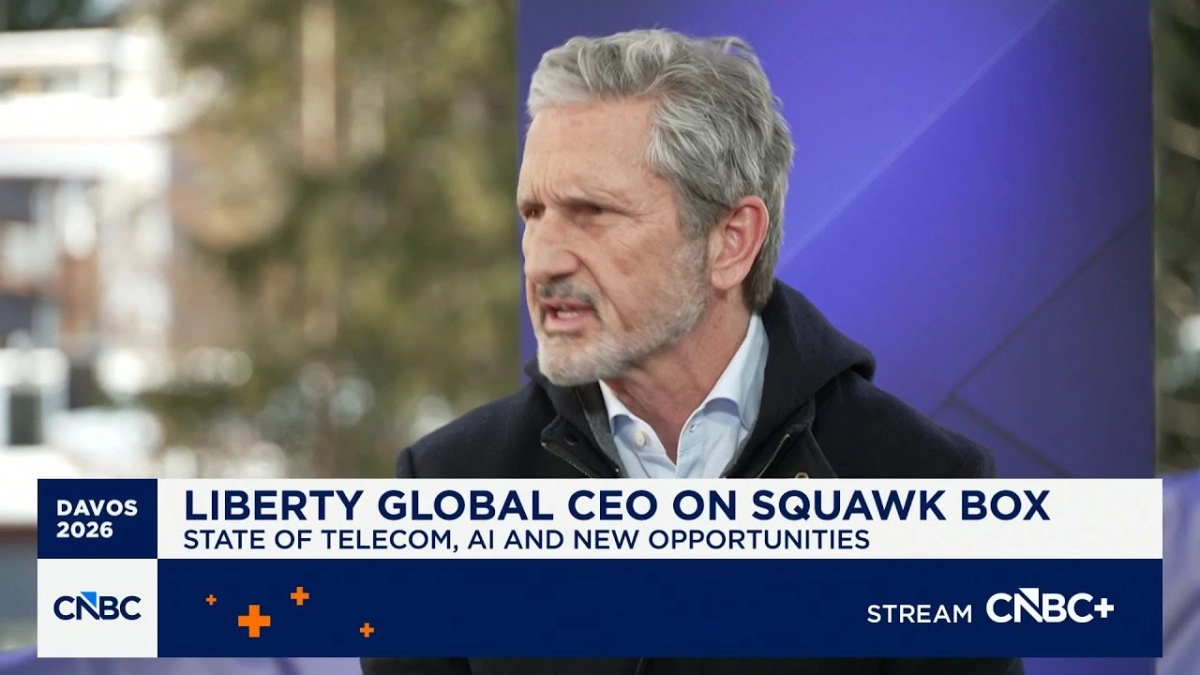
The prevailing mood among global executives at Davos, according to Liberty Global CEO Mike Fries, is one of profound acceleration paired with frustrating underutilization. While discussing the disruptive forces reshaping the telecom sector, Fries articulated a sentiment widely shared among tech insiders: "There’s a 10x gap between what it can do and what we’re doing with it." This immense chasm between AI’s revolutionary potential and its current marginal deployment within established enterprises defines the immediate challenge for CEOs globally. The transformative power of generative AI is undeniable, yet the operational mechanisms required to translate theoretical capability into systemic cost savings and value creation are proving difficult to implement at scale.
Fries, speaking with the anchors of CNBC's Squawk Box at the World Economic Forum in Davos, offered a view spanning geopolitical shifts, European competitiveness, and the transformative demands of artificial intelligence. As an American CEO running a major European telecom and media conglomerate, his perspective bridged the Atlantic divide, providing insight into how macro instability is paradoxically driving localized economic strengthening across the continent. His company, Liberty Global, operates at the intersection of media distribution, telecommunications infrastructure, and high-growth investments, giving him a unique vantage point on global capital flows and technological adoption.

The political friction often dominating transatlantic headlines, Fries suggested, might ultimately serve as a catalyst for European industrial policy. He characterized the current political climate as potentially leading to "a more muscular Europe. One that’s more focused on industrial policy, on defense spending, on the things that it needs to do for itself to get the economies going." This shift implies a realization among EU leaders that relying solely on external stability is no longer viable, forcing a renewed focus on internal economic and defense resilience. For investors and founders, this means understanding that Europe is entering a phase where state support and centralized policy, particularly in critical infrastructure and defense technology, may supersede the pure free-market ideology often championed in the U.S. This growing governmental focus on industrial strength could create significant opportunities for strategic partnerships and government contracts for local tech firms, even as regulatory scrutiny remains high.
Despite the short-term political volatility, Fries maintained a long-term optimism regarding transatlantic ties. He dismissed concerns over lasting damage to the US-Europe partnership as "a red herring," noting pragmatically that political cycles change. "I don’t believe the relationship will change fundamentally over the long haul," he stated, adding a wry observation that current political figures "won't be president forever." For business leaders operating globally, this perspective suggests weathering immediate political storms while trusting in the foundational strength of established international economic systems. The deeper integration of defense and economic interests between the two blocs, driven by shared concerns about global stability and competition with Asian powers, remains fundamentally intact, regardless of temporary diplomatic noise.
In the context of technology, the conversation pivoted back sharply to the operational challenge of AI. Fries admitted that while AI is currently delivering incremental gains—making customer service calls "a little better," for instance—the true, transformative efficiency remains elusive. He contrasted these "marginal improvements" with the necessary, radical shifts that AI promises. He shared a pointed exchange with a major tech CEO, crystallizing the expected return on AI investment: "I spend 14 billion a year on OpEx. I want it to be seven. He said send me your P&L, and we’ll go through it." This anecdote perfectly captures the high-stakes, bottom-line focus VCs and founders must address: AI must move beyond optimization and deliver exponential, structural cost reduction. For telecom providers, burdened by vast operational expenditure, AI represents the primary lever for realizing radical margin improvement, yet the path to achieving that 50% cut remains complex and execution-dependent. The immediate concern for large-scale operators is not whether AI works, but how quickly they can integrate it to fundamentally alter their cost structure and customer experience before competitors achieve the same breakthrough.
Liberty Global's core business model, characterized by Fries as a "classic value play," centers on aggressively unlocking the embedded value of its telecom assets, often undervalued by the broader market. This strategy includes spinning off businesses, such as the recently listed Swiss unit, to appeal to local investors seeking "national champions" and consistent dividends. The goal is to bring these assets to local markets where they are better appreciated by investors who "like dividends, who want to own national champions." This localization strategy is crucial in the fragmented European regulatory environment, where pan-European consolidation remains challenging.
Complementing this core telecom focus is strategic investment in high-growth, diversified assets, notably Formula E, the electric racing series. Fries highlighted the rapid technological progression in electric mobility, noting the physics are favorable: "The physics of this are that it’s going nowhere but up." He emphasized the rarity and value of owning one of the eight global sports properties, positioning these media and infrastructure investments as key drivers of future growth and value appreciation, offsetting the slower, more regulated growth environment of European telecom. Liberty Global’s portfolio management demonstrates a keen understanding of arbitrage opportunities—selling mature, stable telecom cash flows to dividend-focused investors while retaining stakes in volatile, high-upside ventures driven by technological leaps. The company’s ability to navigate these diverse assets, from sprawling European cable networks to electric racing leagues, is a core element of its value creation narrative.
The interview concluded with a brief mention of the ongoing media consolidation, specifically the potential for major content deals involving Warner Bros. Discovery (WBD). Fries, whose company shares historical ties with WBD via John Malone, expressed strong satisfaction with the outcome for shareholders, framing it as a "testament to the value of IP and content." He acknowledged that regardless of the outcome of ongoing media merger discussions, the resulting entity would invariably become a crucial content partner for Liberty Global's distribution network.