


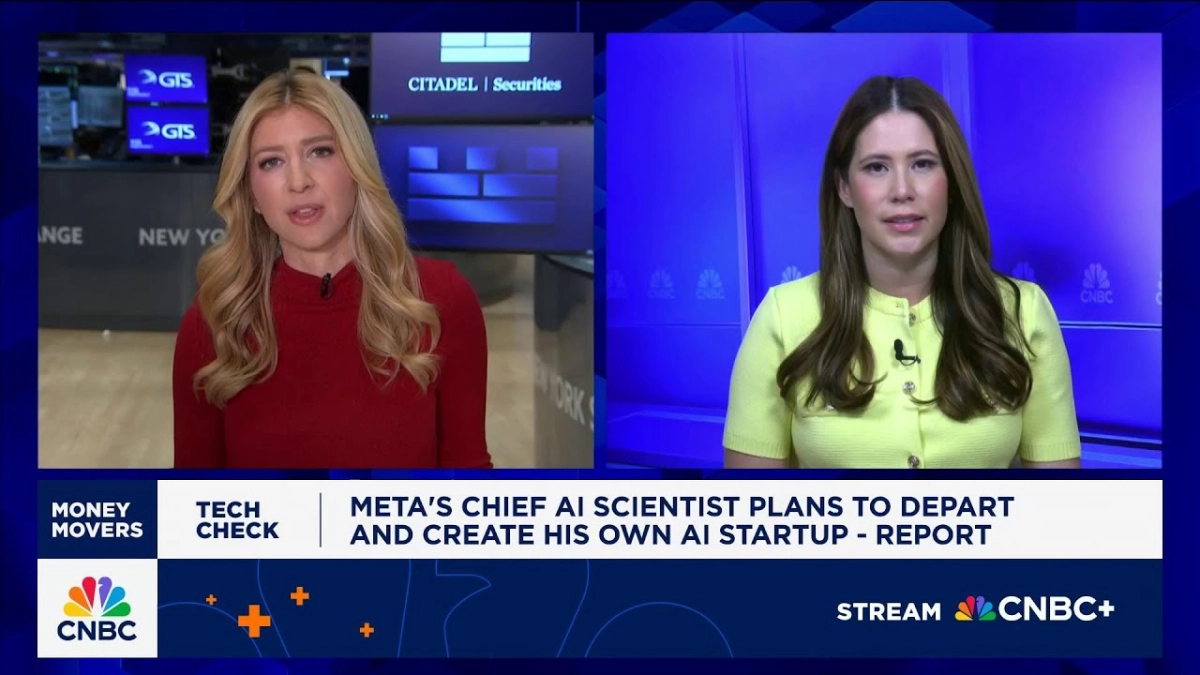
The reported departure of Yann LeCun, Meta's Chief AI Scientist, to launch his own AI startup underscores a profound divergence in artificial intelligence development philosophy, particularly within the behemoth of Big Tech. This move, highlighted by CNBC's Deirdre Bosa on 'Money Movers,' suggests a significant shift in the strategic landscape of AI, moving beyond the current "bigger is better" paradigm that dominates much of the industry. LeCun, a figure of immense stature in the AI community, is not merely another researcher; he is a pioneer of modern AI, whose contributions to deep learning have been foundational.
Deirdre Bosa, speaking with the 'Money Movers' anchors, detailed the implications of LeCun's reported exit, drawing from a Financial Times report. She noted that LeCun has consistently been "one of its most outspoken skeptics" regarding the hype surrounding generative AI and the race for super intelligence. This skepticism has increasingly put him at odds with Meta CEO Mark Zuckerberg's aggressive push to commercialize Meta's AI efforts. While Meta has invested heavily in AI, including its Llama models, the company's trajectory and LeCun's vision appear to be on different paths.
A core insight emerging from this development is the tension between rapid commercialization and foundational research in AI. Meta, under Zuckerberg, has poured billions into AI, aiming for widespread product integration and a competitive edge against rivals like OpenAI and Google. However, this pursuit has seemingly led to a situation where Meta’s initial AI successes, such as the Llama model, have "fallen way down in the LLM rankings," as Bosa pointed out, being superseded by newer, often open-source, Chinese models. This decline in competitive standing for a model once considered among the most capable open-source options suggests that Meta’s current strategy might be sacrificing long-term, deep innovation for short-term product cycles and market visibility. LeCun’s long-held view, encapsulated in a CNBC graphic stating, "Artificial intelligence is not yet as smart as a dog," reflects a more grounded, perhaps more patient, approach to achieving true intelligence.
LeCun's reported next venture centers on "world models," which Bosa described as "AI that learns by observing the physical world." This represents a "slower burn approach," focused on understanding how intelligence fundamentally works, rather than simply scaling up existing models. This philosophical contrast is stark: a methodical, research-driven quest for human-level intelligence versus a market-driven race for larger models and immediate commercial applications. The industry, particularly the startup ecosystem and venture capital firms, must now consider which path holds greater long-term promise. Is the future of AI truly about sheer scale, or does it lie in a more nuanced, biologically inspired understanding of intelligence?
Another critical insight revolves around the financial and strategic viability of Big Tech's current AI spending. Meta’s reported annual expenditure of "more than $70 billion a year" on AI, without the diversified revenue streams of a cloud business like Amazon, Google, or Microsoft, raises significant investor questions. The anchors discussed how investors favor "enterprise AI" because "you can actually see a return on investment." This stark financial reality highlights a potential misallocation of resources within Meta, where vast sums are dedicated to ambitious, long-term AI projects (like the metaverse and advanced AI research) without clear, near-term monetization strategies. The departure of top talent like LeCun, and others from companies like OpenAI, to pursue their own ventures, suggests a growing belief that innovation, especially in more fundamental areas of AI, may be better fostered outside the constraints and commercial pressures of large corporations. These new ventures, while requiring significant funding, often attract billions in seed rounds, illustrating the market’s appetite for disruptive, research-heavy startups that challenge the established giants.
The exodus of a figure as prominent as Yann LeCun from Meta is more than just a personnel change; it is a bellwether for the evolving landscape of AI. It signals a potential bifurcation in the field, with some pursuing grand, "moonshot" goals of super intelligence through massive computational power and data, while others, like LeCun, advocate for a more foundational, "slower-build" approach rooted in deeper understanding. This strategic divergence will shape not only the future of AI technology but also the competitive dynamics among tech giants, startups, and the investors backing them. The question remains whether Meta can reconcile its aggressive commercialization strategy with the kind of fundamental research that once allowed it to lead, or if it will continue to see its pioneering minds seek new, independent avenues for innovation.

