

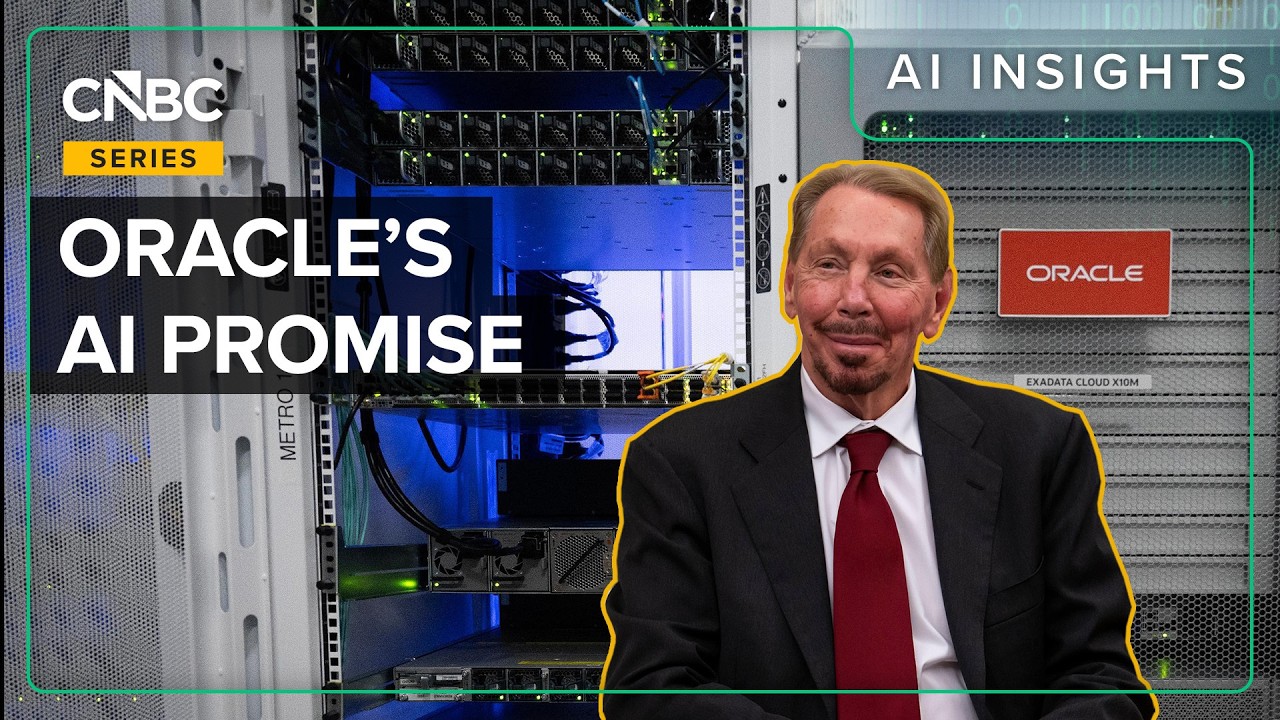
Larry Ellison's AI Ambitions Face Investor Scrutiny

Oracle's ambitious AI data center expansion, heavily reliant on OpenAI, faces increasing investor scrutiny over debt and execution amidst a competitive AI landscape.

Mar 10 at 2:31 PM4 min read
Aerial view of a large, under-construction data center campus with multiple buildings.

The relentless pursuit of artificial intelligence has spurred a massive wave of investment in data center infrastructure. Oracle, a legacy enterprise software giant, is making a significant play in this burgeoning market, aiming to become a key player in the AI ecosystem. However, this ambitious push, particularly its deep ties with OpenAI, is now facing increased scrutiny from investors who are questioning the financial viability and strategic execution of its AI-driven expansion.

Larry Ellison's AI Ambitions Face Investor Scrutiny — from CNBC

The Oracle AI Offensive

Oracle, founded in 1977 by Larry Ellison, Larry Ellison, the Executive Chairman and CTO, is doubling down on its cloud computing capabilities to support the rapidly growing demand for AI. The company has been actively constructing vast data center campuses, with a notable presence in Abilene, Texas, as part of its 'Stargate' project. This aggressive expansion aims to position Oracle as a formidable competitor against established cloud giants like Amazon Web Services (AWS), Microsoft Azure, and Google Cloud.

The video highlights several key developments and news cycles surrounding Oracle's AI strategy. Early reports from September 2025 indicated a substantial $300 billion cloud deal between OpenAI and Oracle, positioning Oracle as a critical infrastructure provider for the AI research lab. This partnership was seen as a major coup, potentially elevating Oracle's profile in the AI race and solidifying its role in supporting cutting-edge AI development.

However, as the AI boom intensified, so did the financial demands. Tyler Radke, a Senior Equity Research Analyst at Citi, noted that while the OpenAI deal validated many of Oracle's investments, the company was still a 'laggard' in the traditional cloud build-out space. This suggests that while Oracle is making significant strides, it faces an uphill battle to catch up with its more established competitors.

Investor Concerns and Market Reaction

Despite the initial enthusiasm, investor sentiment began to shift as the scale of Oracle's AI ambitions and the associated financial commitments became clearer. Reports from October 2025 indicated that Oracle Cloud planned to deploy 50,000 AMD AI chips, signaling new competition for Nvidia. Yet, even as Oracle announced these strategic moves, concerns about its debt load started to mount. Analysts began questioning the company's ability to fund its massive data center expansion, with projections suggesting Oracle might need to borrow between $50 billion to $100 billion, potentially at interest rates of 30-40% higher than expected. This financial pressure could significantly impact Oracle's earnings power.

The market's reaction reflected these growing concerns. A report from MarketWatch in December 2025 highlighted that Oracle's mixed earnings failed to dispel fears about its AI strategy, leading to a stock price decline. Investors were reportedly seeking more detailed financial transparency regarding the data center expansion plans, and the company's performance in securing AI-related business was under scrutiny. The narrative began to shift from overwhelming optimism to a more cautious assessment of Oracle's ability to execute its grand AI vision.

Further compounding these concerns, reports surfaced in December 2025 suggesting that OpenAI itself was facing pressure, with competitors like Google's Gemini and Anthropic's Claude gaining market share. This raised questions about Oracle's heavy reliance on a single, albeit dominant, AI player, and whether its strategy was sufficiently diversified to weather potential shifts in the AI landscape.

The Path Forward and Oracle's AI Barometer

In February 2026, Reuters reported that Oracle shares gained as a $50 billion raise eased data center funding fears. This capital infusion, intended for debt and equity financing, signaled a move to bolster investor confidence. The market reacted positively to Oracle's willingness to diversify its funding beyond solely relying on debt, indicating a more balanced approach to its AI infrastructure build-out.

However, the underlying challenge remains. The AI market is a multi-trillion-dollar opportunity, but it demands immense capital and technological expertise. Analysts like Gil Luria from D.A. Davidson suggested that Oracle's ability to secure the necessary capital and expertise is crucial for its success. He posited that if Oracle cannot secure sufficient funding or if its partnerships falter, the company could find itself in a challenging position, potentially having to shorten contracts or seek alternative solutions.

Ultimately, Oracle's aggressive AI strategy is being closely watched as a bellwether for the broader AI infrastructure market. Its success or failure in building out its data center capabilities and securing key partnerships like the one with OpenAI will not only determine its own future but also serve as a critical case study for the industry's ability to scale and capitalize on the AI revolution.