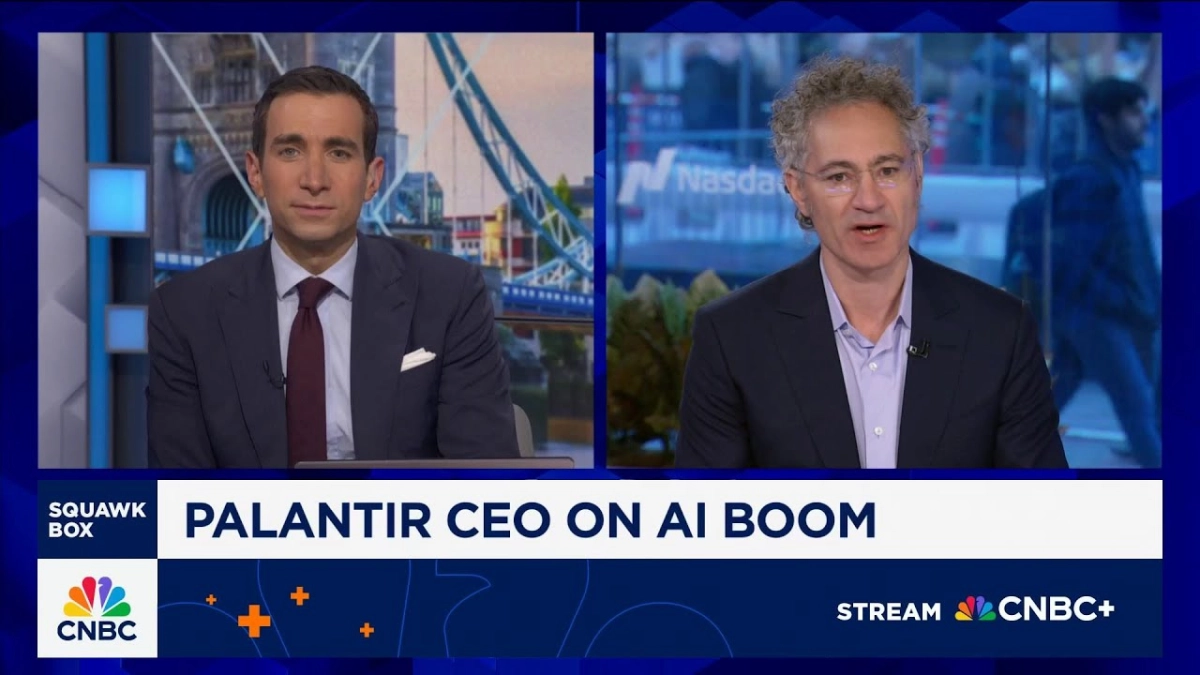
Palantir CEO Alex Karp, in a recent appearance on CNBC's Squawk Box, offered a characteristically direct and unvarnished perspective on the burgeoning artificial intelligence landscape. While discussing Palantir's quarterly earnings and growth outlook with interviewer Andrew Ross Sorkin, Karp pivoted quickly to the core economic and societal questions surrounding the AI boom, particularly addressing concerns about an AI bubble and the distribution of its benefits. His central thesis: the long-term viability and societal acceptance of the AI revolution hinge on whether it genuinely expands the economic pie for the broader populace, not merely a select few.
Karp cut through the speculative fervor by asserting a fundamental economic principle. "There are two subtle issues in AI. One is the addressable market, and one is the addressable market for things that work," he stated, drawing a sharp distinction between theoretical potential and tangible, quantifiable value creation. He emphasized that for AI to avoid becoming a bubble, every component of the technology stack must generate more value than its cost. If this "Pareto optimality" is not achieved, then indeed, a bubble is inevitable. Palantir, he implied, occupies the segment of the market where its AI products demonstrably work, whether in commercial applications or on the battlefield, yielding measurable top-line and bottom-line growth.
The Palantir CEO challenged the prevailing narrative by introducing a critical metric: "worker-available GDP." This concept pushes beyond mere aggregate economic growth to question how much of AI's purported productivity gains are actually accessible to and benefit the average worker. It's a nuanced but vital distinction, moving the conversation from abstract economic models to the tangible impact on livelihoods and societal stability.
Karp's argument resonates with a growing concern among policymakers and the public alike: that technological advancements, while boosting overall GDP, often exacerbate wealth inequality. He articulated this sentiment starkly: "The average American believes AI is happening. They're just not sure if it's going to happen for them or it's just me getting rich." This highlights a profound societal challenge inherent in the current AI trajectory.
For Karp, this isn't merely an economic quandary but a foundational societal imperative. "That's the battle we have to fight because if you want a sane society, you can't just have GDP growth for us and no GDP growth for them," he declared. The implication is clear: a truly transformative and sustainable AI revolution cannot leave a significant portion of the workforce behind. This requires intentional design and deployment of AI solutions that augment human capabilities and create new opportunities, rather than solely automating existing jobs or concentrating wealth.