

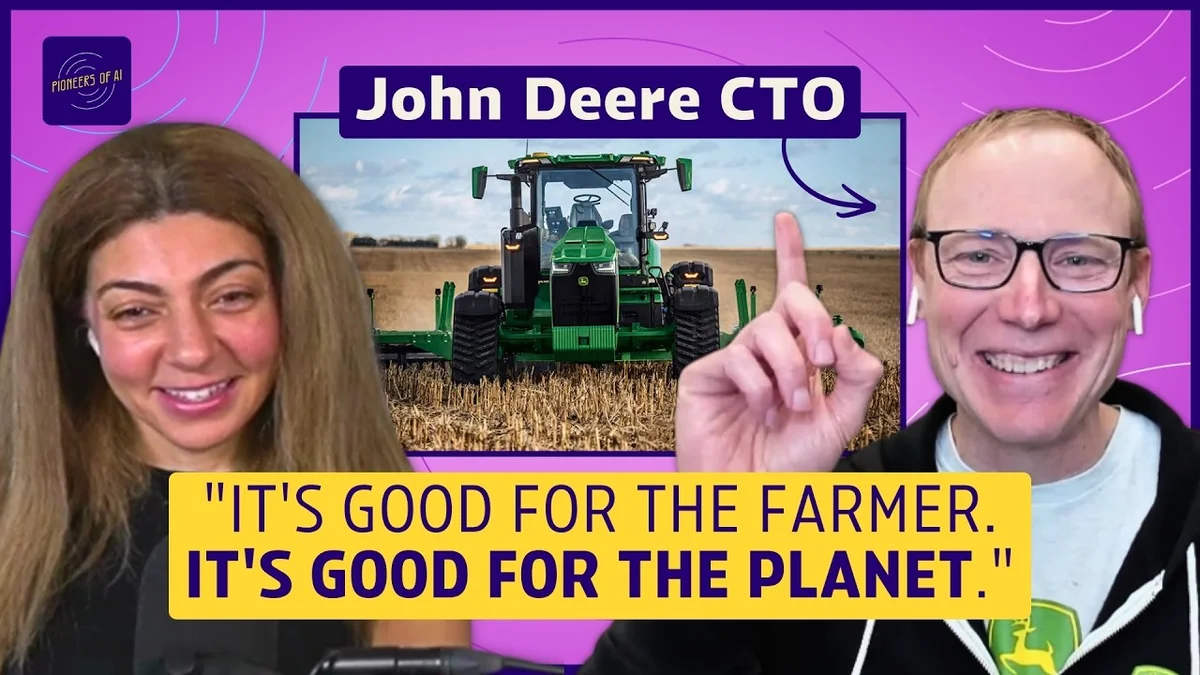
John Deere CTO on AI's Role in Farming

John Deere's CTO, Jahmy Hindman, discusses the company's vision for AI in agriculture, from precision planting to data-driven farming insights.

John Deere CTO Jahmy Hindman discusses AI in agriculture.
Image credit: Pioneers of AI· Pioneers of AI

Jahmy Hindman, Chief Technology Officer at John Deere, recently shared insights into the company's ambitious vision of bringing artificial intelligence to every acre of farmland. In a "Pioneers of AI" interview, Hindman elaborated on how AI is transforming agriculture, enabling more precise farming practices, identifying inefficiencies, and ultimately boosting productivity.

The Vision for AI in Agriculture

Hindman articulated John Deere's core mission: to create a "mechanized farm" and deliver a "master gardener experience for every one of those seeds." This translates to ensuring that each seed is treated precisely where and when it needs to be. AI, he explained, is the key technology enabling this vision by allowing for the interrogation of inefficiencies within the current agricultural system and paving the way for more effective operations.

Related startups

From Tractors to Precision Agriculture

With a history spanning nearly 200 years, John Deere has consistently adapted to technological advancements. Hindman highlighted the pivotal moment in the early 1900s when the internal combustion engine replaced animal power, leading to the development of the tractor. This shift allowed farmers to move beyond manual labor and embrace greater efficiency. Today, John Deere is again at the forefront of technological evolution, integrating AI and advanced sensing capabilities into its equipment.

The full discussion can be found on Pioneers of AI's YouTube channel.
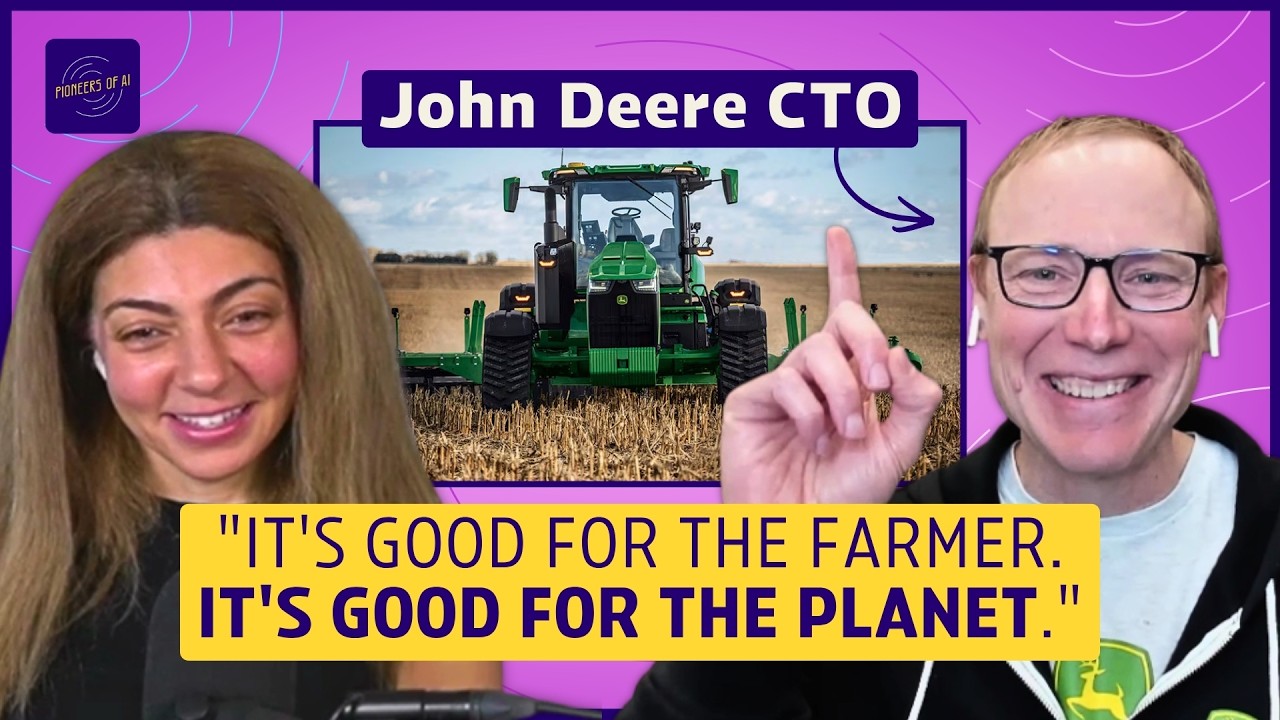
John Deere's CTO on bringing AI to every acre of farmland | Pioneers of AI - Pioneers of AI
John Deere's CTO on bringing AI to every acre of farmland | Pioneers of AI — from Pioneers of AI

Hindman detailed how the company is developing AI-powered tools that analyze vast amounts of data collected from sensors on the farm. For instance, on a large cornfield, with four trillion seeds planted annually, AI can help monitor each one. The company uses computer vision and machine learning to identify specific needs of plants, such as water or nutrient deficiencies, allowing for targeted interventions. This precision agriculture approach not only optimizes resource use but also minimizes environmental impact.

Data-Driven Insights for Farmers

The data collected by John Deere's intelligent machines is crucial for providing farmers with actionable insights. Hindman explained that the company is building a robust data infrastructure that allows farmers to access information about their fields, crop health, and the performance of their equipment. This data can be used to make more informed decisions about planting, fertilizing, pest control, and harvesting, ultimately leading to better yields and profitability.

For example, the company's systems can create detailed yield maps, showing variations in crop production across different sections of a field. This allows farmers to identify areas that may require special attention or different treatment strategies in the future. The ability to leverage this data is a significant step towards a more sustainable and efficient agricultural future.

The Role of AI in Feeding the Planet

Hindman emphasized the broader societal impact of bringing AI to agriculture. With a growing global population and the increasing challenges posed by climate change, optimizing food production is more critical than ever. AI-powered farming can help increase yields, reduce waste, and conserve resources, contributing to global food security. John Deere's commitment to innovation in this space is a testament to its role in shaping the future of food production.

© 2026 StartupHub.ai. All rights reserved. Do not enter, scrape, copy, reproduce, or republish this article in whole or in part. Use as input to AI training, fine-tuning, retrieval-augmented generation, or any machine-learning system is prohibited without written license. Substantially-similar derivative works will be pursued to the fullest extent of applicable copyright, database, and computer-misuse laws. See our terms.