

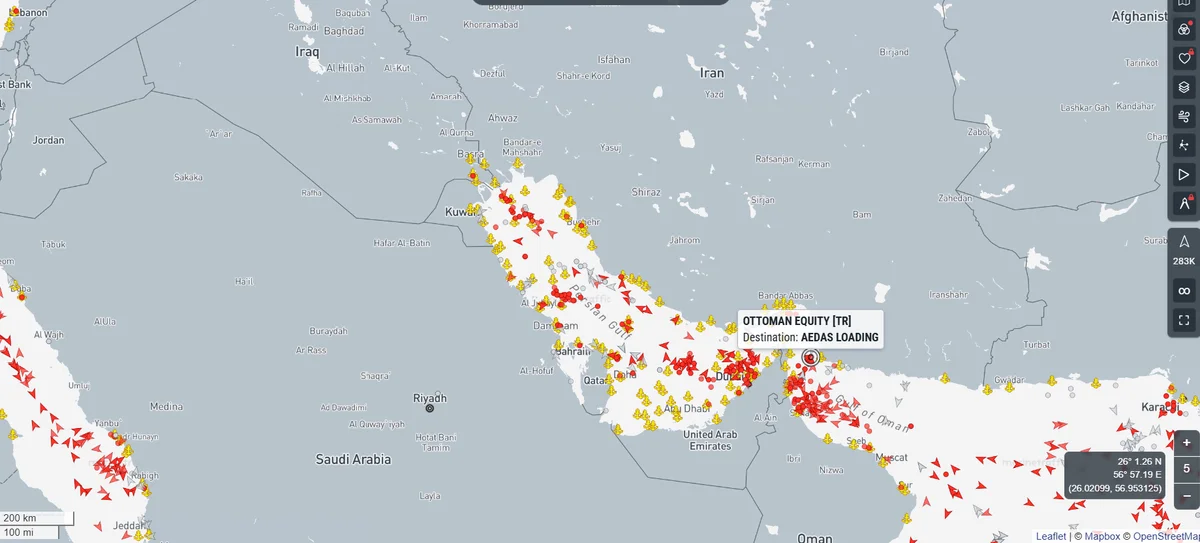
Updated 4 May 2026 — Abu Dhabi. The United Arab Emirates came under Iranian fire for the first time since the 8 April ceasefire on Monday, with the UAE Defence Ministry reporting four cruise missiles fired from Iran — three intercepted by air defences, one falling into the sea — and a separate drone attack that sparked a fire at a key oil facility in the eastern emirate of Fujairah. Three people were injured.
The UAE Foreign Ministry separately confirmed that two drones struck an Adnoc-affiliated tanker transiting the Strait of Hormuz earlier in the day. No crew were injured. The UK Maritime Trade Operations agency reported a second tanker off Fujairah was hit by unidentified projectiles, with all crew safe.
The strikes coincide with the start of Project Freedom, US President Donald Trump's operation to escort the roughly 2,000 vessels — and an estimated 20,000 seafarers — that have been trapped in the Persian Gulf since the war began. US Central Command has committed destroyers, more than 100 aircraft, unmanned platforms and about 15,000 service members to the effort.
Iran calls Project Freedom a ceasefire violation
Tehran framed Monday's strikes as a direct response. Ebrahim Azizi, head of the Iranian parliament's National Security Commission, warned that "any US interference in the Strait of Hormuz would be considered a violation of the ceasefire that has been in effect since April 8."
Iran has not formally claimed the tanker attacks, but the timing — within hours of the first US-flagged merchant ships transiting the strait under Navy escort — leaves little ambiguity about the message.
The wider war: 2,800+ missiles and drones since February
Monday's exchange is the latest chapter in the broader conflict that began on 28 February 2026, when coordinated US and Israeli strikes hit Iranian military and nuclear-related sites. Iran retaliated by opening a multi-front campaign against US allies in the Gulf, with the UAE bearing the heaviest civilian impact.
Through the first ceasefire on 8 April, Iran fired more than 2,800 missiles and drones at the UAE alone. UAE air defences — built around THAAD and Patriot systems — intercepted 537 ballistic missiles, 2,256 drones and 26 cruise missiles. The cumulative cost of the war on the UAE: 13 dead (two military personnel, one contractor, ten civilians) and 224 injured, with civilian disruption across Abu Dhabi, Dubai, Sharjah and Fujairah.
Oil production in the UAE dropped by an estimated 500,000 to 800,000 barrels per day at the peak of the strikes — the largest single-country output cut in the Gulf since Saudi Arabia's 2019 Abqaiq attack.
The shift in Emirati posture
The UAE — historically the most cautious of Gulf states, preferring back-channel diplomacy and economic ties with Tehran — has visibly hardened. Abu Dhabi co-signed the March joint statement with Saudi Arabia, Bahrain, Kuwait, Oman and Qatar condemning Iran's regional missile and drone campaign, an unusually direct attribution.
By early April the UAE was openly weighing a more direct role in securing the Strait of Hormuz against Iranian mining and harassment — a departure from its long-standing preference for restraint.
What's stranded in the Gulf
The IMO estimates roughly 2,000 vessels are stuck on the Iranian side of the strait, including crude tankers, LNG carriers, container ships, bulk carriers and several cruise liners. Many crews have been on board for over two months. Project Freedom's stated humanitarian framing — guiding stranded ships out — is the political cover for what is, operationally, the most significant US naval movement in the Gulf since 1988's Operation Praying Mantis.
What to watch this week
- Tanker insurance markets. Lloyd's war-risk premiums on Hormuz-routed hulls jumped sharply Monday afternoon — a leading indicator of how the merchant fleet itself reads the risk.
- Oil prices. Brent reaction will signal whether the market believes the ceasefire is meaningfully broken or this is a one-day exchange.
- Saudi and Qatari posture. Both have so far avoided being drawn in directly. A second strike day on UAE soil would test that.
- Iranian domestic signalling. Whether Tehran officially claims today's strikes — versus letting them be ambiguous — will tell us how committed Khamenei is to a renewed escalation cycle.
Sources: UAE Ministry of Defence statements (4 May 2026); UAE Ministry of Foreign Affairs; UKMTO advisories; US Central Command briefings; Al Jazeera; CNN; Reuters; The National (Abu Dhabi).
