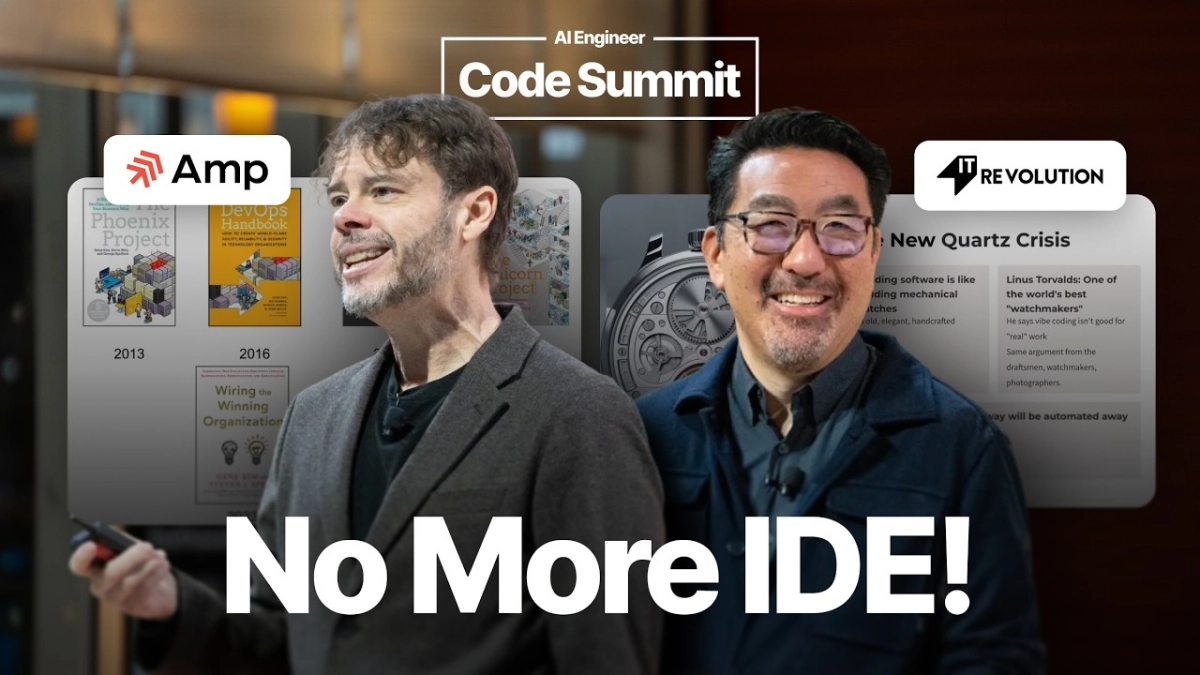
"It just doesn't make sense to me that human beings would stop interacting at all with source code until we get to like AGI, I guess, where human beings aren't going to be doing a lot of different things." This provocative statement from Nathan Sobo, founder of Zed, cuts directly to the heart of a burgeoning debate: the future of Integrated Development Environments (IDEs) in an era increasingly dominated by AI coding tools. In a recent interview with Sonya Huang and Pat Grady of Sequoia Capital, Sobo, a veteran IDE builder known for Atom at GitHub, articulated a compelling vision for how visual code interfaces will not only survive but thrive by becoming the essential nexus for human and artificial intelligence collaboration.
Sobo's core argument hinges on the fundamental nature of source code itself. Despite the allure of terminal-based AI interactions and large language models (LLMs) that generate code through natural language prompts, Sobo contends that code is inherently a human language. He cites the esteemed computer science professor Harold Abelson, who famously stated, "Programs should be written for people to read and only incidentally for machines to execute." This perspective suggests that while AI can certainly assist in generating code, the critical act of understanding, reviewing, and refining it remains firmly within the human domain, necessitating a robust visual interface.

The current landscape of AI coding tools, particularly those operating within terminals, often falls short in providing the rich context and comprehensive overview essential for human comprehension. Sobo highlights the problem of reviewing AI-generated code through a mere ten-line excerpt in a terminal, a process he likens to viewing a complex landscape through a tiny peephole. Such limited visibility makes it challenging to grasp the broader implications of AI edits, understand their interconnectedness within a larger codebase, or effectively provide nuanced feedback. This restricted view underscores a critical insight: human developers require a holistic, visual representation of code to truly interact with it meaningfully.
Sobo's conviction that the IDE remains indispensable stems from his belief that the ultimate user interface for coding must facilitate this human-centric interaction. Without visual tools, developers are left to mentally reconstruct the codebase, a cognitive burden that detracts from higher-order problem-solving and collaboration.
This leads to Sobo's vision for a new paradigm of collaboration, one that transcends the limitations of asynchronous, Git-based workflows. While Git has been foundational for distributed teams, its snapshot-oriented approach often fragments conversations and context across pull requests and external communication channels. Sobo envisions a future where collaboration is deeply integrated and synchronous, allowing humans and AI agents to interact with code in real-time, within a shared, persistent context. Zed, his latest venture built from scratch in Rust with GPU-accelerated rendering, is designed to embody this vision. The Agent Client Protocol (ACP) positions Zed as "Switzerland" for various AI coding agents, enabling seamless integration and communication between different AI tools and the human developer.
Sobo's journey to Zed was born from hard-won lessons, particularly from his experience with Atom. While Atom, built on web technologies (Electron), achieved popularity for its extensibility, it ultimately hit a performance ceiling. "Performance is not a feature that you can really go back and add later," Sobo states, emphasizing that it must be baked into the foundational architecture. This insight drove the decision to build Zed in Rust, prioritizing responsiveness and efficiency from the ground up. This architectural choice is crucial for enabling the high-fidelity, real-time interactions required for advanced human-AI collaboration.
Related Reading
- AI Agents and the Human Brain: Orchestrating the Future of IT
- AIE Code Summit: The Unspoken Rhythms of AI Innovation
- Google's AI Unleashed: Gemini 3 Marks an Era of Action
In this evolving ecosystem, Sobo sees code transforming into a rich metadata backbone. Conversations, edits, and contextual information would be permanently anchored directly to the code, creating a living document that captures the entire evolutionary history and collaborative dialogue around it. This moves beyond mere comments to a dynamic, interactive layer of information that enhances understanding for both humans and AI. The idea is to make the IDE the ultimate interface, not just for writing and executing code, but for understanding and evolving it through continuous, contextualized interaction with multiple intelligences.
For Sobo, the role of AI is not to replace the human programmer but to become a powerful, integrated partner. He envisions AI agents as "spirit beings" or "ghosts" within the code, offering suggestions and making changes that humans can then review, guide, and converse with directly within the IDE. This fine-grained edit tracking and contextual conversation are pivotal to fostering a richer, more productive collaboration layer that asynchronous workflows simply cannot provide. The journey is still in progress, with Zed actively developing these capabilities, but the underlying conviction remains: the visual interface of the IDE, optimized for human understanding and real-time interaction, will be the enduring platform where the future of coding unfolds.