

IBM Master Inventor on AI's Contextual Bottleneck

IBM Master Inventor Martin Keen discusses how context is the key bottleneck for AI models, outlining four pillars of context engineering: connected access, knowledge layer, precision retrieval, and runtime governance.

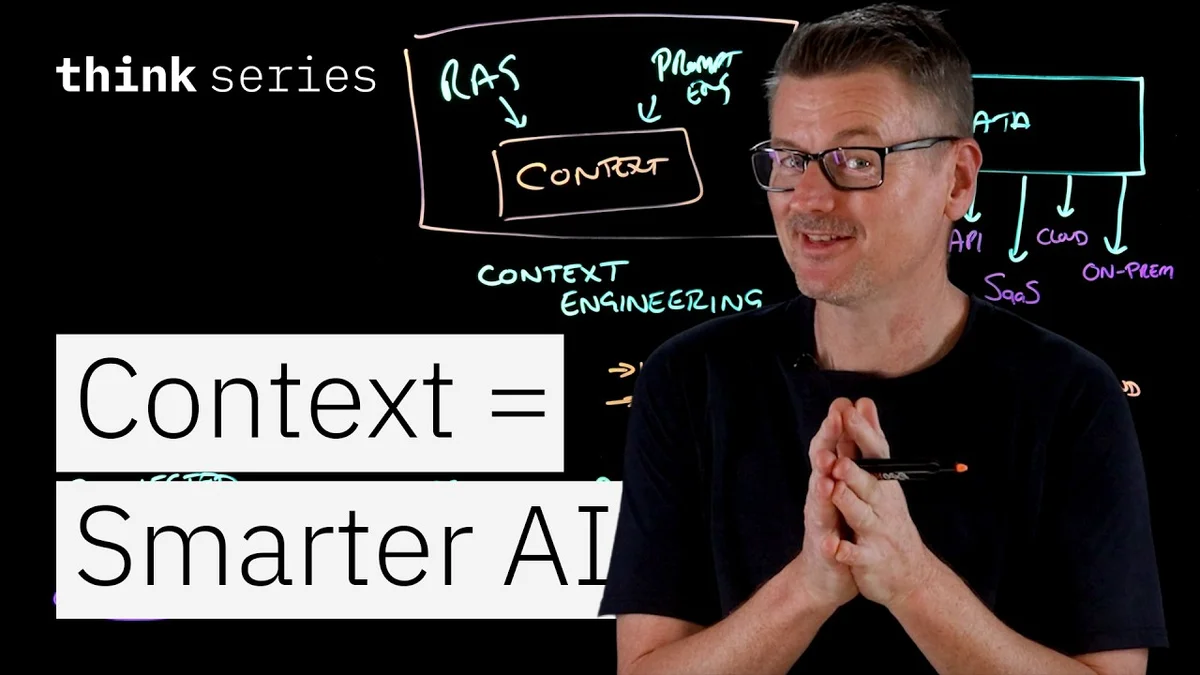
Martin Keen, Master Inventor at IBM, speaking with a marker in his hand.
Image credit: IBM· IBM

Martin Keen, a Master Inventor at IBM, recently shared insights into a critical challenge facing artificial intelligence development: context. In a video discussing the intricacies of AI models, Keen highlighted that the primary obstacle to achieving desired AI performance often lies not within the models themselves, but in the contextual information they receive and process.

Understanding the Contextual Challenge

Keen explained that current AI models, despite their impressive capabilities, can still produce incorrect or unreliable outputs when they lack the necessary contextual understanding. He drew a parallel to his own experience, where he had a list of applications to code but lacked the time or skills to complete them. Similarly, AI models can falter if they are not provided with the right context.

He identified four key pillars for effective AI context engineering:

Related startups

The full discussion can be found on IBM's YouTube channel.
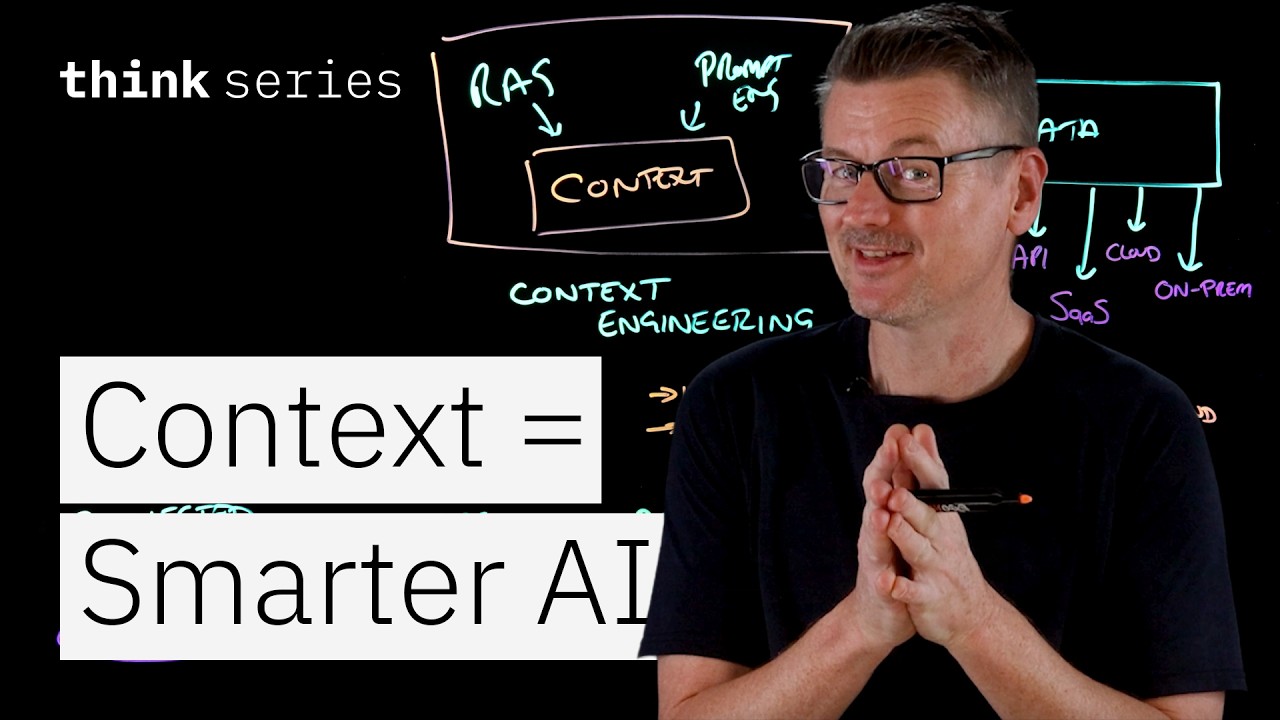
How RAG, GraphRAG, and Context Engineering Improve AI Performance - IBM
How RAG, GraphRAG, and Context Engineering Improve AI Performance — from IBM
  • Connected Access: The AI needs to be able to access data from various sources, including databases, APIs, SaaS platforms, and on-premises systems. This access must be reliable and, importantly, governed by appropriate permissions.
  • Knowledge Layer: Raw data is not always useful. A knowledge layer is needed to process this data, extract meaning, map relationships, and provide structured information such as entity resolution, decision traces, and institutional knowledge.
  • Precision Retrieval: This involves retrieving the most relevant pieces of information from the available data. Standard RAG (Retrieval-Augmented Generation) is effective for simple lookups, but advanced methods like graph RAG and context compression are crucial for more complex scenarios.
  • Runtime Governance: Ensuring that AI models adhere to rules and policies in real-time is essential. This involves controlling the information the AI accesses and how it uses that information to make decisions, making the AI's output defensible.

The Nuances of Retrieval-Augmented Generation (RAG)

Keen elaborated on the different types of RAG. Standard RAG, he noted, involves chunking documents, embedding them into vectors, and then performing a similarity search at query time. While effective for basic lookups, it can struggle with complex relationships and large context windows.

He then introduced two more sophisticated approaches: graph RAG and context compression.

Graph RAG utilizes a graph structure to represent entities and their relationships. This allows the AI to navigate context more effectively, understanding how different pieces of information connect. This approach can uncover deeper insights and provide more nuanced responses.

Context Compression, on the other hand, focuses on reducing the amount of noise in the context provided to the AI. By summarizing, prioritizing, or filtering information, context compression ensures that the most relevant data is presented, improving the AI's efficiency and accuracy, especially when dealing with very large context windows.

The Importance of Contextual Intelligence

Keen emphasized that the ability of an AI model to access and interpret context is paramount to its success. Without proper context, even the most advanced models can produce generic or inaccurate results. He stated, "A model is only as good as the context it can access."

He further explained that context engineering is not just about providing more data, but about providing the right data in the right way. This involves understanding the specific task, the user's intent, the relevant time frame, and the applicable policies. By effectively engineering context, organizations can move beyond simple information retrieval and unlock more sophisticated reasoning and decision-making capabilities from their AI models.

In essence, Keen's insights underscore that the future of effective AI lies in its ability to understand and operate within the complexities of real-world context, transforming raw data into actionable intelligence.

© 2026 StartupHub.ai. All rights reserved. Do not enter, scrape, copy, reproduce, or republish this article in whole or in part. Use as input to AI training, fine-tuning, retrieval-augmented generation, or any machine-learning system is prohibited without written license. Substantially-similar derivative works will be pursued to the fullest extent of applicable copyright, database, and computer-misuse laws. See our terms.