

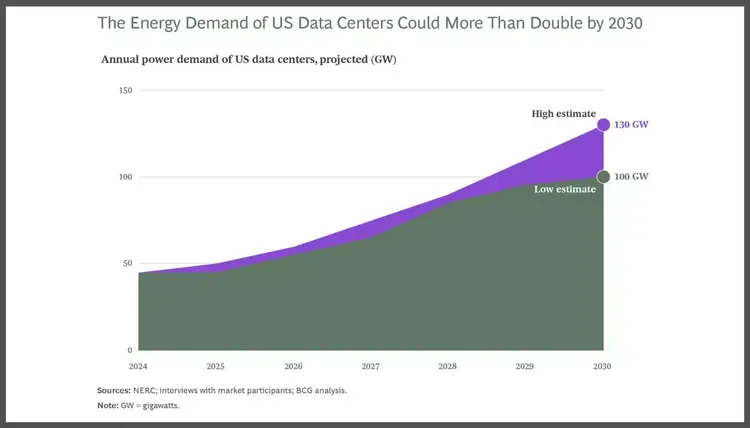
As Generative AI transforms industries, its appetite for energy is pushing power grids, and corporate climate commitments, to the brink. A recent Boston Consulting Group (BCG) report highlights how the rapid growth of AI, coupled with increased cloud migration, is fueling an unprecedented surge in US energy demand. Hyperscalers like Amazon, Microsoft, and Google face a mounting challenge: scaling their AI operations while honoring net-zero pledges.
BCG’s analysis presents a paradox. The very AI-driven productivity gains these companies are chasing could undermine their sustainability goals. By 2030, US data centers alone are expected to consume up to 130 gigawatt hours of electricity annually. For comparison, that's 3.3% of the world’s total electricity at any given moment, albeit to just one industry.
Without a shift in strategy, this demand could drive AI’s carbon footprint to unsustainable levels.
BCG’s Maurice Berns sees a silver lining. “We can use [the growing demand] as an impetus to spur the development of low-carbon technologies,” he suggests, proposing that hyperscalers invest in green energy sources, smaller AI models, and energy-efficient hardware.
Amazon’s Nuclear Bet: Investing in SMRs to Power AI Sustainably
Amazon unveiled plans to support the development of small modular reactors (SMRs), an emerging nuclear technology with the potential to deliver reliable, carbon-free power at scale. Amazon’s agreements with Energy Northwest in Washington and Dominion Energy in Virginia aim to bring new SMR projects online, providing significant power capacity for Amazon’s operations and the regional grid.