


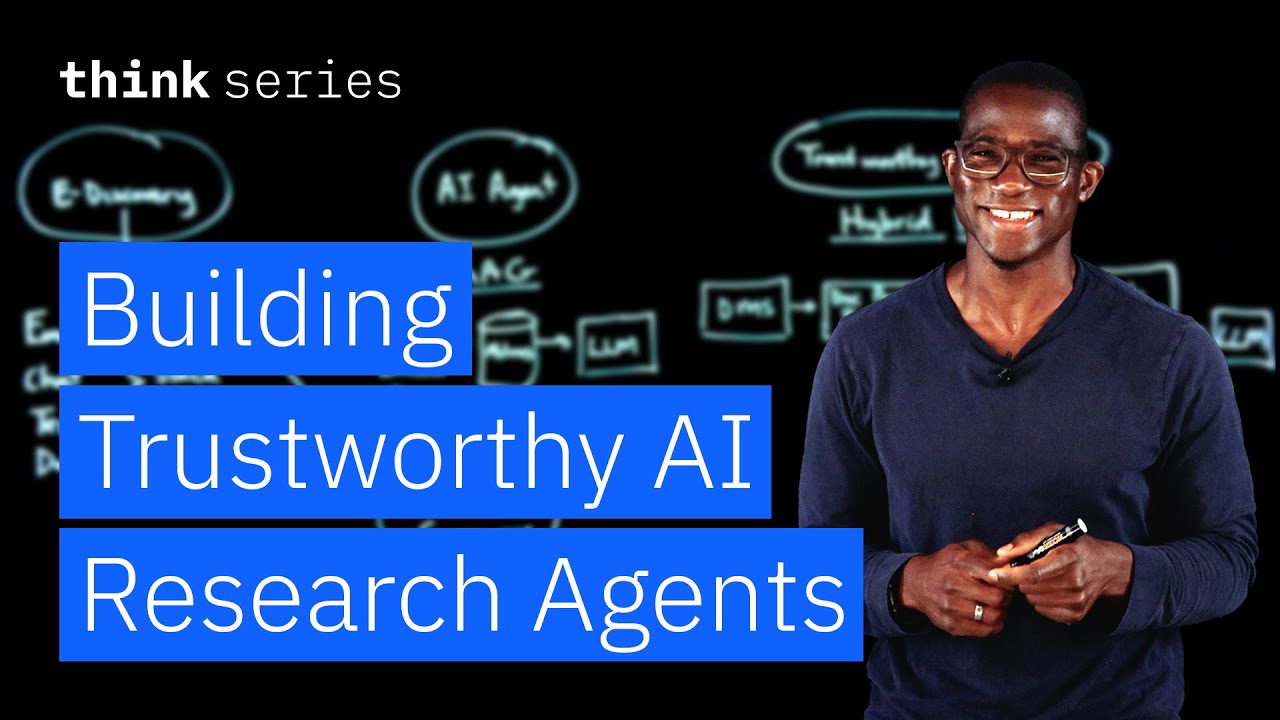
The unbridled potential of AI agents in enterprise systems often collides with the imperative for reliability and accountability, particularly in fields where trust is paramount. This challenge, and a robust solution, was the central theme of Joseph Washington's presentation for the IBM Think Series. Washington, Lead AI & Automation at IBM, articulated how a "Trustworthy AI Agent" built upon a Hybrid RAG architecture transcends the limitations of conventional AI, offering explainable and defensible outputs crucial for high-stakes workflows like legal e-discovery.
Washington opened by illustrating the arduous process of e-discovery in a legal discrimination suit, where a company's legal team must meticulously preserve, collect, and share every relevant message or document. This includes a vast array of data from emails across Outlook and Gmail, chat logs from Slack, text messages, contracts, and documents stored in systems like SharePoint. These thousands of files represent the raw, often unstructured, data from which critical insights must be extracted. The sheer volume and disparate nature of this data make traditional manual review an overwhelming task, costing immense time and resources.
AI research agents offer a compelling solution to this data deluge, capable of filtering and summarizing key findings. Imagine an agent sifting through countless communications, identifying mentions of a specific individual alongside terms like "performance review" or "termination." This capability dramatically accelerates the discovery process. However, as Washington keenly observed, "The AI agent's findings are useless... unless it's trustworthy." This single insight underscores the profound difference between merely intelligent AI and genuinely useful, enterprise-grade AI.
For AI outputs to be admissible and actionable in contexts such as legal proceedings, they must be transparent and verifiable. The agent must provide a clear audit trail, answering fundamental questions: "What documents did it pull the data from? What was the timestamp? Who wrote the message? What keywords triggered it?" Without this level of explainability, an AI's summary, however accurate, holds no legal weight. It becomes an oracle rather than an evidentiary tool.
This is where the concept of Hybrid RAG emerges as a critical architectural advancement. Traditional Retrieval Augmented Generation (RAG) systems convert document management system (DMS) data into vector embeddings, storing them in a vector database and feeding them to a Large Language Model (LLM). While effective for semantic similarity searches, this approach often falls short in providing the granular traceability required for legal or medical contexts. It excels at finding conceptually related information but struggles with precise, metadata-driven filtering.
Hybrid RAG addresses this by integrating a sophisticated document processing pipeline with both semantic search and structured metadata filtering. This means the AI agent doesn't just understand the *meaning* of a document; it can also leverage its metadata—such as author, date range, platform, access control lists (ACL), and change history—which are often stored in structured databases. This dual approach allows for a much higher degree of precision and context. For instance, the system can perform a semantic search for "performance issues" but then filter those results to only include documents authored by a specific manager within a particular date range, or those containing exact phrases like "non-compete" or "harassment."
"By answering these questions," Washington emphasized, "the agent's outputs will be explainable, trustworthy, and defensible." This defensibility is not merely a technical feature but a strategic necessity. It transforms AI from a black box into a transparent, auditable assistant, capable of supporting human decision-making with verifiable evidence. The ability to trace every piece of information back to its original source, complete with timestamps and access controls, builds a foundation of trust essential for enterprise adoption.
The implication for founders, VCs, and AI professionals is clear: the next frontier of AI isn't just about building smarter models, but about building models that are inherently trustworthy and transparent. "In many fields like law or medicine, trust is foundational," Washington concluded. "And as engineers, it's not enough to just build smart agents, we have to build ones that are trustworthy as well." Investing in and developing AI solutions that embed explainability and traceability from the ground up, like Hybrid RAG, will be critical for unlocking the full potential of AI in regulated industries and ensuring its responsible integration into high-stakes enterprise systems.

