

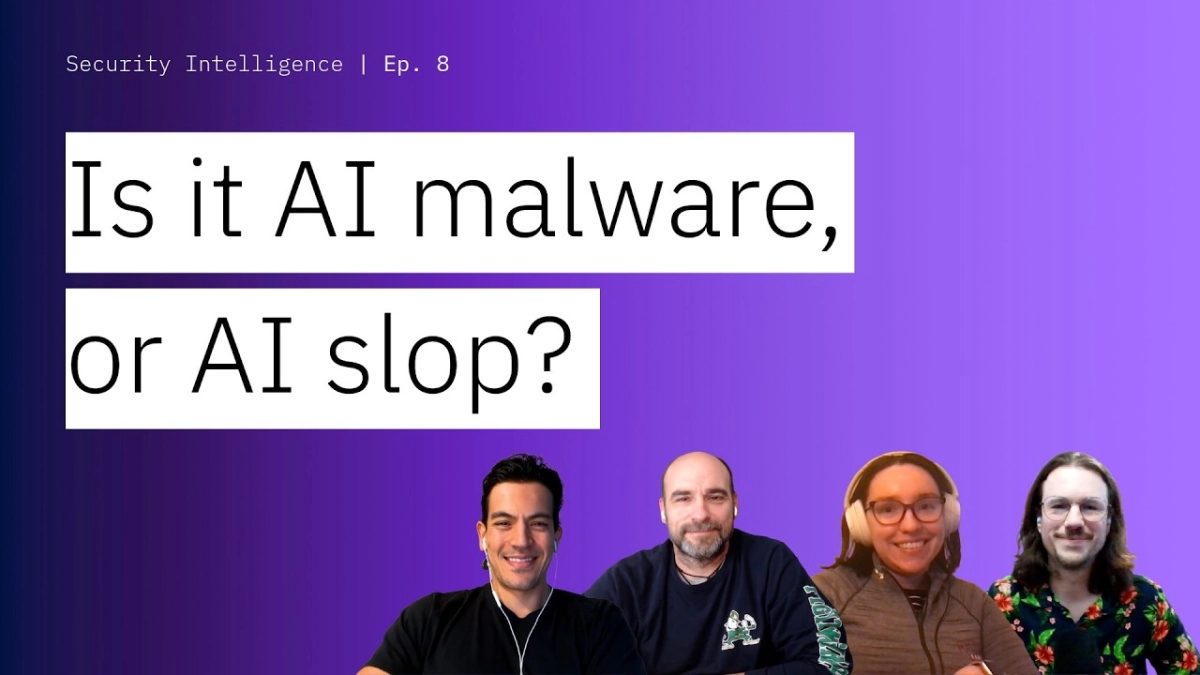
"It's not the AI writing the malware, it's actually more in the prompt, the individual is using to get the AI to make the malware better." This incisive observation by Dave Bales, X-Force Incident Command, cuts through the sensationalism surrounding artificial intelligence in cybersecurity, anchoring the discussion firmly in the human element. The recent Security Intelligence podcast, hosted by Matt Kosinski, brought together a panel of cybersecurity experts, Bales, alongside Claire Nunez (Creative Director, IBM X-Force Cyber Range) and Austin Zeizel (Threat Intelligence Consultant), to dissect the evolving threat landscape, particularly focusing on the intersection of artificial intelligence, operational technology, and human vulnerabilities. Their collective insights underscore a critical reality for founders, VCs, and AI professionals: the most significant cybersecurity risks often stem not from autonomous, self-evolving AI, but from the strategic exploitation of human behavior and systemic operational weaknesses.
A glaring vulnerability highlighted in the discussion is the significant gap in patching rates between IT (Information Technology) and OT (Operational Technology) systems. IBM Institute for Business Value benchmarks reveal that critical OT vulnerabilities are patched at an 80% median rate, trailing IT’s 90%. This 10-percentage-point disparity widens further for medium vulnerabilities. This lag is not merely a statistical anomaly; it represents a profound operational challenge. OT systems, prevalent in critical infrastructure sectors like water, energy, and agriculture, prioritize continuous uptime and physical safety over rapid software updates. As Dave Bales explained, patching OT systems often requires "somebody actually has to get up from their desk and physically walk over and patch the OT systems," a process that disrupts operations and is inherently slow. Austin Zeizel elaborated, noting that this operational mindset creates a "predictable window of exposure" that adversaries are increasingly exploiting. Claire Nunez added that much of this infrastructure is decades old, delicate, and expensive to upgrade, leading organizations to prioritize "availability over actually ensuring that they're secure." This inherent conflict between operational continuity and cybersecurity best practices, particularly with the increasing convergence of IT and OT networks, creates a fertile ground for malicious actors. The physical consequences are dire, as hackers have demonstrated by manipulating chemicals in water treatment facilities, posing direct threats to public safety.
The podcast further illuminated how cyberattacks are transcending the purely digital realm, manifesting in tangible, real-world theft and disruption. A Proofpoint report detailed a sophisticated cybercrime ring targeting freight companies to steal physical cargo. The scheme involves hackers impersonating legitimate freight companies to post fake loads, compromising real carriers' accounts, and then using those compromised accounts to bid on actual loads. Once secured, they dispatch their own trucks to collect and steal the cargo. Claire Nunez highlighted the meticulous organization required for such an operation, often initiated by a simple, well-timed phishing email. Dave Bales likened it to a "true-life episode of Shipping Wars," noting that these attacks are escalating, with a projected 22% increase this year. The motivation is simple: "Because it's easy to do, that's why." This blurring of lines between cyber and physical security, where digital vulnerabilities lead directly to material loss, represents a critical evolution in the threat landscape, impacting supply chain integrity and consumer trust.
Another insidious trend discussed was the discovery of time-delayed logic bombs embedded within NuGet packages. These malicious components are designed to lie dormant for years, silently corrupting functions with a low probability to avoid detection, only to detonate at a predetermined future date, such as 2027 or 2028. Austin Zeizel emphasized that this technique leverages "dwell time," exploiting the fact that initial dependencies are often forgotten by the time the payload triggers. This strategic patience reflects a long-term persistence in cyber warfare, where attackers are thinking in "years" rather than days or months. Dave Bales cautioned that such logic bombs, particularly when targeting databases and industrial control systems, could lead to "really big disruptions" and "wipe out" years of accumulated data or operational integrity. The core insight here is that the digital detritus of unmanaged software and organizational complacency creates enduring vulnerabilities that can be weaponized years down the line, underscoring the need for proactive security hygiene and comprehensive software lifecycle management.
The conversation then pivoted to the ongoing debate around "AI malware vs. AI slop," addressing the sensationalism often surrounding AI-powered threats. While Google’s "Prompt-Fux" malware, designed to interact with Gemini’s API for code rewrites, initially sounded alarming, it was noted that its self-modification function was commented out, rendering it inactive. Similarly, a widely cited MIT Sloan paper claiming 80% of ransomware attacks used AI was later withdrawn due to flawed methodology. This suggests that the threat of truly autonomous, self-evolving AI malware remains largely in the realm of science fiction. The real danger, as Dave Bales articulated, is not sentient AI, but rather humans leveraging AI as a tool to make existing malware "better" through "code embellishment" and more effective phishing campaigns. Austin Zeizel warned that an overemphasis on hypothetical AI-driven threats could lead to "misallocating resources" on advanced AI detection tools while "underspending on basic security hygiene" like patching and identity management. Claire Nunez concurred, stating that while it would be "silly for a threat actor not to be using AI" to optimize their operations, the current reality is that AI is a powerful enhancer of human-driven malicious activity, not an independent malicious entity.